
乳腺癌内分泌治疗耐药机制:聚焦信号通路、微小RNA及基于基因的耐药性
Mechanisms of resistance to endocrine therapy in breast cancer: focus on signaling pathways, miRNAs and genetically based resistance.
作者信息
García-Becerra Rocío, Santos Nancy, Díaz Lorenza, Camacho Javier
机构信息
Department of Reproductive Biology, National Institute of Medical Sciences and Nutrition Salvador Zubirán, Vasco de Quiroga No. 15, Tlalpan, México 14000, D.F., Mexico.
出版信息
Int J Mol Sci. 2012 Dec 20;14(1):108-45. doi: 10.3390/ijms14010108.
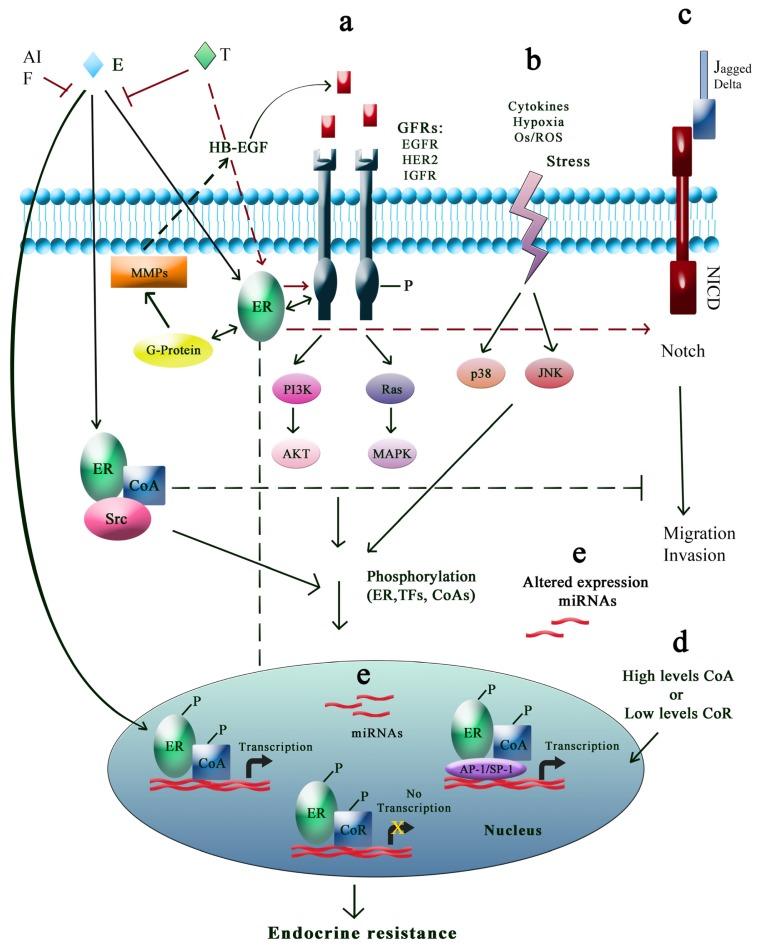
Breast cancer is the most frequent malignancy diagnosed in women. Approximately 70% of breast tumors express the estrogen receptor (ER). Tamoxifen and aromatase inhibitors (AIs) are the most common and effective therapies for patients with ERα-positive breast cancer. Alone or combined with chemotherapy, tamoxifen significantly reduces disease progression and is associated with more favorable impact on survival in patients. Unfortunately, endocrine resistance occurs, either de novo or acquired during the course of the treatment. The mechanisms that contribute to hormonal resistance include loss or modification in the ERα expression, regulation of signal transduction pathways, altered expression of specific microRNAs, balance of co-regulatory proteins, and genetic polymorphisms involved in tamoxifen metabolic activity. Because of the clinical consequences of endocrine resistance, new treatment strategies are arising to make the cells sensitive to tamoxifen. Here, we will review the current knowledge on mechanisms of endocrine resistance in breast cancer cells. In addition, we will discuss novel therapeutic strategies to overcome such resistance. Undoubtedly, circumventing endocrine resistance should help to improve therapy for the benefit of breast cancer patients.
乳腺癌是女性中最常被诊断出的恶性肿瘤。大约70%的乳腺肿瘤表达雌激素受体(ER)。他莫昔芬和芳香化酶抑制剂(AIs)是雌激素受体α(ERα)阳性乳腺癌患者最常用且有效的治疗方法。单独使用或与化疗联合使用时,他莫昔芬可显著降低疾病进展,并对患者生存产生更有利的影响。不幸的是,会出现原发性或在治疗过程中获得性的内分泌抵抗。导致激素抵抗的机制包括ERα表达的缺失或改变、信号转导通路调控、特定微小RNA表达改变、共调节蛋白平衡以及参与他莫昔芬代谢活性的基因多态性。由于内分泌抵抗的临床后果,新的治疗策略不断涌现,以使细胞对他莫昔芬敏感。在此,我们将综述目前关于乳腺癌细胞内分泌抵抗机制的知识。此外,我们还将讨论克服这种抵抗的新型治疗策略。毫无疑问,规避内分泌抵抗应有助于改善治疗,造福乳腺癌患者。

 Zotero 插件