Vilquin Paul, Donini Caterina F, Villedieu Marie, Grisard Evelyne, Corbo Laura, Bachelot Thomas, Vendrell Julie A, Cohen Pascale A
ISPB, Faculté de Pharmacie, 8 Avenue Rockefeller, 69008, Lyon, France.
Université Lyon 1, 8 Avenue Rockefeller, 69008, Lyon, France.
Breast Cancer Res. 2015 Jan 30;17(1):13. doi: 10.1186/s13058-015-0515-1.
Increasing evidence indicates that microRNAs (miRNAs) are important players in oncogenesis. Considering the widespread use of aromatase inhibitors (AIs) in endocrine therapy as a first-line treatment for postmenopausal estrogen receptor α-positive breast cancer patients, identifying deregulated expression levels of miRNAs in association with AI resistance is of utmost importance.
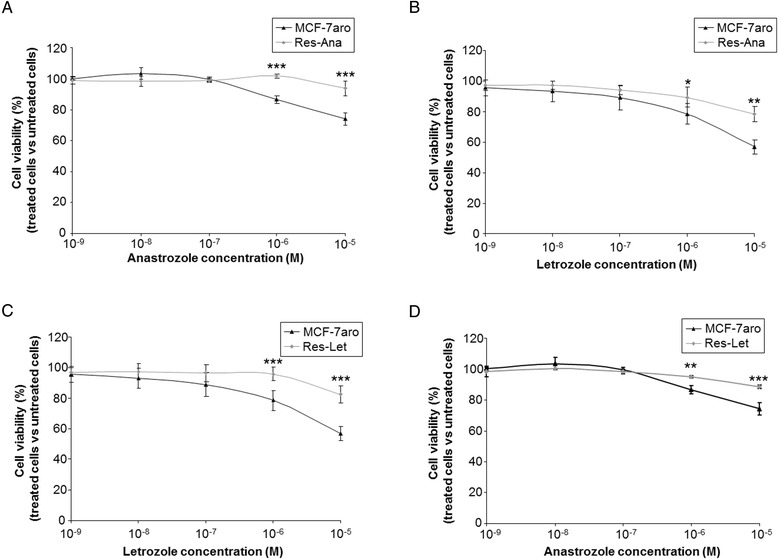
To gain further insight into the molecular mechanisms underlying the AI resistance, we performed miRNA microarray experiments using a new model of acquired resistance to letrozole (Res-Let cells), obtained by long-term exposure of aromatase-overexpressing MCF-7 cells (MCF-7aro cells) to letrozole, and a model of acquired anastrozole resistance (Res-Ana cells). Three miRNAs (miR-125b, miR-205 and miR-424) similarly deregulated in both AI-resistant cell lines were then investigated in terms of their functional role in AI resistance development and breast cancer cell aggressiveness and their clinical relevance using a cohort of 65 primary breast tumor samples.
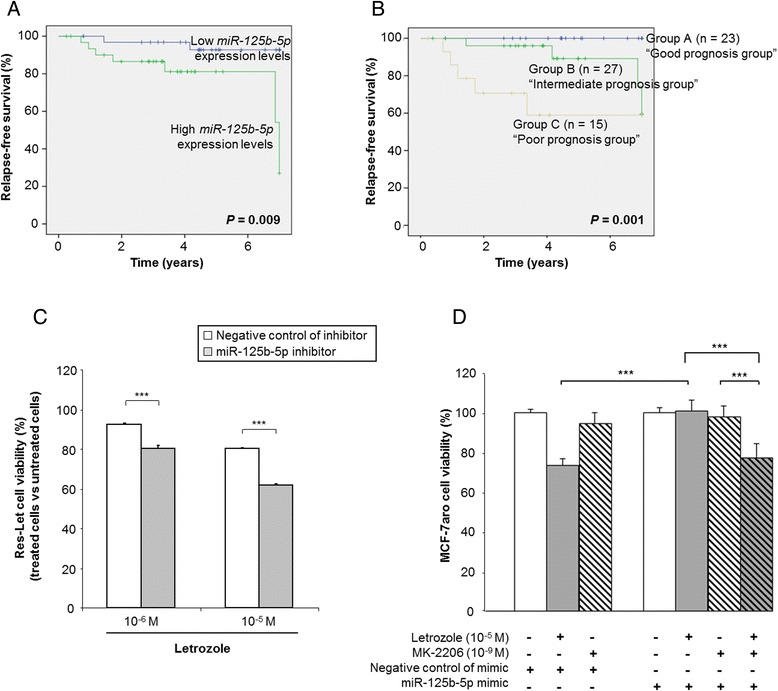
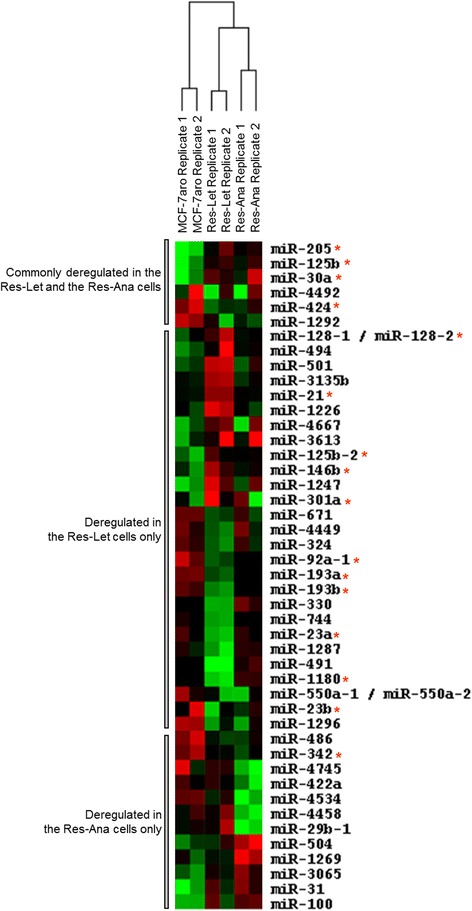
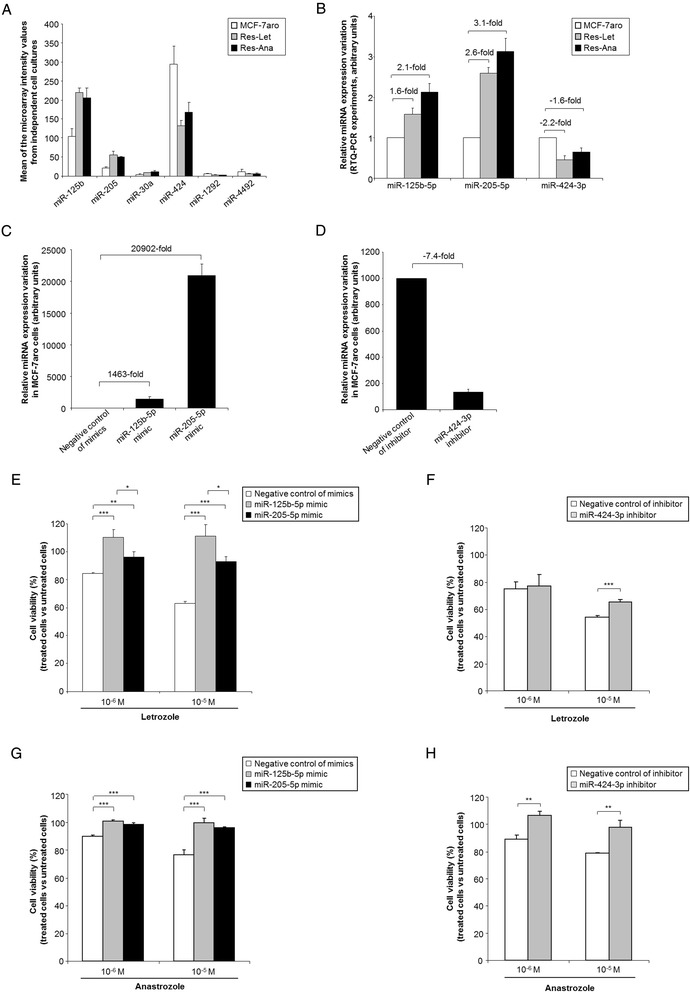
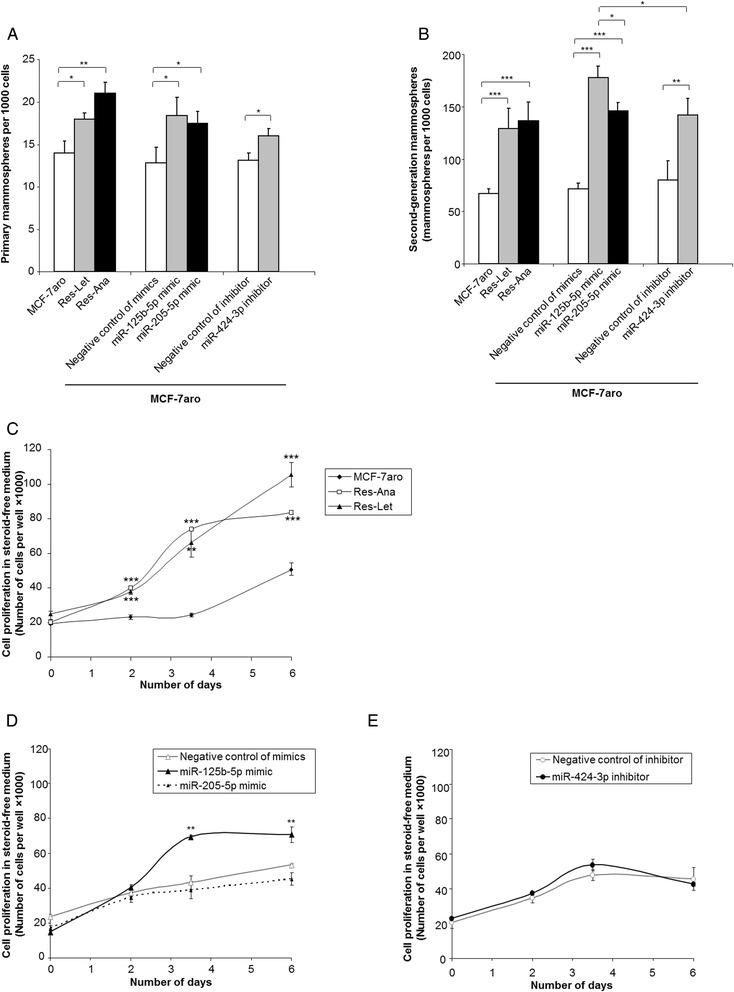
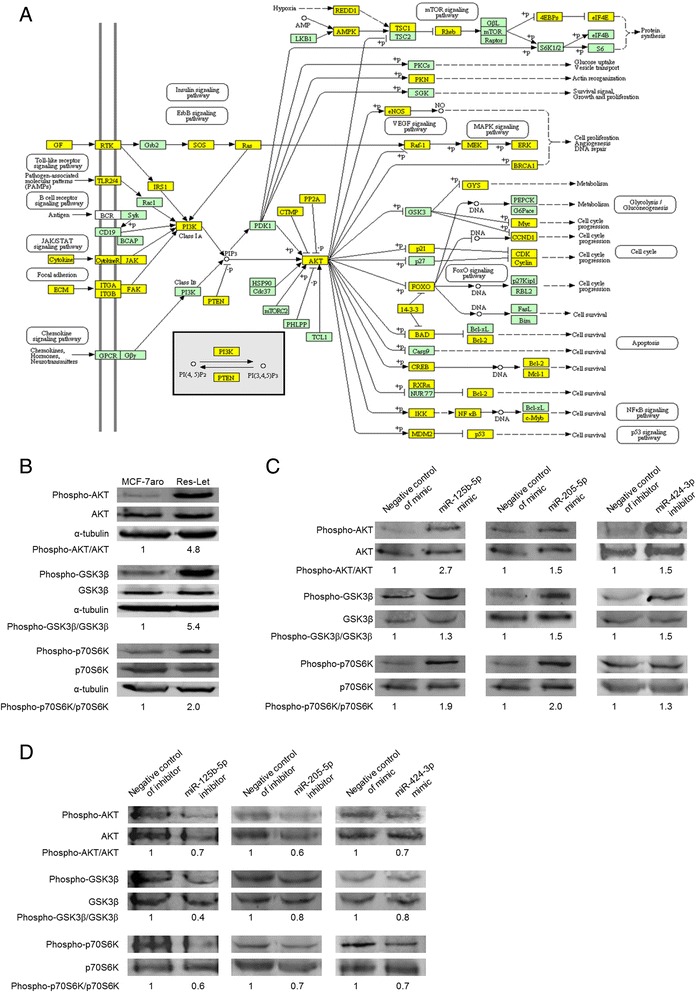
We identified the deregulated expression of 33 miRNAs in Res-Let cells and of 18 miRNAs in Res-Ana cells compared with the sensitive MCF-7aro cell line. The top-ranked Kyoto Encyclopedia of Genes and Genomes pathways delineated by both miRNA signatures converged on the AKT/mTOR pathway, which was found to be constitutively activated in both AI-resistant cell lines. We report for the first time, to our knowledge, that ectopic overexpression of either miR-125b or miR-205, or the silencing of miR-424 expression, in the sensitive MCF-7aro cell line was sufficient to confer resistance to letrozole and anastrozole, to target and activate the AKT/mTOR pathway and to increase the formation capacity of stem-like and tumor-initiating cells possessing self-renewing properties. Increasing miR-125b expression levels was also sufficient to confer estrogen-independent growth properties to the sensitive MCF-7aro cell line. We also found that elevated miR-125b expression levels were a novel marker for poor prognosis in breast cancer and that targeting miR-125b in Res-Let cells overcame letrozole resistance.
This study highlights that acquisition of specific deregulated miRNAs is a newly discovered alternative mechanism developed by AI-resistant breast cancer cells to achieve constitutive activation of the AKT/mTOR pathway and to develop AI resistance. It also highlights that miR-125b is a new biomarker of poor prognosis and a candidate therapeutic target in AI-resistant breast cancers.
越来越多的证据表明,微小RNA(miRNA)在肿瘤发生过程中起着重要作用。鉴于芳香化酶抑制剂(AI)在绝经后雌激素受体α阳性乳腺癌患者的内分泌治疗中作为一线治疗药物被广泛使用,确定与AI耐药相关的miRNA表达失调至关重要。
为了进一步深入了解AI耐药的分子机制,我们使用了一种新的来曲唑获得性耐药模型(Res-Let细胞)进行miRNA微阵列实验,该模型是通过将过表达芳香化酶的MCF-7细胞(MCF-7aro细胞)长期暴露于来曲唑而获得的,同时还使用了阿那曲唑获得性耐药模型(Res-Ana细胞)。然后,我们在65例原发性乳腺肿瘤样本队列中研究了在两种AI耐药细胞系中同样失调的三种miRNA(miR-125b、miR-205和miR-424)在AI耐药发展和乳腺癌细胞侵袭性方面的功能作用及其临床相关性。
与敏感的MCF-7aro细胞系相比,我们在Res-Let细胞中鉴定出33种miRNA表达失调,在Res-Ana细胞中鉴定出18种miRNA表达失调。两种miRNA特征所描绘的排名靠前的京都基因与基因组百科全书通路都汇聚在AKT/mTOR通路上,发现该通路在两种AI耐药细胞系中均持续激活。据我们所知,我们首次报道,在敏感的MCF-7aro细胞系中异位过表达miR-125b或miR-205,或沉默miR-424的表达,足以赋予对来曲唑和阿那曲唑的耐药性,靶向并激活AKT/mTOR通路,并增加具有自我更新特性的干细胞样和肿瘤起始细胞的形成能力。增加miR-125b的表达水平也足以赋予敏感的MCF-7aro细胞系雌激素非依赖性生长特性。我们还发现,miR-125b表达水平升高是乳腺癌预后不良的一个新标志物,并且在Res-Let细胞中靶向miR-125b可克服来曲唑耐药性。
本研究强调,获得特定的失调miRNA是AI耐药乳腺癌细胞新发现的一种替代机制,可实现AKT/mTOR通路的持续激活并产生AI耐药性。它还强调,miR-125b是预后不良的新生物标志物,也是AI耐药乳腺癌的候选治疗靶点。