Division of Hematology/Oncology, Barbara Ann Karmanos Cancer Institute, Wayne State University, 4100 John R, Detroit, MI 48201, USA.
Cancer Chemother Pharmacol. 2013 Mar;71(3):565-73. doi: 10.1007/s00280-012-2030-8. Epub 2013 Jan 24.
As tyrosine kinase inhibitors have been associated with cardiotoxicity, we evaluated the effect of pazopanib, an inhibitor of vascular endothelial growth factor receptor, platelet-derived growth factor receptor, and c-Kit, on electrocardiographic parameters in patients with cancer.
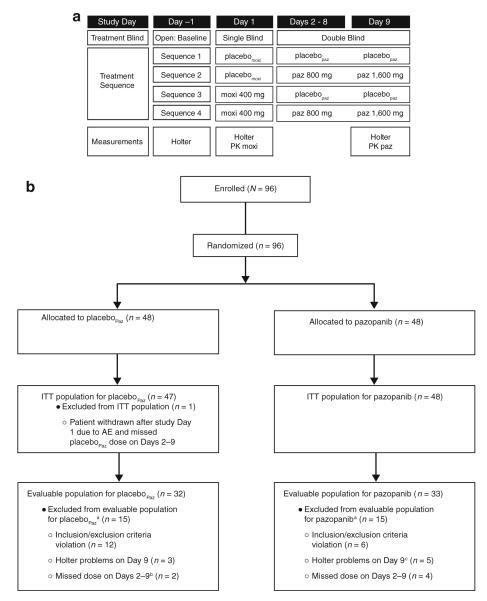
This double-blind, placebo-controlled, parallel-group study randomized patients (N = 96) to moxifloxacin (positive control) or placebo on Day 1 followed by pazopanib or placebo 800 mg/day (fasted) on Days 2-8 and 1,600 mg (with food) on Day 9. Treatment effects were evaluated by baseline-adjusted, time-matched, serial Holter electrocardiograms.
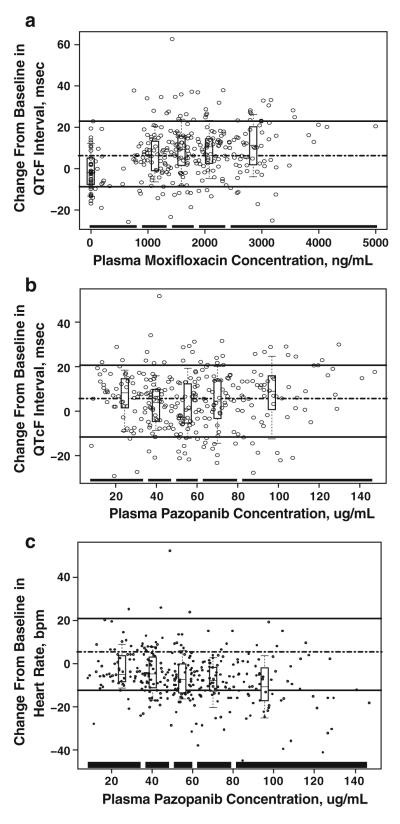
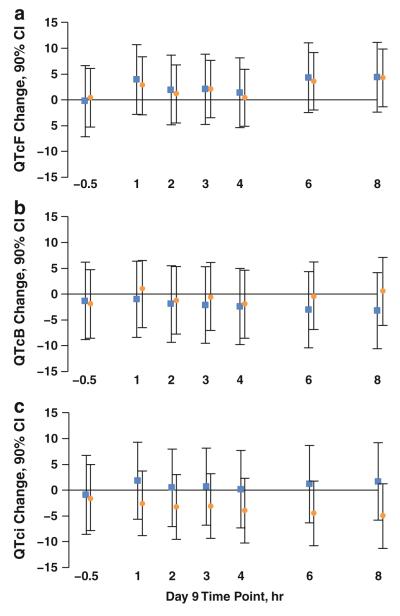
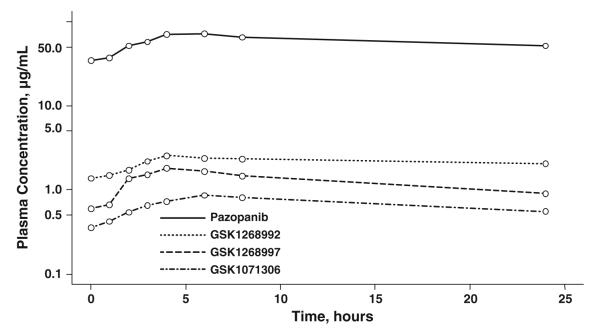
Sixty-five patients were evaluable for preplanned analyses. On Day 1, the maximum mean difference in baseline-adjusted, time-matched Fridericia-corrected QT (QTcF) interval in moxifloxacin-treated patients versus placebo was 10.6 ms (90% confidence interval [CI]: 4.2, 17.0). The administration scheme increased plasma pazopanib concentrations approximately 1.3- to 1.4-fold versus the recommended 800 mg once-daily dose. Pazopanib caused clinically significant increases from baseline in blood pressure, an anticipated class effect, and an unexpected reduction in heart rate from baseline that correlated with pazopanib exposure. On Day 9, the maximum mean difference in baseline-adjusted, time-matched QTcF interval in pazopanib-treated patients versus placebo was 4.4 ms (90% CI: -2.4, 11.2). Mixed-effects modeling indicated no significant concentration-dependent effect of pazopanib or its metabolites on QTcF interval.
Pazopanib as administered in this study achieved supratherapeutic concentrations, produced a concentration-dependent decrease in heart rate, and caused a small, concentration-independent prolongation of the QTcF interval.
由于酪氨酸激酶抑制剂与心脏毒性相关,我们评估了血管内皮生长因子受体、血小板衍生生长因子受体和 c-Kit 抑制剂帕唑帕尼对癌症患者心电图参数的影响。
这项双盲、安慰剂对照、平行分组研究将患者(N=96)随机分为莫西沙星(阳性对照)或安慰剂组,第 1 天;随后第 2-8 天和第 9 天每天服用帕唑帕尼或安慰剂 800mg(空腹),第 9 天服用 1600mg(随餐)。通过基线校正、时间匹配、连续动态心电图评估治疗效果。
65 例患者可进行预设分析。第 1 天,莫西沙星治疗组与安慰剂组相比,校正后的 Fridericia 校正 QT(QTcF)间期的最大平均差异为 10.6ms(90%置信区间[CI]:4.2,17.0)。该给药方案使血浆帕唑帕尼浓度相对于推荐的 800mg 每日一次剂量增加约 1.3-1.4 倍。帕唑帕尼引起血压升高,这是一种预期的作用,以及心率从基线下降,与帕唑帕尼暴露相关,这是一种意外的作用。第 9 天,帕唑帕尼治疗组与安慰剂组相比,校正后的 QTcF 间期的最大平均差异为 4.4ms(90% CI:-2.4,11.2)。混合效应模型表明,帕唑帕尼或其代谢物对 QTcF 间期无显著浓度依赖性影响。
本研究中给予的帕唑帕尼达到了治疗窗以上的浓度,导致心率呈浓度依赖性下降,并导致 QTcF 间期出现小的、浓度无关的延长。