Division of Cellular and Molecular Immunology, Department of Pediatrics, Cincinnati Children's Hospital Medical Center, University of Cincinnati Cincinnati, OH, USA.
Front Immunol. 2013 Jan 23;3:404. doi: 10.3389/fimmu.2012.00404. eCollection 2012.
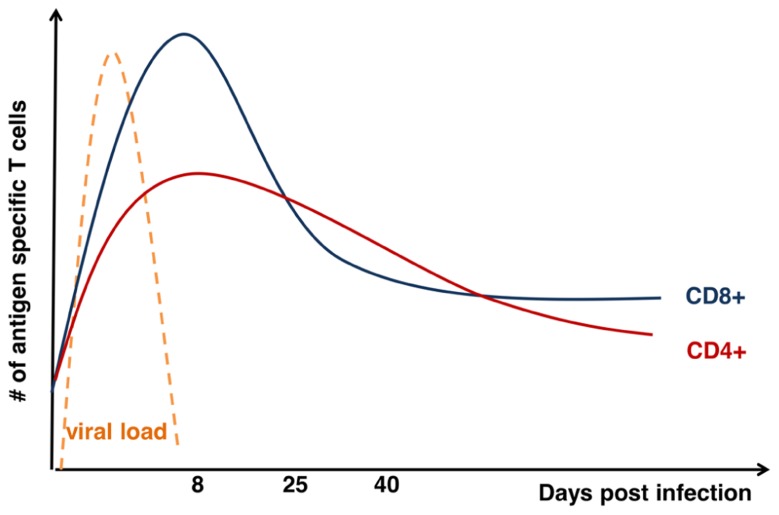
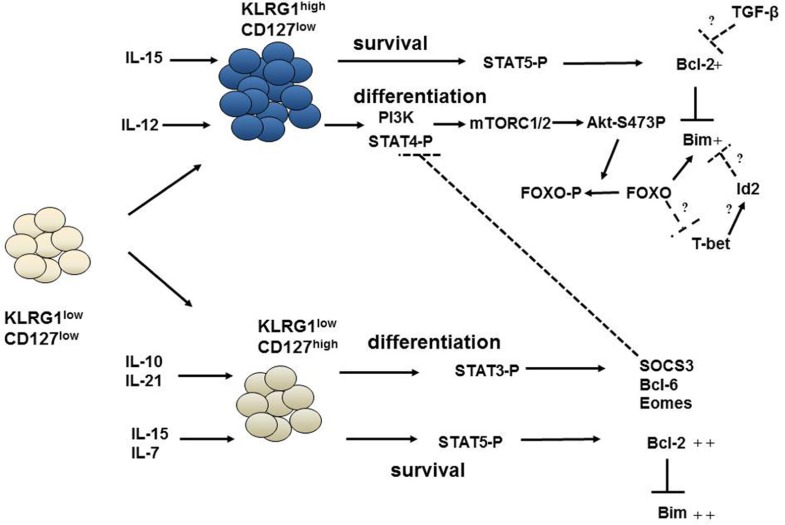
Vaccines, arguably the single most important intervention in improving human health, have exploited the phenomenon of immunological memory. The elicitation of memory T cells is often an essential part of successful long-lived protective immunity. Our understanding of T cell memory has been greatly aided by the development of TCR Tg mice and MHC tetrameric staining reagents that have allowed the precise tracking of antigen-specific T cell responses. Indeed, following acute infection or immunization, naïve T cells undergo a massive expansion culminating in the generation of a robust effector T cell population. This peak effector response is relatively short-lived and, while most effector T cells die by apoptosis, some remain and develop into memory cells. Although the molecular mechanisms underlying this cell fate decision remain incompletely defined, substantial progress has been made, particularly with regards to CD8(+) T cells. For example, the effector CD8(+) T cells generated during a response are heterogeneous, consisting of cells with more or less potential to develop into full-fledged memory cells. Development of CD8(+) T cell memory is regulated by the transcriptional programs that control the differentiation and survival of effector T cells. While the type of antigenic stimulation and level of inflammation control effector CD8(+) T cell differentiation, availability of cytokines and their ability to control expression and function of Bcl-2 family members governs their survival. These distinct differentiation and survival programs may allow for finer therapeutic intervention to control both the quality and quantity of CD8(+) T cell memory. Effector to memory transition of CD4(+) T cells is less well characterized than CD8(+) T cells, emerging details will be discussed. This review will focus on the recent progress made in our understanding of the mechanisms underlying the development of T cell memory with an emphasis on factors controlling survival of effector T cells.
疫苗可以说是改善人类健康的最重要干预措施之一,它利用了免疫记忆现象。记忆 T 细胞的产生通常是成功产生长期保护性免疫的重要组成部分。我们对 T 细胞记忆的理解得益于 TCR Tg 小鼠和 MHC 四聚体染色试剂的发展,这些试剂允许精确跟踪抗原特异性 T 细胞反应。事实上,在急性感染或免疫接种后,幼稚 T 细胞会经历大规模扩增,最终产生强大的效应 T 细胞群体。这种高峰效应反应的寿命相对较短,虽然大多数效应 T 细胞通过细胞凋亡而死亡,但有些仍会存活并发展为记忆细胞。尽管决定这种细胞命运的分子机制仍不完全明确,但已经取得了重大进展,特别是在 CD8(+) T 细胞方面。例如,在反应中产生的效应 CD8(+) T 细胞是异质的,由具有或多或少潜力发展为成熟记忆细胞的细胞组成。CD8(+) T 细胞记忆的发展受控制效应 T 细胞分化和存活的转录程序调节。虽然抗原刺激的类型和炎症水平控制效应 CD8(+) T 细胞分化,但细胞因子的可用性及其控制 Bcl-2 家族成员表达和功能的能力决定了它们的存活。这些不同的分化和存活程序可能允许更精细的治疗干预来控制 CD8(+) T 细胞记忆的质量和数量。CD4(+) T 细胞的效应向记忆的转变不如 CD8(+) T 细胞那么明显,新出现的细节将进行讨论。本文将重点介绍我们对 T 细胞记忆发展机制的理解方面的最新进展,重点介绍控制效应 T 细胞存活的因素。