National Jewish Health, Denver, CO, USA.
Prev Chronic Dis. 2013;10:E10. doi: 10.5888/pcd10.120083.
Compliance with National Cholesterol Education Program Adult Treatment Panel III (NCEP) guidelines has been shown to significantly reduce incident cardiovascular events. We investigated physicians' compliance with NCEP guidelines to reduce cardiovascular disease (CVD) risk in a population infected with HIV.
We analyzed HIV Outpatient Study (HOPS) data, following eligible patients from January 1, 2002, or first HOPS visit thereafter to calculate 10-year cardiovascular risk (10yCVR), until September 30, 2009, death, or last office visit. We categorized participants into four 10yCVR strata, according to guidelines determined by NCEP, the Infectious Disease Society of America, and the Adult AIDS Clinical Trials Group. We calculated percentages of patients treated for dyslipidemia and hypertension, calculated percentages of patients who achieved recommended goals, and categorized them by 10yCVR stratum.
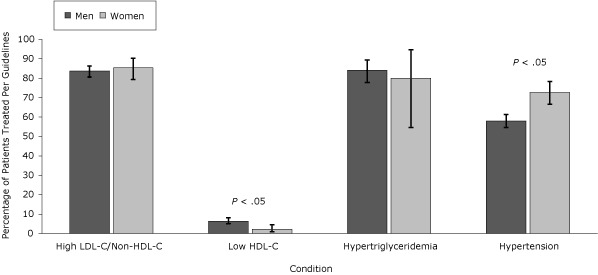
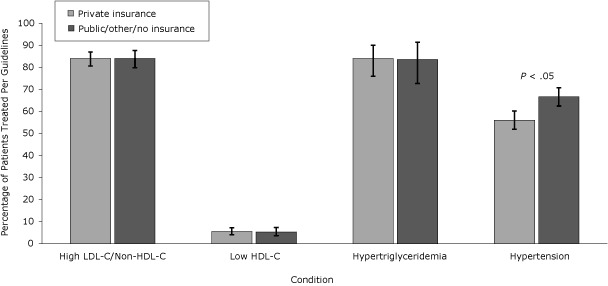
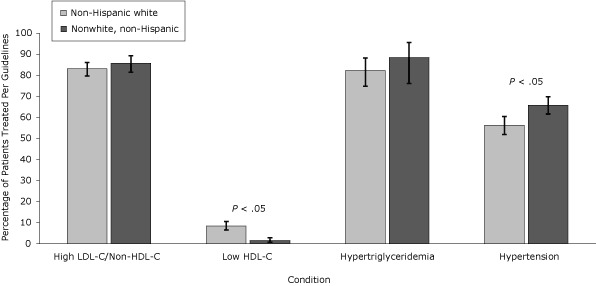
Of 2,005 patients analyzed, 33.7% had fewer than 2 CVD risk factors. For patients who had 2 or more risk factors, 10yCVR was less than 10% for 28.2%, 10% to 20% for 18.2%, and higher than 20% for 20.0% of patients. Of patients eligible for treatment, 81% to 87% were treated for elevated low-density lipoprotein cholesterol/non-high-density lipoprotein cholesterol (LDL-C/non-HDL-C), 2% to 11% were treated for low HDL-C, 56% to 91% were treated for high triglycerides, and 46% to 69% were treated for hypertension. Patients in higher 10yCVR categories were less likely to meet treatment goals than patients in lower 10yCVR categories.
At least one-fifth of contemporary HOPS patients have a 10yCVR higher than 20%, yet a large percentage of at-risk patients who were eligible for pharmacologic treatment did not receive recommended interventions and did not reach recommended treatment goals. Opportunities exist for CVD prevention in the HIV-infected population.
遵循国家胆固醇教育计划成人治疗专家组 III 版(NCEP)指南可显著降低心血管事件的发生。我们调查了医生在感染 HIV 的人群中遵循 NCEP 指南以降低心血管疾病(CVD)风险的情况。
我们分析了 HIV 门诊研究(HOPS)的数据,从 2002 年 1 月 1 日或此后的首次 HOPS 就诊开始,对符合条件的患者进行随访,以计算 10 年心血管风险(10yCVR),直至 2009 年 9 月 30 日死亡或最后一次就诊。我们根据 NCEP、传染病学会和成人艾滋病临床试验组确定的指南,将参与者分为四个 10yCVR 亚组。我们计算了血脂异常和高血压治疗患者的百分比,计算了达到推荐目标的患者百分比,并根据 10yCVR 亚组进行了分类。
在分析的 2005 名患者中,33.7%的患者 CVD 风险因素少于 2 个。对于有 2 个或更多风险因素的患者,10yCVR 小于 10%的患者占 28.2%,10%至 20%的患者占 18.2%,大于 20%的患者占 20.0%。在符合治疗条件的患者中,81%至 87%的患者接受了升高的低密度脂蛋白胆固醇/非高密度脂蛋白胆固醇(LDL-C/non-HDL-C)治疗,2%至 11%的患者接受了低 HDL-C 治疗,56%至 91%的患者接受了高甘油三酯治疗,46%至 69%的患者接受了高血压治疗。处于较高 10yCVR 类别的患者比处于较低 10yCVR 类别的患者更不可能达到治疗目标。
至少五分之一的当代 HOPS 患者的 10yCVR 高于 20%,但大量有风险的患者符合药物治疗条件,但未接受推荐的干预措施,也未达到推荐的治疗目标。在 HIV 感染人群中存在预防 CVD 的机会。