Cellular Genetics, Graduate School of Science and Engineering, Tokyo Metropolitan University, Hachioji, Tokyo, Japan.
PLoS One. 2013;8(1):e53706. doi: 10.1371/journal.pone.0053706. Epub 2013 Jan 22.
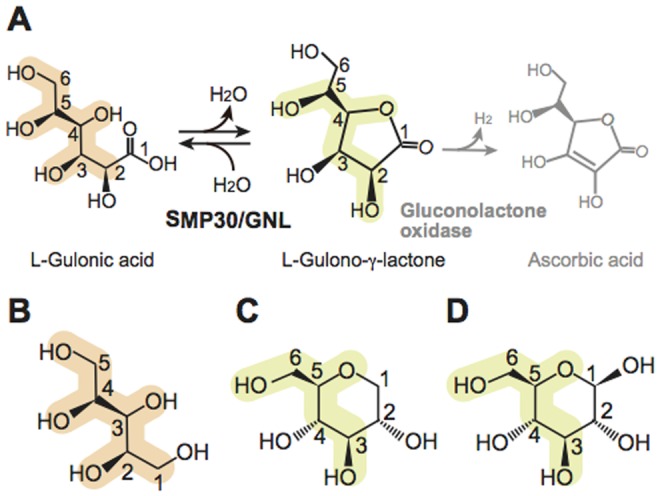
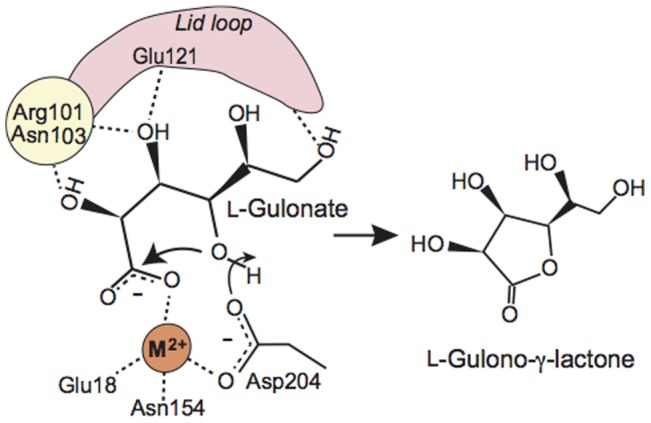
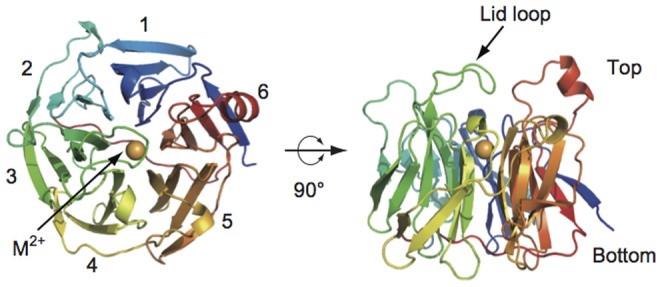
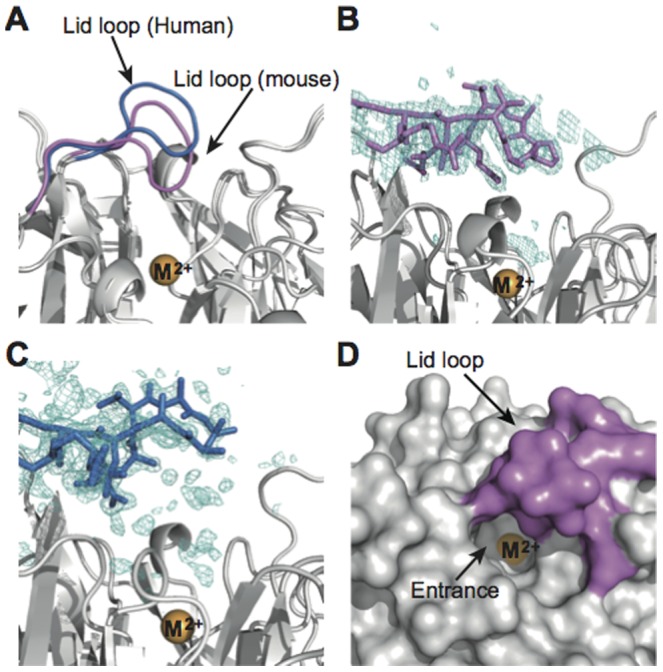
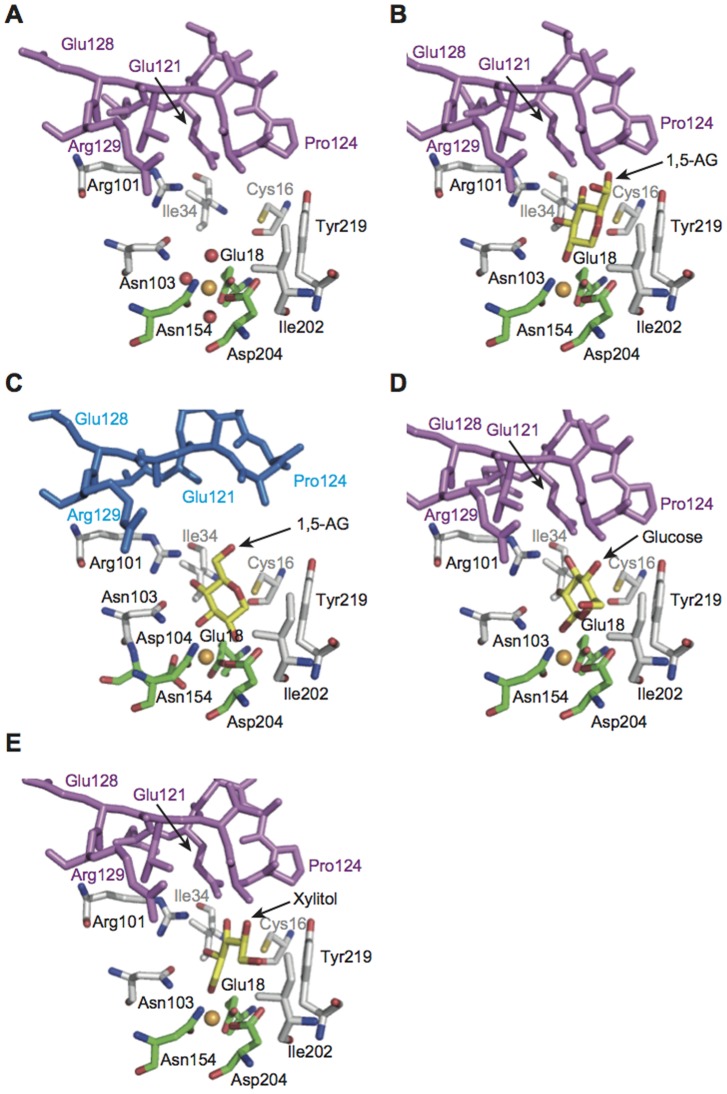
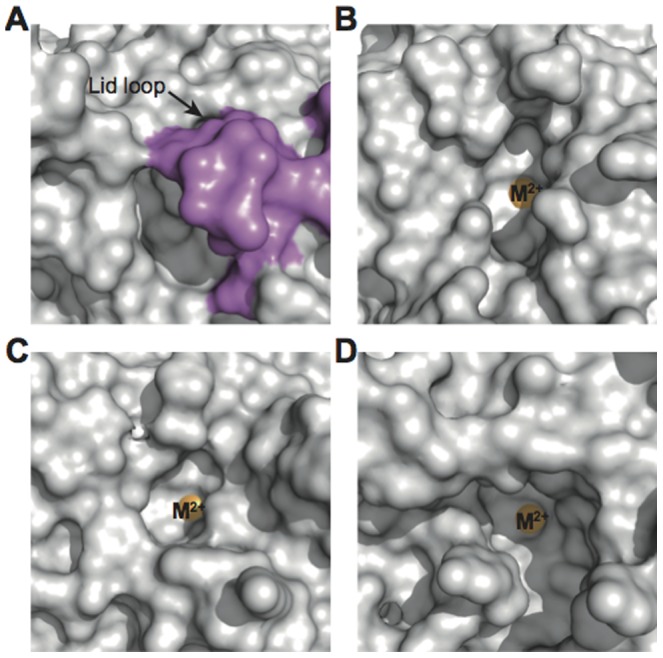
The senescence marker protein-30 (SMP30), which is also called regucalcin, exhibits gluconolactonase (GNL) activity. Biochemical and biological analyses revealed that SMP30/GNL catalyzes formation of the γ-lactone-ring of L-gulonate in the ascorbic acid biosynthesis pathway. The molecular basis of the γ-lactone formation, however, remains elusive due to the lack of structural information on SMP30/GNL in complex with its substrate. Here, we report the crystal structures of mouse SMP30/GNL and its complex with xylitol, a substrate analogue, and those with 1,5-anhydro-D-glucitol and D-glucose, product analogues. Comparison of the crystal structure of mouse SMP30/GNL with other related enzymes has revealed unique characteristics of mouse SMP30/GNL. First, the substrate-binding pocket of mouse SMP30/GNL is designed to specifically recognize monosaccharide molecules. The divalent metal ion in the active site and polar residues lining the substrate-binding cavity interact with hydroxyl groups of substrate/product analogues. Second, in mouse SMP30/GNL, a lid loop covering the substrate-binding cavity seems to hamper the binding of L-gulonate in an extended (or all-trans) conformation; L-gulonate seems to bind to the active site in a folded conformation. In contrast, the substrate-binding cavities of the other related enzymes are open to the solvent and do not have a cover. This structural feature of mouse SMP30/GNL seems to facilitate the γ-lactone-ring formation.
衰老标志物蛋白-30(SMP30),也称为钙网蛋白,具有葡糖酸内酯酶(GNL)活性。生化和生物学分析表明,SMP30/GNL 催化抗坏血酸生物合成途径中 L-古洛糖酸的γ-内酯环的形成。然而,由于缺乏 SMP30/GNL 与底物复合物的结构信息,γ-内酯形成的分子基础仍然难以捉摸。在这里,我们报告了小鼠 SMP30/GNL 及其与木糖醇(底物类似物)和 1,5-脱水-D-葡萄糖醇和 D-葡萄糖(产物类似物)复合物的晶体结构。将小鼠 SMP30/GNL 的晶体结构与其他相关酶进行比较,揭示了小鼠 SMP30/GNL 的独特特征。首先,小鼠 SMP30/GNL 的底物结合口袋被设计为专门识别单糖分子。活性位点中的二价金属离子和沿底物结合腔排列的极性残基与底物/产物类似物的羟基相互作用。其次,在小鼠 SMP30/GNL 中,覆盖底物结合腔的盖子环似乎阻碍了伸展(或全反式)构象中 L-古洛糖酸的结合;L-古洛糖酸似乎以折叠构象结合到活性位点。相比之下,其他相关酶的底物结合腔对溶剂开放,并且没有盖子。小鼠 SMP30/GNL 的这种结构特征似乎有利于γ-内酯环的形成。