Microbiology Department, Hospital Universitario Donostia-Instituto Biodonostia, San Sebastián, Spain.
PLoS One. 2013;8(1):e54333. doi: 10.1371/journal.pone.0054333. Epub 2013 Jan 22.
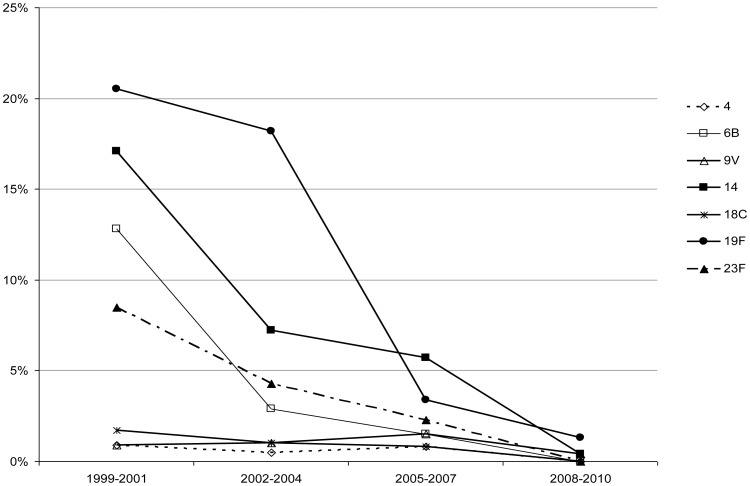
The aim of this study was to determine the serotype and clonal distribution of pneumococci causing acute otitis media (AOM) and their relationship with recurrences and mixed infections with other microorganisms under the influence of the 7-valent pneumococcal conjugate vaccine (PCV7). To do this, all pneumococcal isolates collected from the spontaneous middle-ear drainage of children <5 years old diagnosed of AOM by their pediatrician or their general practitioner from 1999 to 2010 were phenotypically characterized and the most frequent serotypes were genotyped. In the 12-year study, 818 episodes of pneumococcal AOM were detected, mostly (70.5%) in children younger than 2 years old. In 262 episodes (32%), the pneumococci were isolated with another bacterium, mainly (n=214) Haemophilus influenzae. Mixed infections were similar in children under or over 2 years old. The most frequent serotypes were 19A (n=227, 27.8%), 3 (n=92, 11.2%) and 19F (n=74, 9%). Serotypes included in the PCV7 sharply decreased from 62.4% in the pre-vaccination (1999-2001) to 2.2% in the late post-vaccination period (2008-2010). Serotype diversity steadily increased after the introduction of the PCV7 but decreased from 2008-2010 due to the predominant role of serotype 19A isolates, mostly ST276 and ST320. The prevalence of serotype 3 doubled from 6.1% (20/326) in 1999-2004 to 14.6% (72/492) in 2005-2010. Relapses mainly occurred in male infants infected with isolates with diminished antimicrobial susceptibility. Reinfections caused by isolates with the same serotype but different genotype were frequent, highlighting the need for genetic studies to differentiate among similar strains. In conclusion, the main change in pneumococcal AOM observed after the introduction of the PCV7 was the sharp decrease in vaccine serotypes. Also notable was the high burden of serotype 19A in total pneumococcal AOM before and especially after the introduction of the PCV7, as well as in relapses and reinfections.
本研究旨在确定引起急性中耳炎(AOM)的肺炎球菌的血清型和克隆分布及其与 7 价肺炎球菌结合疫苗(PCV7)的关系。为此,对 1999 年至 2010 年间由儿科医生或全科医生诊断为 AOM 的 5 岁以下儿童自发中耳引流中收集的所有肺炎球菌分离株进行表型特征分析,并对最常见的血清型进行基因分型。在 12 年的研究中,共检测到 818 例肺炎球菌性 AOM,其中大多数(70.5%)发生在 2 岁以下的儿童中。在 262 例(32%)中,肺炎球菌与另一种细菌(主要为 n=214 流感嗜血杆菌)一起分离出来。2 岁以下和 2 岁以上儿童的混合感染相似。最常见的血清型为 19A(n=227,27.8%)、3(n=92,11.2%)和 19F(n=74,9%)。PCV7 疫苗接种前(1999-2001 年)血清型比例为 62.4%,接种后晚期(2008-2010 年)急剧下降至 2.2%。PCV7 引入后血清型多样性稳步增加,但由于 19A 分离株(主要为 ST276 和 ST320)的主要作用,从 2008-2010 年减少。血清型 3 的流行率从 1999-2004 年的 6.1%(20/326)增加到 2005-2010 年的 14.6%(72/492)。复发主要发生在对抗菌药物敏感性降低的分离株感染的男性婴儿中。由相同血清型但不同基因型的分离株引起的再感染很常见,这突出表明需要进行遗传研究以区分相似的菌株。总之,PCV7 引入后观察到的肺炎球菌 AOM 的主要变化是疫苗血清型的急剧减少。在 PCV7 引入之前和之后,尤其是在 PCV7 引入之后,19A 血清型在总肺炎球菌 AOM 中以及在复发和再感染中所占比例很高,这也值得注意。