Fenner School of Environment and Society, The Australian National University, Canberra, Australian Capital Territory, Australia.
PLoS One. 2013;8(1):e54539. doi: 10.1371/journal.pone.0054539. Epub 2013 Jan 18.
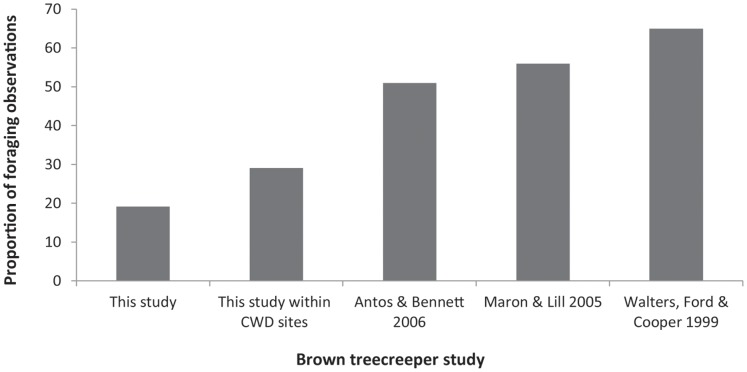
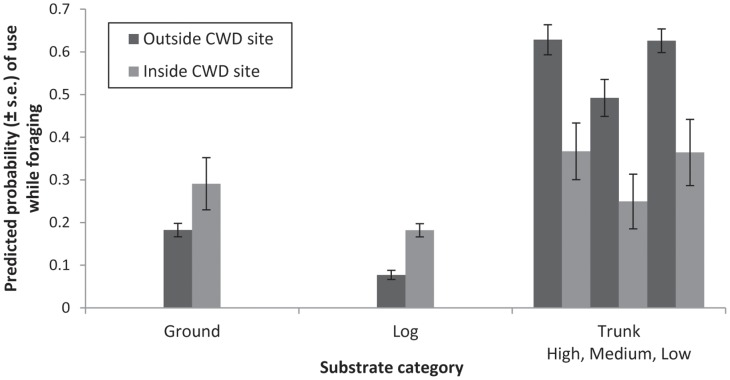
Habitat restoration can play an important role in recovering functioning ecosystems and improving biodiversity. Restoration may be particularly important in improving habitat prior to species reintroductions. We reintroduced seven brown treecreeper (Climacteris picumnus) social groups into two nature reserves in the Australian Capital Territory in south-eastern Australia. This study provided a unique opportunity to understand the interactions between restoration ecology, behavioural ecology and habitat ecology. We examined how experimental restoration treatments (addition of coarse woody debris, variations in ground vegetation cover and nest box installation) influenced the behaviour and microhabitat use of radio-tracked individuals to evaluate the success of restoration treatments. The addition of coarse woody debris benefited the brown treecreeper through increasing the probability of foraging on a log or on the ground. This demonstrated the value of using behaviour as a bio-indicator for restoration success. Based on previous research, we predicted that variations in levels of ground vegetation cover would influence behaviour and substrate use, particularly that brown treecreepers would choose sites with sparse ground cover because this allows better access to food and better vigilance for predators. However, there was little effect of this treatment, which was likely influenced by the limited overall use of the ground layer. There was also little effect of nest boxes on behaviour or substrate use. These results somewhat confound our understanding of the species based on research from extant populations. Our results also have a significant impact regarding using existing knowledge on a species to inform how it will respond to reintroduction and habitat restoration. This study also places great emphasis on the value of applying an experimental framework to ecological restoration, particularly when reintroductions produce unexpected outcomes.
生境恢复可以在恢复功能生态系统和提高生物多样性方面发挥重要作用。在物种重新引入之前,恢复可能尤其重要。我们在澳大利亚东南部的澳大利亚首都领地的两个自然保护区重新引入了七个棕树雀(Climacteris picumnus)社会群体。这项研究提供了一个独特的机会,可以了解恢复生态学、行为生态学和栖息地生态学之间的相互作用。我们研究了实验性恢复处理(添加粗木质碎屑、地面植被覆盖变化和巢箱安装)如何影响无线电跟踪个体的行为和微生境利用,以评估恢复处理的成功。添加粗木质碎屑通过增加在原木或地面上觅食的可能性使棕树雀受益。这证明了将行为用作恢复成功的生物指标的价值。基于先前的研究,我们预测地面植被覆盖水平的变化会影响行为和基质利用,特别是棕树雀会选择稀疏地面覆盖的地点,因为这可以更好地获取食物并更好地警惕捕食者。然而,这种处理的效果很小,这可能受到地面层总体使用有限的影响。巢箱对行为或基质利用也几乎没有影响。这些结果与我们基于现存种群的研究对该物种的理解有些混淆。我们的研究结果也对利用现有物种知识来告知其对重新引入和生境恢复的反应方式产生了重大影响。这项研究还非常重视将实验框架应用于生态恢复的价值,特别是在重新引入产生意外结果时。