Department of Neuropsychology, Children's Healthcare of Atlanta, Atlanta, GA, USA.
J Int Neuropsychol Soc. 2013 Apr;19(4):380-9. doi: 10.1017/S1355617712001567. Epub 2013 Jan 28.
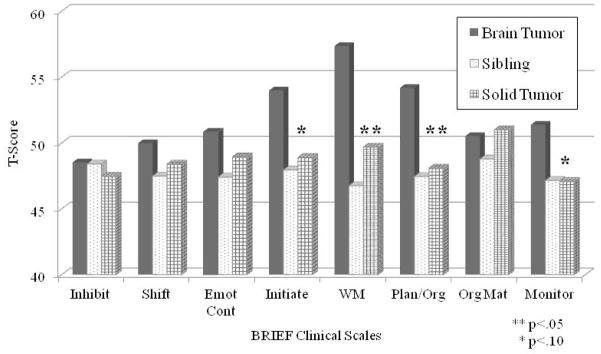
Childhood brain tumor survivors are at increased risk for neurocognitive impairments, including working memory (WM) problems. WM is typically assessed using performance measures. Little is known about the value of parent ratings for identifying WM difficulties, the relationship between rater and performance measures, or predictors of parent-reported WM problems in this population. Accordingly, the current study examined the utility of parent report in detecting WM difficulties among childhood brain tumor survivors treated with conformal radiation therapy (n = 50) relative to siblings (n = 40) and solid tumor survivors not receiving central nervous system-directed therapy (n = 40). Parents completed the Behavior Rating Inventory of Executive Function (BRIEF). Participants were administered WM measures (digit span, self-ordered search tasks). Findings revealed parents rated brain tumor survivors as having significantly more WM problems (p < .01) compared to controls. However, the BRIEF-WM scale demonstrated poor sensitivity and specificity for detecting performance-based problems. Significant, albeit modest, correlations were found between the BRIEF-WM scale and performance measures (r = -.24-.22; p < .05) for the combined group. Age at testing, socioeconomic status, and IQ were significant predictors of parent reported WM problems. Rater and performance measures offer complimentary yet different information in assessing WM, which reiterates the importance of using both within the context of clinical assessment.
儿童脑瘤幸存者患神经认知障碍的风险增加,包括工作记忆 (WM) 问题。WM 通常通过绩效评估进行评估。对于识别 WM 困难、评估者和绩效评估之间的关系,以及在该人群中预测父母报告的 WM 问题的父母评分的价值知之甚少。因此,本研究在接受适形放射治疗的儿童脑瘤幸存者(n = 50)中,相对于兄弟姐妹(n = 40)和未接受中枢神经系统定向治疗的实体瘤幸存者(n = 40),检查了父母报告在检测 WM 困难方面的效用。父母完成了执行功能行为评定量表(BRIEF)。参与者进行了 WM 测试(数字跨度,自我排序搜索任务)。研究结果显示,与对照组相比,父母认为脑瘤幸存者的 WM 问题明显更多(p <.01)。然而,BRIEF-WM 量表在检测基于表现的问题方面的敏感性和特异性较差。对于合并组,BRIEF-WM 量表与绩效评估之间存在显著但适度的相关性(r = -.24-.22;p <.05)。测试时的年龄、社会经济地位和智商是父母报告 WM 问题的重要预测因素。评估者和绩效评估在评估 WM 方面提供了互补但不同的信息,这再次强调了在临床评估中同时使用两者的重要性。