Department of Parasitology, Faculty of Medicine, University of Malaya, 50603, Kuala Lumpur, Malaysia.
Parasit Vectors. 2013 Jan 28;6:27. doi: 10.1186/1756-3305-6-27.
Despite the continuous efforts to improve the quality of life of Orang Asli (Aborigines) communities, these communities are still plagued with a wide range of health problems including parasitic infections. The first part of this study aimed at determining the prevalence of soil-transmitted helminth (STH) infections and identifying their associated factors among rural Orang Asli children.
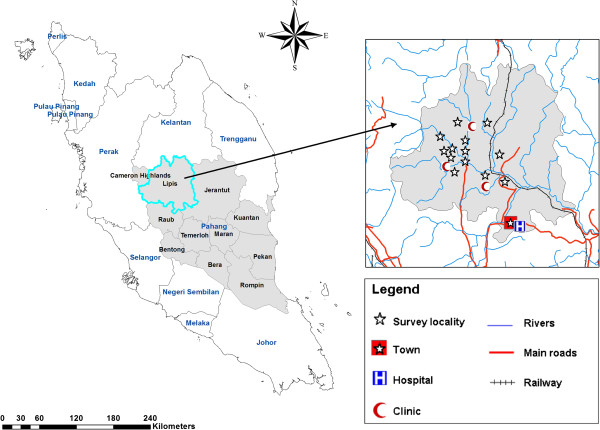
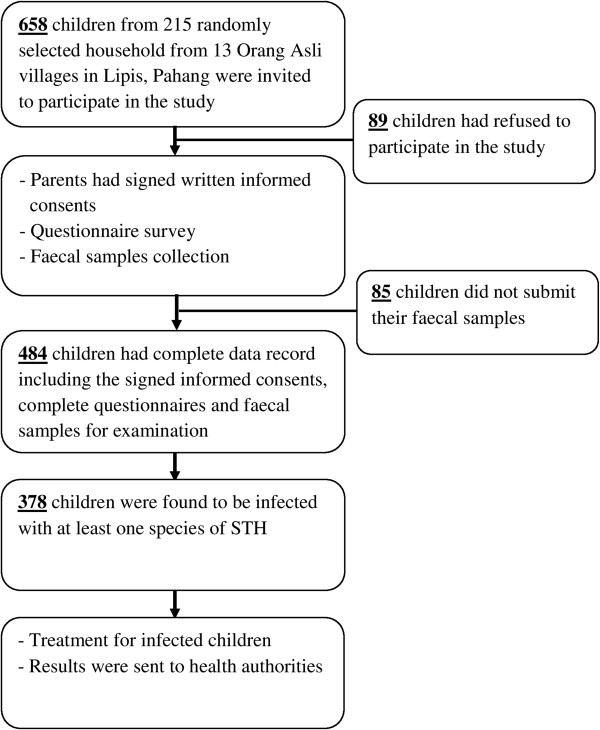
A cross-sectional study was carried out among 484 Orang Asli children aged ≤ 15 years (235 females and 249 males) belonging to 215 households from 13 villages in Lipis district, Pahang, Malaysia. Faecal samples were collected and examined by using formalin-ether sedimentation, Kato Katz and Harada Mori techniques. Demographic, socioeconomic, environmental and behavioural information were collected by using a pre-tested questionnaire.
Overall, 78.1% of the children were found to be infected with one or more STH species. The prevalence of trichuriasis, ascariasis and hookworm infections were 71.7%, 37.4% and 17.6%, respectively. Almost all, three quarters and one fifth of trichuriasis, ascariasis and hookworm infections, respectively, were of moderate-to-heavy intensities. Multiple logistic regression analysis showed that age of ≥ 6 years (school-age), using unsafe water supply as a source for drinking water, absence of a toilet in the house, large family size (≥ 7 members), not washing hands before eating, and not washing hands after defecation were the key factors significantly associated with STH among these children.
This study reveals an alarmingly high prevalence of STH among Orang Asli children and clearly brings out an urgent need to implement school-based de-worming programmes and other control measures like providing a proper sanitation, as well as a treated drinking water supply and proper health education regarding good personal hygiene practices. Such an integrated control program will help significantly in reducing the prevalence and intensity of STH in Orang Asli communities.
尽管不断努力改善原住民族(原住民)社区的生活质量,但这些社区仍受到各种健康问题的困扰,包括寄生虫感染。本研究的第一部分旨在确定农村原住民儿童中土壤传播性蠕虫(STH)感染的流行情况,并确定其相关因素。
在马来西亚彭亨州立丕区的 13 个村庄中,对 215 户家庭的 484 名年龄在 15 岁以下的原住民儿童(女性 235 名,男性 249 名)进行了横断面研究。使用福尔马林乙醚沉淀、加藤厚涂片和哈拉达-森田法收集粪便样本并进行检查。使用预先测试的问卷收集人口统计学、社会经济、环境和行为信息。
总体而言,78.1%的儿童被发现感染了一种或多种 STH 物种。鞭虫病、蛔虫病和钩虫病的患病率分别为 71.7%、37.4%和 17.6%。鞭虫病、蛔虫病和钩虫病的几乎所有(四分之三)和五分之一(五分之一)感染均为中重度。多因素逻辑回归分析表明,年龄≥6 岁(学龄期)、使用不安全的水作为饮用水源、家中无厕所、家庭规模大(≥7 人)、饭前不洗手、便后不洗手是这些儿童感染 STH 的关键因素。
本研究揭示了原住民儿童中 STH 的高患病率,迫切需要实施基于学校的驱虫计划和其他控制措施,如提供适当的卫生设施、处理过的饮用水供应以及良好的个人卫生习惯的适当健康教育。这种综合控制计划将有助于显著降低原住民社区 STH 的流行率和严重程度。