Institute of Medical Science, University of Toronto, Toronto, Ontario.
J Pain Res. 2013;6:39-51. doi: 10.2147/JPR.S38878. Epub 2013 Jan 10.
Persistent pain and psychological distress are common after traumatic musculoskeletal injury (TMsI). Individuals sustaining a TMsI are often young, do not recover quickly, and place a large economic burden on society.
The aim of this systematic review is to determine (1) the incidence of persistent pain following TMsI, (2) the characteristics of pain, characterized by injury severity and type, and (3) risk and protective factors associated with persistent pain following TMsI.
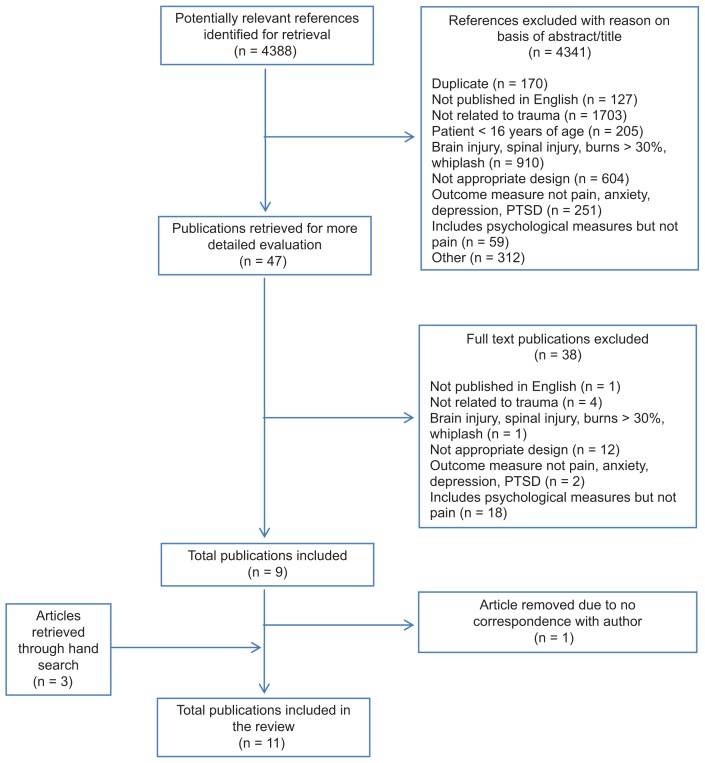
A systematic search of electronic databases (MEDLINE(®), PubMed(®), Embase, and PsycINFO(®)) was conducted for prospective, interventional, or noninterventional studies measuring the incidence of pain associated with TMsI.
The search revealed 4388 studies. Eleven studies examined persistent pain and met inclusion criteria. Pain was assessed using a validated measure of pain intensity or pain presence in six studies. Persistent pain was reported by all studies at variable time points up to 84 months postinjury, with wide variation among studies in pain intensity (ie, from mild to very severe) and pain incidence at each time point. The incidence of pain decreased over time within each study. Two studies found significant relationships between injury severity and persistent pain. Frequently cited predictive factors for persistent pain included: symptoms of anxiety and depression, patient perception that the injury was attributable to external sources (ie, they were not at fault), cognitive avoidance of distressing thoughts, alcohol consumption prior to trauma, lower educational status, being injured at work, eligibility for compensation, pain at initial assessment, and older age.
The evidence from the eleven studies included in this review indicates that persistent pain is prevalent up to 84 months following traumatic injury. Further research is needed to better evaluate persistent pain and other long-term posttraumatic outcomes.
创伤性肌肉骨骼损伤(TMsI)后常出现持续性疼痛和心理困扰。TMsI 患者通常较为年轻,恢复缓慢,并给社会带来巨大的经济负担。
本系统评价旨在确定:(1)TMsI 后持续性疼痛的发生率;(2)疼痛的特征,包括损伤严重程度和类型;(3)TMsI 后持续性疼痛相关的风险和保护因素。
对电子数据库(MEDLINE®、PubMed®、Embase 和 PsycINFO®)进行了系统检索,以查找评估 TMsI 相关疼痛发生率的前瞻性、干预性或非干预性研究。
搜索结果显示有 4388 项研究。11 项研究检查了与 TMsI 相关的持续性疼痛,并符合纳入标准。6 项研究使用疼痛强度的验证性测量或疼痛存在的测量来评估疼痛。所有研究均在损伤后长达 84 个月的不同时间点报告了持续性疼痛,各研究之间的疼痛强度(即从轻度到重度)和各时间点的疼痛发生率存在很大差异。每个研究中疼痛的发生率随时间推移而降低。两项研究发现损伤严重程度与持续性疼痛之间存在显著关系。经常被引用的持续性疼痛预测因素包括:焦虑和抑郁症状、患者认为损伤是由外部原因引起的(即他们没有过错)、对痛苦想法的认知回避、创伤前饮酒、较低的教育程度、在工作中受伤、有资格获得赔偿、初始评估时疼痛以及年龄较大。
本综述纳入的 11 项研究的证据表明,创伤后长达 84 个月仍存在持续性疼痛。需要进一步研究以更好地评估持续性疼痛和其他创伤后长期结局。