Gippsland School of Information Technology, Monash University, Australia.
BMC Bioinformatics. 2013;14 Suppl 2(Suppl 2):S14. doi: 10.1186/1471-2105-14-S2-S14. Epub 2013 Jan 21.
The over consumption of fossil fuels has led to growing concerns over climate change and global warming. Increasing research activities have been carried out towards alternative viable biofuel sources. Of several different biofuel platforms, cyanobacteria possess great potential, for their ability to accumulate biomass tens of times faster than traditional oilseed crops. The cyanobacterium Cyanothece sp. ATCC 51142 has recently attracted lots of research interest as a model organism for such research. Cyanothece can perform efficiently both photosynthesis and nitrogen fixation within the same cell, and has been recently shown to produce biohydrogen--a byproduct of nitrogen fixation--at very high rates of several folds higher than previously described hydrogen-producing photosynthetic microbes. Since the key enzyme for nitrogen fixation is very sensitive to oxygen produced by photosynthesis, Cyanothece employs a sophisticated temporal separation scheme, where nitrogen fixation occurs at night and photosynthesis at day. At the core of this temporal separation scheme is a robust clocking mechanism, which so far has not been thoroughly studied. Understanding how this circadian clock interacts with and harmonizes global transcription of key cellular processes is one of the keys to realize the inherent potential of this organism.
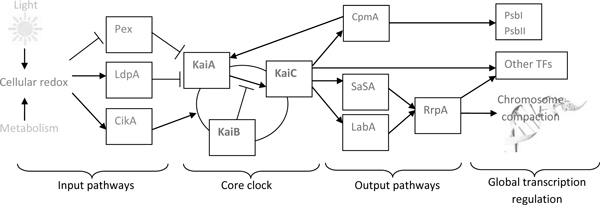
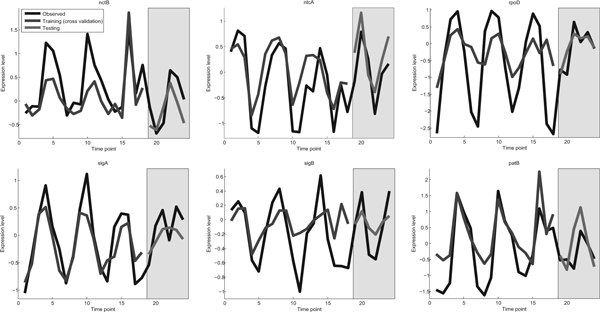
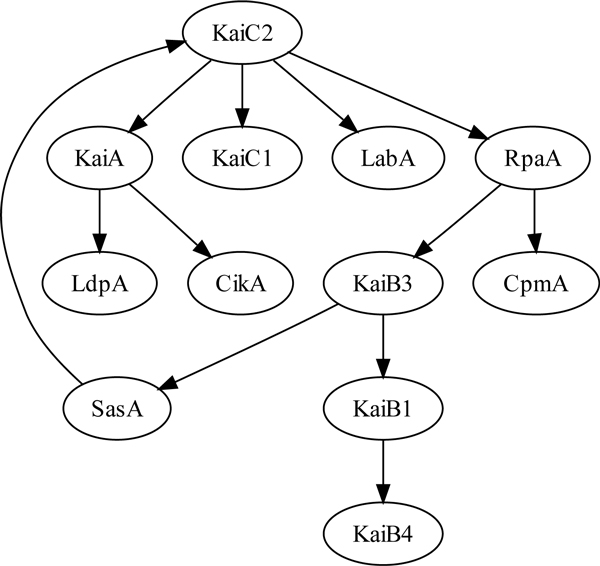
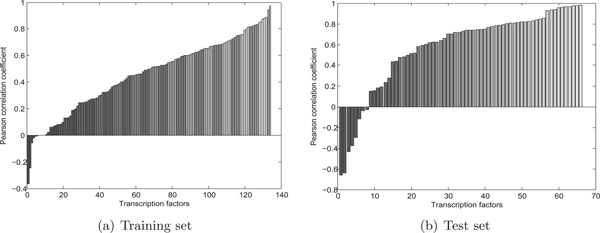
In this paper, we employ several state of the art bioinformatics techniques for studying the core circadian clock in Cyanothece sp. ATCC 51142, and its interactions with other key cellular processes. We employ comparative genomics techniques to map the circadian clock genes and genetic interactions from another cyanobacterial species, namely Synechococcus elongatus PCC 7942, of which the circadian clock has been much more thoroughly investigated. Using time series gene expression data for Cyanothece, we employ gene regulatory network reconstruction techniques to learn this network de novo, and compare the reconstructed network against the interactions currently reported in the literature. Next, we build a computational model of the interactions between the core clock and other cellular processes, and show how this model can predict the behaviour of the system under changing environmental conditions. The constructed models significantly advance our understanding of the Cyanothece circadian clock functional mechanisms.
化石燃料的过度消耗导致人们对气候变化和全球变暖的担忧日益加剧。人们开展了越来越多的研究活动,以寻找替代可行的生物燃料来源。在几种不同的生物燃料平台中,蓝藻具有巨大的潜力,因为它们能够以比传统油料作物快几十倍的速度积累生物量。蓝藻 Cyanothece sp. ATCC 51142 最近作为此类研究的模式生物引起了广泛的研究兴趣。Cyanothece 可以在同一个细胞内高效地进行光合作用和固氮作用,并且最近已经证明可以以比以前描述的产氢光合微生物高几倍的速率非常高的速率产生生物氢--固氮的副产物。由于固氮的关键酶对光合作用产生的氧气非常敏感,Cyanothece 采用了一种复杂的时间分离方案,其中固氮作用发生在夜间,光合作用发生在白天。这种时间分离方案的核心是一种强大的计时机制,迄今为止尚未对其进行深入研究。了解这种生物钟如何与关键细胞过程的全局转录相互作用并协调,是实现该生物固有潜力的关键之一。
在本文中,我们采用了几种最先进的生物信息学技术来研究 Cyanothece sp. ATCC 51142 的核心生物钟及其与其他关键细胞过程的相互作用。我们采用比较基因组学技术来绘制生物钟基因和遗传相互作用,这些基因和遗传相互作用来自另一种蓝细菌物种,即 Synechococcus elongatus PCC 7942,其生物钟已经得到了更深入的研究。使用 Cyanothece 的时间序列基因表达数据,我们采用基因调控网络重建技术从头学习这个网络,并将重建的网络与文献中目前报道的相互作用进行比较。接下来,我们构建了核心时钟与其他细胞过程之间相互作用的计算模型,并展示了如何根据环境条件的变化预测系统的行为。所构建的模型大大提高了我们对 Cyanothece 生物钟功能机制的理解。