Cerebrovascular Research, Lerner Research Institute, Cleveland Clinic, Cleveland, OH 44195, USA.
BMC Neurosci. 2013 Feb 6;14:18. doi: 10.1186/1471-2202-14-18.
The study of the cerebrovascular physiology is crucial to understand the pathogenesis of neurological disease and the pharmacokinetic of drugs. Appropriate models in vitro often fail to represent in vivo physiology. To address these issues we propose the use of a novel artificial vascular system that closely mimics capillary and venous segments of human cerebrovasculature while also allowing for an extensive control of the experimental variables and their manipulation.
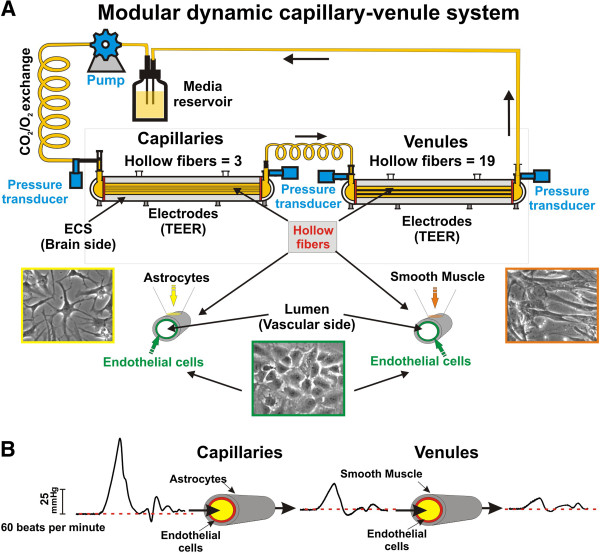
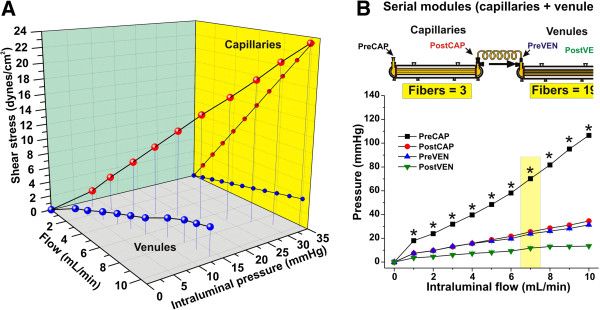
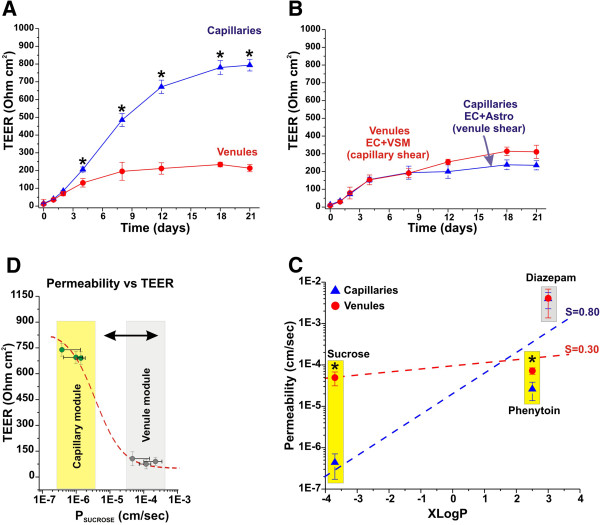
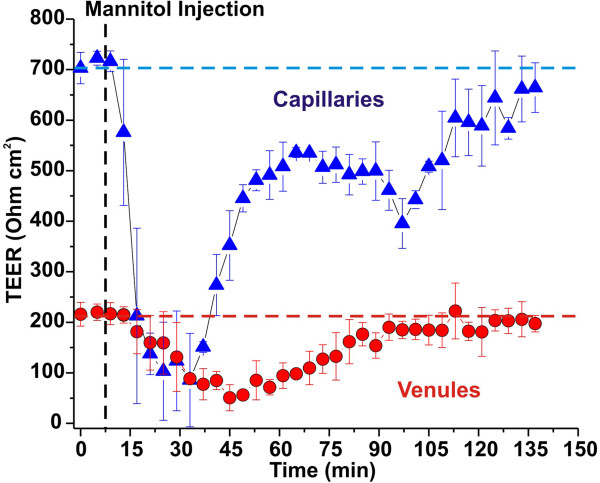
Using hollow fiber technology, we modified an existing dynamic artificial model of the blood-brain barrier (BBB) (DIV-capillary) to encompass the distal post-capillary (DIV-venules) segments of the brain circulatory system. This artificial brain vascular system is comprised of a BBB module serially connected to a venule segment. A pump generates a pulsatile flow with arterial pressure feeding the system. The perfusate of the capillary module achieves levels of shear stress, pressure, and flow rate comparable to what observed in situ. Endothelial cell exposure to flow and abluminal astrocytic stimuli allowed for the formation of a highly selective capillary BBB with a trans-endothelial electrical resistance (TEER; >700 ohm cm2) and sucrose permeability (< 1X10-u cm/sec) comparable to in vivo. The venule module, which attempted to reproduce features of the hemodynamic microenvironment of venules, was perfused by media resulting in shear stress and intraluminal pressure levels lower than those found in capillaries. Because of altered cellular and hemodynamic factors, venule segments present a less stringent vascular bed (TEER <250 Ohm cm2; Psucrose > 1X10⁻⁴ cm/sec) than that of the BBB. Abluminal human brain vascular smooth muscle cells were used to reproduce the venular abluminal cell composition.
The unique characteristics afforded by the DIV-BBB in combination with a venule segment will realistically expand our ability to dissect and study the physiological and functional behavior of distinct segments of the human cerebrovascular network.
研究脑血管生理学对于理解神经疾病的发病机制和药物的药代动力学至关重要。体外的合适模型往往无法代表体内生理学。为了解决这些问题,我们提出使用一种新的人工血管系统,该系统紧密模拟人脑血管系统的毛细血管和静脉段,同时允许对实验变量进行广泛控制和操作。
我们使用中空纤维技术,对现有的血脑屏障(BBB)动态人工模型(DIV-capillary)进行了修改,纳入了脑循环系统的远端后毛细血管(DIV-venules)段。该人工脑血管系统由一个 BBB 模块与一个静脉段串联组成。一个泵以动脉压为动力产生脉动血流供给系统。毛细血管模块的灌流液达到了与体内观察到的剪切应力、压力和流速相当的水平。内皮细胞暴露于流动和基底外侧星形胶质细胞刺激下,形成了具有高度选择性的毛细血管 BBB,其跨内皮电阻(TEER;>700 欧姆 cm2)和蔗糖通透性(<1X10⁻⁴ 厘米/秒)与体内相似。试图再现静脉微血管血流动力学微环境特征的静脉段,由灌流液灌注,导致剪切应力和管腔内压力水平低于毛细血管。由于细胞和血流动力学因素的改变,静脉段呈现出较不严格的血管床(TEER<250 欧姆 cm2;Psucrose>1X10⁻⁴ 厘米/秒),不如 BBB 严格。使用基底外侧人脑血管平滑肌细胞来再现静脉段的基底外侧细胞组成。
DIV-BBB 与静脉段相结合所具有的独特特征,将切实提高我们剖析和研究人脑血管网络不同段的生理和功能行为的能力。