Cedars-Sinai/UCLA Medical Center and OMC Clinical Research Center, 8641 Wilshire Blvd, Suite 301, Beverly Hills, CA 90211, USA.
Osteoporos Int. 2013 Aug;24(8):2309-17. doi: 10.1007/s00198-013-2284-y. Epub 2013 Feb 12.
This observational study evaluated the occurrence of nonvertebral fragility fractures (NVFX) in over 4,000 men and women with osteoporosis treated with teriparatide (TPTD). The incidence of new NVFX decreased for patients receiving TPTD treatment for greater than 6 months. No new significant safety findings were observed in this large trial.
The Direct Assessment of Nonvertebral Fractures in Community Experience (DANCE) study evaluated the occurrence of NVFX in patients receiving TPTD for osteoporosis in a real-world setting.
DANCE is a multicenter, prospective, observational trial that examined the long-term effectiveness of TPTD in men and women with osteoporosis whom study physicians judged to be suitable for TPTD therapy. Patients received 20 μg TPTD per day by subcutaneous injection for up to 24 months and were followed for 24 months after treatment cessation. The incidence of patients experiencing a new NVFX, defined as a fracture associated with low trauma, was evaluated during four 6-month periods in both the treatment and cessation phases with >0 to ≤6 months serving as the reference. We also observed the spectrum and occurrence of serious adverse events.
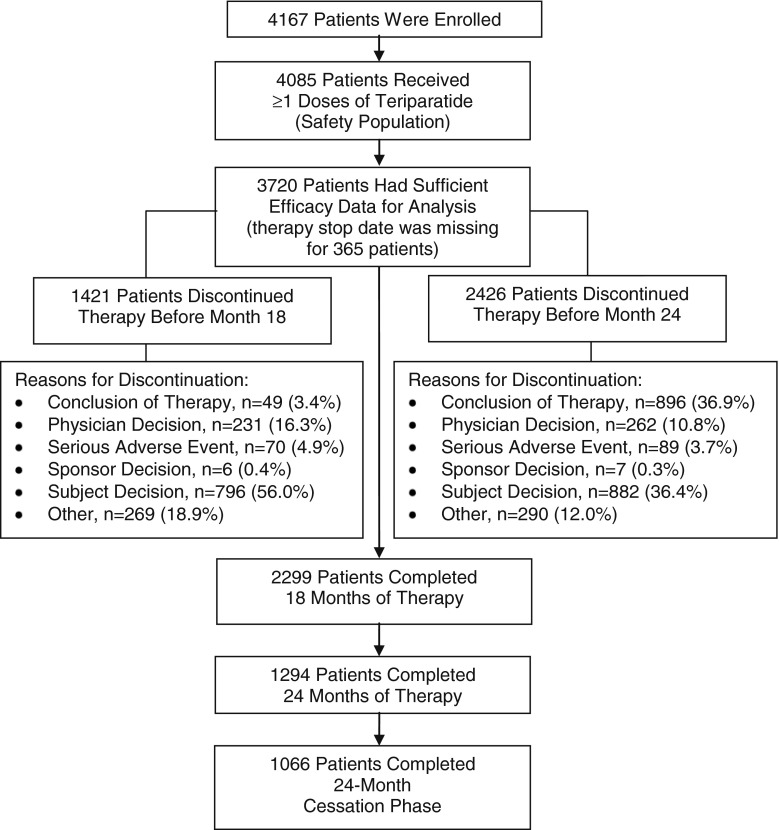
Of the 4,167 patients enrolled, 4,085 took one or more doses of TPTD (safety population); 3,720 were included in the efficacy analysis. The incidence of patients experiencing a NVFX was 1.42, 0.91, 0.70, and 0.81 % for the four treatment periods, respectively, and 0.80, 0.68, 0.33, and 0.33 % for the four periods after treatment cessation. Differences for each period were statistically significant compared with the reference period (first 6-month interval, each p < 0.05). No new significant safety findings were observed.
In this study, the incidence of NVFX decreased for patients receiving TPTD for all three treatment periods >6 months compared to 0 to ≤6 months, and this trend persisted throughout the cessation phase. TPTD was generally well tolerated.
本观察性研究评估了超过 4000 名接受特立帕肽(TPTD)治疗的骨质疏松症患者中非椎体脆性骨折(NVFX)的发生情况。接受 TPTD 治疗超过 6 个月的患者,新发 NVFX 的发生率降低。在这项大型试验中未观察到新的重大安全性发现。
直接评估社区经验中的非椎体骨折(DANCE)研究评估了在真实环境中接受 TPTD 治疗的骨质疏松症患者中 NVFX 的发生情况。
DANCE 是一项多中心、前瞻性、观察性试验,研究了每天接受 20μg 特立帕肽皮下注射治疗的男性和女性骨质疏松症患者的长期疗效,研究医生认为这些患者适合接受 TPTD 治疗。患者接受治疗 24 个月,并在治疗停止后随访 24 个月。在治疗和停药两个阶段的四个 6 个月期间,评估患者发生新的 NVFX(定义为与低创伤相关的骨折)的发生率,以治疗开始后 0 至≤6 个月作为参考期。我们还观察了严重不良事件的发生情况。
在 4167 名入组患者中,4085 名患者接受了 1 剂或多剂 TPTD(安全性人群);3720 名患者纳入疗效分析。四个治疗期的 NVFX 发生率分别为 1.42%、0.91%、0.70%和 0.81%,停药后四个期的发生率分别为 0.80%、0.68%、0.33%和 0.33%。与参考期(第一个 6 个月间隔,p 值均<0.05)相比,每个时期的差异均有统计学意义。未观察到新的重大安全性发现。
在这项研究中,与治疗开始后 0 至≤6 个月相比,接受 TPTD 治疗 6 个月以上的患者的 NVFX 发生率在所有三个治疗期均降低,这种趋势在停药期持续存在。TPTD 通常具有良好的耐受性。