Human Genetics Group, Spanish National Cancer Centre (CNIO), Madrid, Spain.
PLoS One. 2013;8(2):e55681. doi: 10.1371/journal.pone.0055681. Epub 2013 Feb 8.
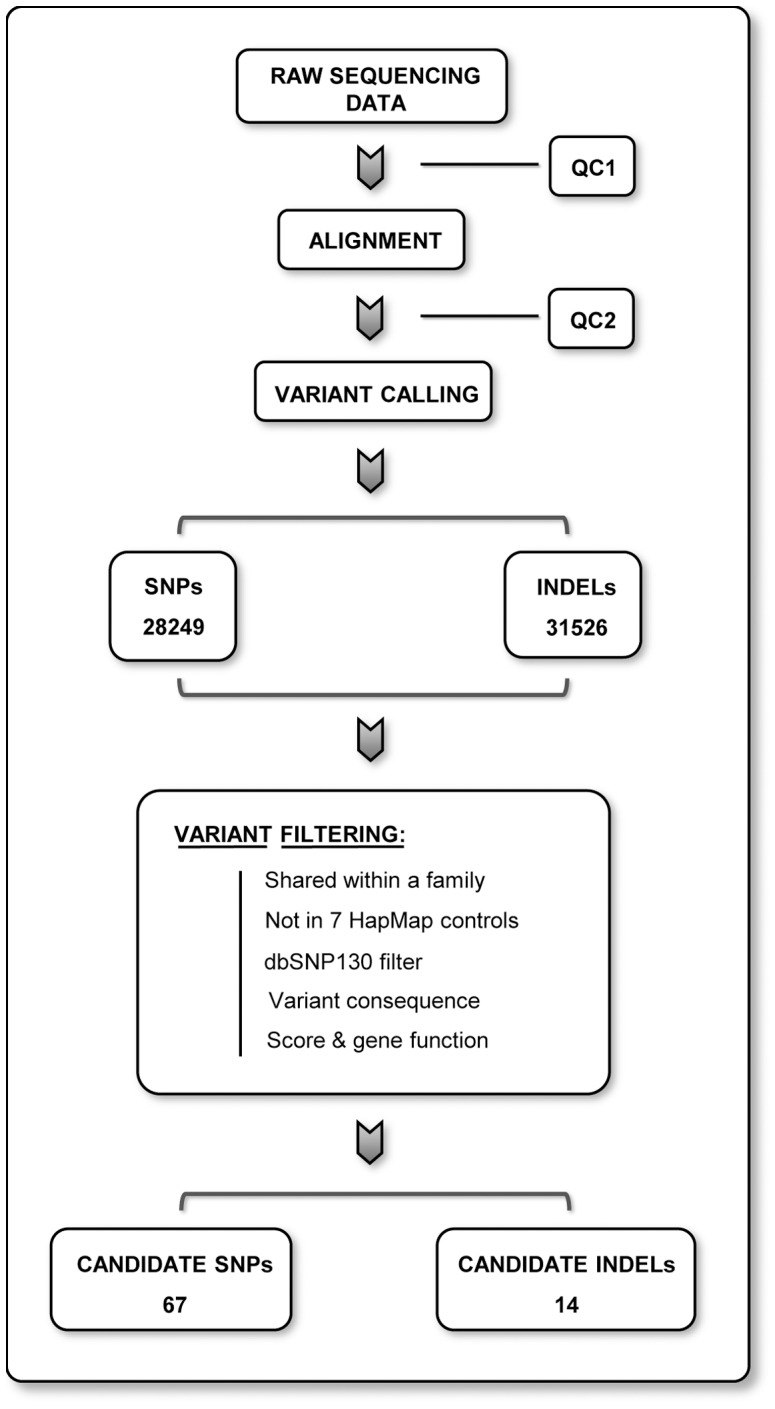
The identification of the two most prevalent susceptibility genes in breast cancer, BRCA1 and BRCA2, was the beginning of a sustained effort to uncover new genes explaining the missing heritability in this disease. Today, additional high, moderate and low penetrance genes have been identified in breast cancer, such as P53, PTEN, STK11, PALB2 or ATM, globally accounting for around 35 percent of the familial cases. In the present study we used massively parallel sequencing to analyze 7 BRCA1/BRCA2 negative families, each having at least 6 affected women with breast cancer (between 6 and 10) diagnosed under the age of 60 across generations. After extensive filtering, Sanger sequencing validation and co-segregation studies, variants were prioritized through either control-population studies, including up to 750 healthy individuals, or case-control assays comprising approximately 5300 samples. As a result, a known moderate susceptibility indel variant (CHEK2 1100delC) and a catalogue of 11 rare variants presenting signs of association with breast cancer were identified. All the affected genes are involved in important cellular mechanisms like DNA repair, cell proliferation and survival or cell cycle regulation. This study highlights the need to investigate the role of rare variants in familial cancer development by means of novel high throughput analysis strategies optimized for genetically heterogeneous scenarios. Even considering the intrinsic limitations of exome resequencing studies, our findings support the hypothesis that the majority of non-BRCA1/BRCA2 breast cancer families might be explained by the action of moderate and/or low penetrance susceptibility alleles.
两个最常见的乳腺癌易感基因 BRCA1 和 BRCA2 的鉴定,开启了一项持续的努力,旨在揭示新的基因,以解释这种疾病中缺失的遗传性。如今,已经在乳腺癌中发现了其他高、中、低外显率基因,如 P53、PTEN、STK11、PALB2 或 ATM,这些基因总体上占家族病例的约 35%。在本研究中,我们使用大规模平行测序分析了 7 个 BRCA1/BRCA2 阴性家族,每个家族至少有 6 名患有乳腺癌的受影响女性(6 至 10 人之间),且在 60 岁前跨代诊断。经过广泛的过滤、Sanger 测序验证和共分离研究,通过对照人群研究(包括多达 750 名健康个体)或病例对照分析(约 5300 个样本)对变体进行优先排序。结果,确定了一个已知的中度易感性缺失变异(CHEK2 1100delC)和一个与乳腺癌有迹象关联的 11 个罕见变异目录。所有受影响的基因都参与了重要的细胞机制,如 DNA 修复、细胞增殖和存活或细胞周期调节。这项研究强调了需要通过针对遗传异质性情况优化的新型高通量分析策略,调查罕见变异在家族性癌症发展中的作用。即使考虑到外显子组重测序研究的固有局限性,我们的发现支持了这样一种假设,即大多数非 BRCA1/BRCA2 乳腺癌家族可能是由中度和/或低外显率易感等位基因的作用所解释。