Department of Statistics and Information Science, Dongguk University, Gyeongju 780-714, Korea.
BMC Bioinformatics. 2013 Feb 19;14:58. doi: 10.1186/1471-2105-14-58.
A popular objective of many high-throughput genome projects is to discover various genomic markers associated with traits and develop statistical models to predict traits of future patients based on marker values.
In this paper, we present a prediction method for time-to-event traits using genome-wide single-nucleotide polymorphisms (SNPs). We also propose a MaxTest associating between a time-to-event trait and a SNP accounting for its possible genetic models. The proposed MaxTest can help screen out nonprognostic SNPs and identify genetic models of prognostic SNPs. The performance of the proposed method is evaluated through simulations.
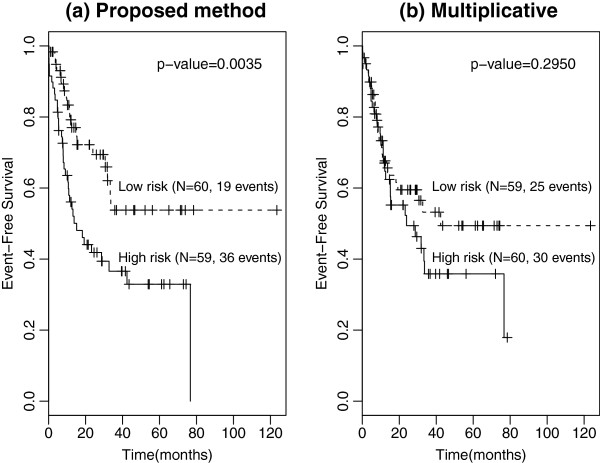
In conjunction with the MaxTest, the proposed method provides more parsimonious prediction models but includes more prognostic SNPs than some naive prediction methods. The proposed method is demonstrated with real GWAS data.
许多高通量基因组项目的一个热门目标是发现与性状相关的各种基因组标记,并开发统计模型,根据标记值预测未来患者的性状。
本文提出了一种基于全基因组单核苷酸多态性(SNP)的用于预测事件时间性状的方法。我们还提出了一种 MaxTest,它将事件时间性状与 SNP 之间的关联考虑在内,以解释其可能的遗传模型。所提出的 MaxTest 可以帮助筛选出非预后 SNP,并识别预后 SNP 的遗传模型。通过模拟评估了所提出方法的性能。
与 MaxTest 结合使用,所提出的方法提供了更简约的预测模型,但比一些简单的预测方法包含了更多的预后 SNP。该方法已在真实的 GWAS 数据上进行了验证。