Department of Infectious Diseases and Microbiology, Graduate School of Public Health, University of Pittsburgh, Pittsburgh, PA 15261, USA.
J Acquir Immune Defic Syndr. 2013 Aug 1;63(4):428-37. doi: 10.1097/QAI.0b013e31828ac85f.
Chemokines provide critical immune cell homing and activation signals that if altered could affect the inflammatory milieu and cellular composition of lymphoid tissues. During HIV-1 and simian immunodeficiency virus (SIV)-infection, the virus triggers an increase in inflammation or activation, leading to immunodeficiency and development of opportunistic infections, such as in the lungs-a massive interface between the host and the environment.
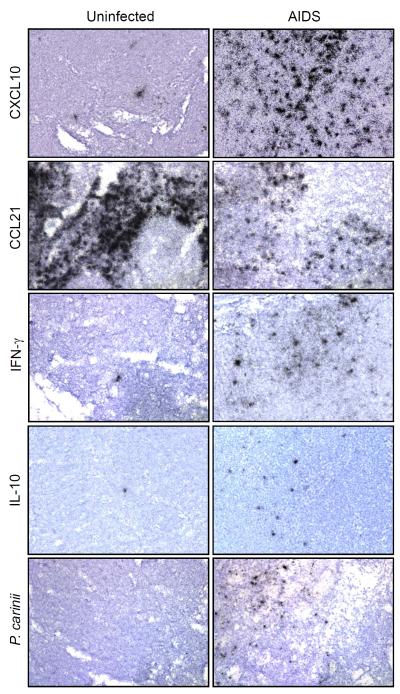
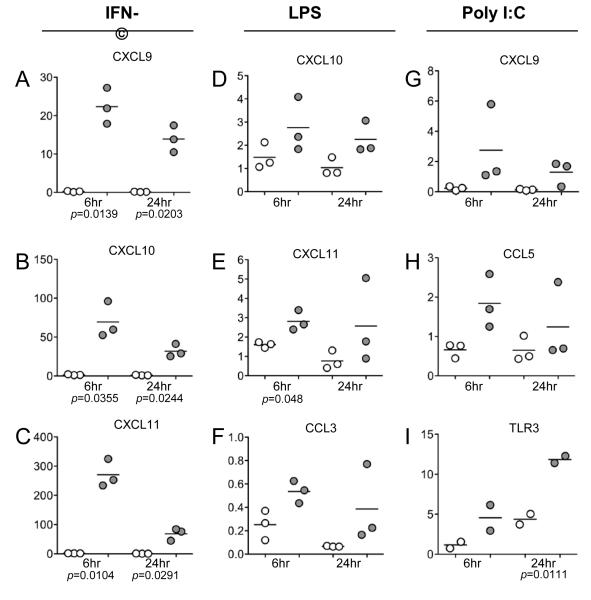
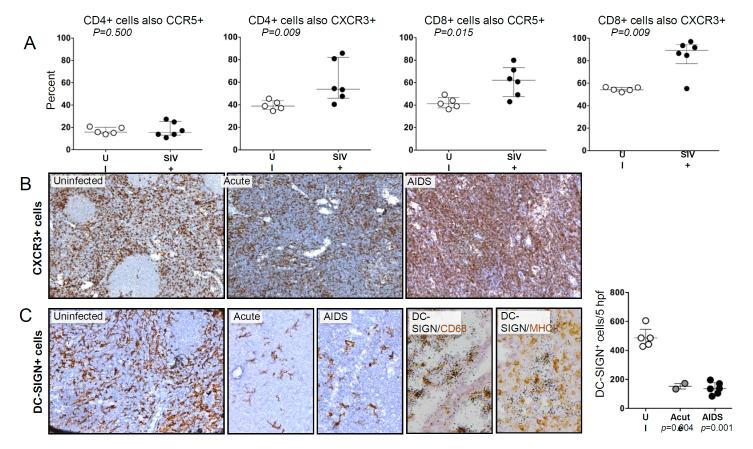
Chemokine, cytokine, and chemokine receptor expression profiles were determined using real-time reverse transcriptase-polymerase chain reaction and in situ hybridization in hilar lymph nodes (HiLNs) from cynomolgus macaques at different stages after infection with SIV/DeltaB670. Immunostaining of tissue sections and flow cytometric analysis of cryopreserved cells were used to examine cellular compositions of lymph nodes.
Interferon-gamma, type 1 chemokine, and cognate chemokine receptor mRNAs were upregulated, whereas type 2 and homeostatic chemokine and chemokine receptor mRNAs were down-regulated in HiLNs after SIV infection. Local SIV and interferon-gamma levels were positively correlated with type 1 chemokine levels but negatively correlated with type 2 and homeostatic chemokine levels. Using in situ hybridization, Pneumocystis carinii rRNA was detected in lung-draining lymph nodes from animals with P. carinii pneumonia. Changes in the cellular composition of HiLNs included decreased proportions of CD4 cells and dendritic cells and increased proportions of CD8, CXCR3, and CCR5 cells.
SIV infection of cynomolgus macaques dramatically alters the cellular homing signals of lung-draining lymph nodes, which correlated with changes in the immune cellular composition. These changes could contribute to the loss of immune function that defines AIDS.
趋化因子提供了关键的免疫细胞归巢和激活信号,如果这些信号发生改变,可能会影响淋巴组织的炎症环境和细胞组成。在 HIV-1 和猴免疫缺陷病毒(SIV)感染期间,病毒会引发炎症或激活增加,导致免疫功能缺陷和机会性感染的发展,例如肺部——这是宿主和环境之间的一个巨大界面。
使用实时逆转录-聚合酶链反应和原位杂交技术,在感染 SIV/DeltaB670 后不同时间点的恒河猴肺门淋巴结(HiLNs)中,确定趋化因子、细胞因子和趋化因子受体的表达谱。通过免疫组织化学染色和冷冻细胞的流式细胞术分析,检查淋巴结的细胞组成。
SIV 感染后,HiLNs 中干扰素-γ、1 型趋化因子和同源趋化因子受体 mRNA 上调,而 2 型和稳态趋化因子和趋化因子受体 mRNA 下调。局部 SIV 和干扰素-γ水平与 1 型趋化因子水平呈正相关,与 2 型和稳态趋化因子水平呈负相关。通过原位杂交,在患有卡氏肺孢子虫肺炎的动物的肺引流淋巴结中检测到卡氏肺孢子虫 rRNA。HiLNs 细胞组成的变化包括 CD4 细胞和树突状细胞比例降低,CD8、CXCR3 和 CCR5 细胞比例增加。
SIV 感染恒河猴会极大地改变肺引流淋巴结的细胞归巢信号,这与免疫细胞组成的变化相关。这些变化可能导致定义艾滋病的免疫功能丧失。