Population Studies Center, University of Pennsylvania, 3718 Locust Walk, Philadelphia, PA 19104, USA.
Popul Health Metr. 2013 Feb 28;11(1):4. doi: 10.1186/1478-7954-11-4.
The objective of these analyses is to document the relationship between biomarker-based indicators of health and socioeconomic status (SES) in a low-income African population where the cumulative effects of exposure to multiple stressors on physiological functions and health in general are expected to be highly detrimental for the well-being of individuals.
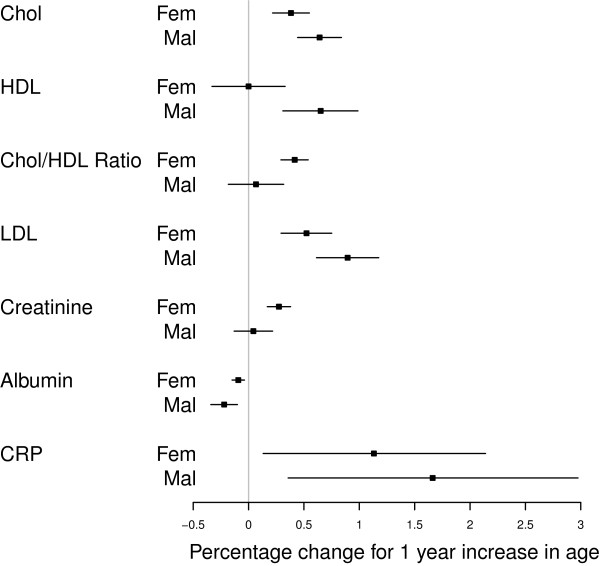
Biomarkers were collected subsequent to the 2008 round of the Malawi Longitudinal Study of Families and Health (MLSFH), a population-based study in rural Malawi, including blood lipids (total cholesterol, LDL, HDL, ratio of total cholesterol to HDL), biomarkers of renal and liver organ function (albumin and creatinine) and wide-range C-reactive protein (CRP) as a non-specific biomarker for inflammation. These biomarkers represent widely used indicators of health that are individually or cumulatively recognized as risk factors for age-related diseases among prime-aged and elderly individuals. Quantile regressions are used to estimate the age-gradient and the within-day variation of each biomarker distribution. Differences in biomarker levels by socioeconomic status are investigated using descriptive and multivariate statistics.
Overall, the number of significant associations between the biomarkers and socioeconomic measures is very modest. None of the biomarkers significantly varies with schooling. Except for CRP where being married is weakly associated with lower risk of having an elevated CRP level, marriage is not associated with the biomarkers measured in the MLSFH. Similarly, being Muslim is associated with a lower risk of having elevated CRP but otherwise religion does not predict being in the high-risk quartiles of any of the MLSFH biomarkers. Wealth does not predict being in the high-risk quartile of any of the MLSFH biomarkers, with the exception of a weak effect on creatinine. Being overweight or obese is associated with increased likelihood of being in the high-risk quartile for cholesterol, Chol/HDL ratio, and LDL.
The results provide only weak evidence for variation of the biomarkers by socioeconomic indicators in a poor Malawian context. Our findings underscore the need for further research to understand the determinants of health outcomes in a poor low-income context such as rural Malawi.
本分析旨在记录健康的生物标志物指标与社会经济地位(SES)之间的关系,该人群为非洲低收入人群,他们长期暴露于多种压力源,这对生理功能和整体健康的累积影响预计会对个人的幸福感造成极大的危害。
本研究的数据来自马拉维家庭与健康纵向研究(MLSFH)2008 年一轮调查,这是在马拉维农村地区进行的一项基于人群的研究,包括血脂(总胆固醇、LDL、HDL、总胆固醇与 HDL 的比值)、肾功能和肝功能的生物标志物(白蛋白和肌酐)以及广谱 C 反应蛋白(CRP)作为炎症的非特异性生物标志物。这些生物标志物是广泛使用的健康指标,它们单独或累积被认为是主要年龄段和老年人群中与年龄相关疾病的危险因素。分位数回归用于估计每个生物标志物分布的年龄梯度和日内变化。使用描述性和多变量统计方法研究生物标志物水平与社会经济地位的差异。
总体而言,生物标志物与社会经济衡量指标之间存在显著关联的数量非常有限。没有任何生物标志物与受教育程度显著相关。除了 CRP 外,CRP 水平与婚姻呈弱相关,表明 CRP 水平升高的风险较低,婚姻与 MLSFH 中测量的生物标志物无关。同样,穆斯林与 CRP 升高的风险较低有关,但宗教与 MLSFH 中任何生物标志物的高危四分位区间都没有预测作用。财富与 MLSFH 中任何生物标志物的高危四分位区间都没有关系,除了对肌酐有微弱影响。超重或肥胖与胆固醇、Chol/HDL 比值和 LDL 处于高危四分位区间的可能性增加有关。
这些结果仅为在贫困的马拉维背景下,生物标志物因社会经济指标而发生变化提供了微弱的证据。我们的研究结果强调了在像马拉维农村这样的贫困低收入环境中,需要进一步研究以了解健康结果的决定因素。