University of Nantes, Laboratory Motricité, Interactions, Performance (EA 4334), F-44000, Nantes, France.
J Neuroeng Rehabil. 2013 Mar 1;10:26. doi: 10.1186/1743-0003-10-26.
The current experiment investigated the impact of two potential confounding variables on the postural balance in young participants: the induced-experimental activity prior to the static postural measurements and the well-documented time-of-day effects. We mainly hypothesized that an exhaustive exercise and a high attention-demanding task should result in alterations of postural control.
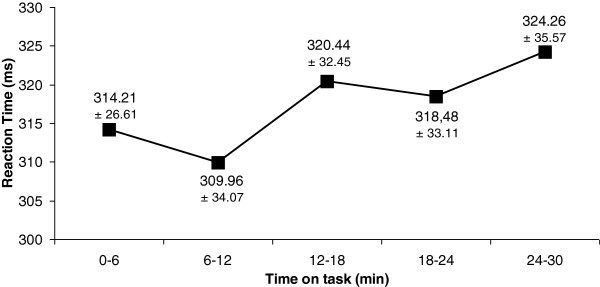
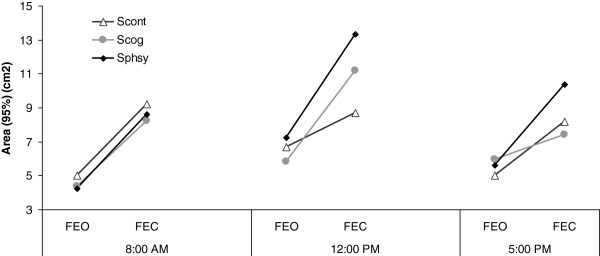
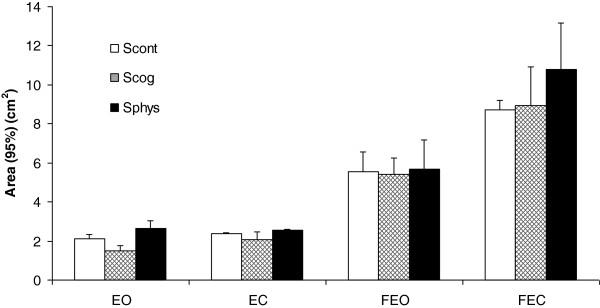
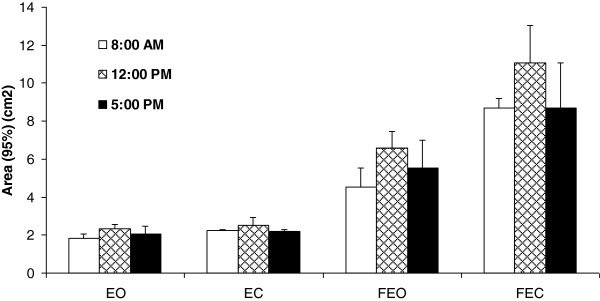
Ten participants performed three experimental sessions (differentiated by the activity - none, cognitive or physical - prior of the assessment of postural stability), separated by one day at least. Each session included postural balance assessments around 8 a.m., 12.00 p.m. and 5 p.m. ± 30 min. The physical and cognitive activities were performed only before the 12 o'clock assessment. The postural tests consisted of four conditions of quiet stance: stance on a firm surface with eyes open; stance on a firm surface with eyes closed; stance on a foam surface with eyes open and stance on a foam surface with eyes closed. Postural performance was assessed by various center of pressure (COP) parameters.
Overall, the COP findings indicated activity-related postural impairment, with an increase in body sway in the most difficult conditions (with foam surface), especially when postural measurements are recorded just after the running exercise (physical session) or the psychomotor vigilance test (cognitive session).
Even if no specific influence of time-of-day on static postural control is demonstrated, our results clearly suggest that the activities prior to balance tests could be a potential confounding variable to be taken into account and controlled when assessing clinical postural balance.
本实验研究了两个潜在的混杂变量对年轻参与者姿势平衡的影响:静态姿势测量前的诱导实验活动和众所周知的时间效应。我们主要假设,一项耗竭性运动和一项高注意力要求的任务应该导致姿势控制的改变。
十名参与者进行了三次实验(通过活动区分,即评估姿势稳定性之前的无活动、认知或身体活动),至少间隔一天。每次会议包括上午 8 点、12 点和下午 5 点±30 分钟的姿势平衡评估。身体和认知活动仅在 12 点评估之前进行。姿势测试包括四种安静姿势条件:睁眼在坚固表面上站立;闭眼在坚固表面上站立;睁眼在泡沫表面上站立和闭眼在泡沫表面上站立。姿势表现通过各种中心压力(COP)参数进行评估。
总体而言,COP 结果表明与活动相关的姿势障碍,在最困难的条件下(带有泡沫表面),身体摆动增加,尤其是当在跑步运动(身体会议)或精神运动警觉测试(认知会议)后立即进行姿势测量时。
即使没有证明时间对静态姿势控制的特定影响,我们的结果清楚地表明,平衡测试前的活动可能是评估临床姿势平衡时需要考虑和控制的一个潜在混杂变量。