Centro de Investigación y Estudios Avanzados (CINVESTAV) del Instituto Politécnico Nacional (CINVESTAV-IPN), Mérida, México.
PLoS One. 2013;8(2):e56569. doi: 10.1371/journal.pone.0056569. Epub 2013 Feb 14.
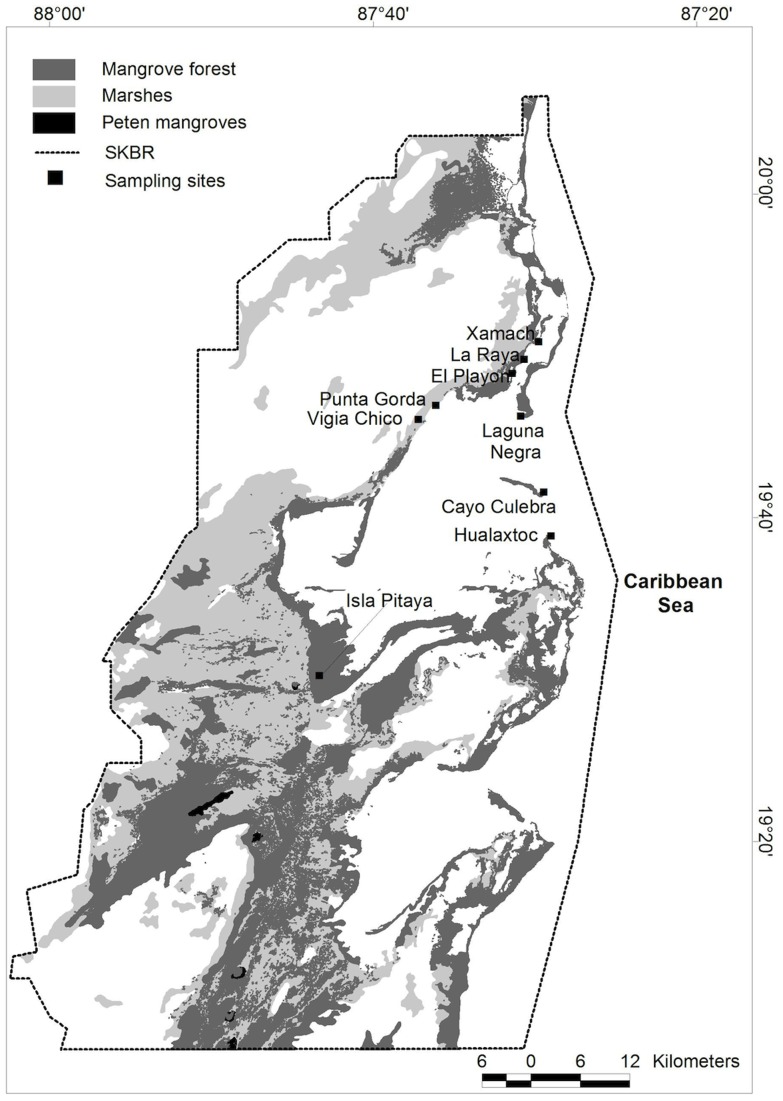
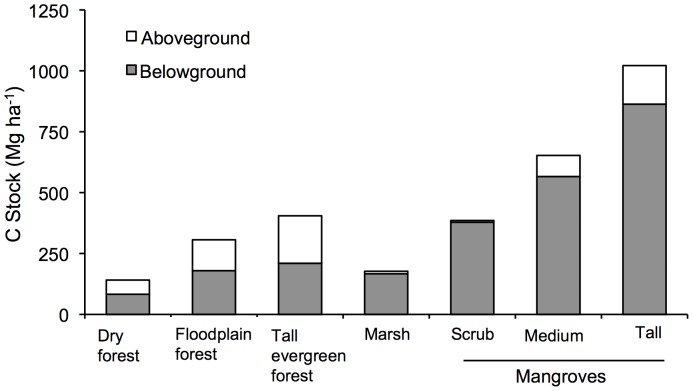
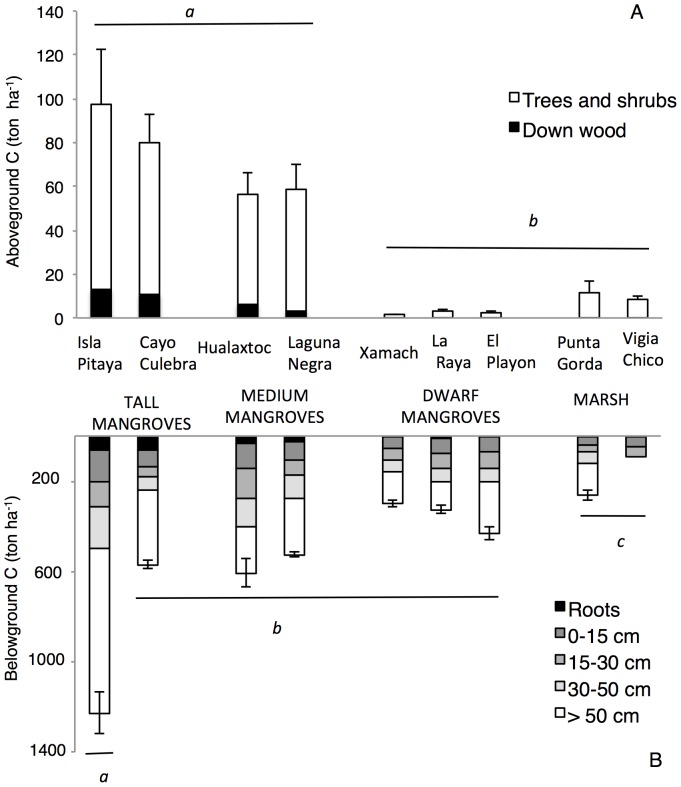
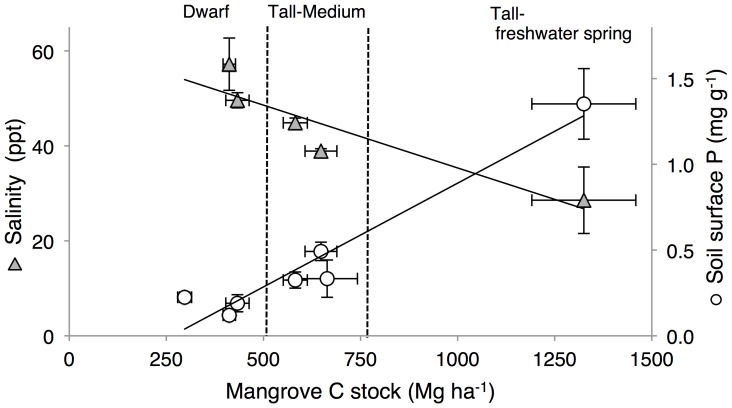
Coastal wetlands can have exceptionally large carbon (C) stocks and their protection and restoration would constitute an effective mitigation strategy to climate change. Inclusion of coastal ecosystems in mitigation strategies requires quantification of carbon stocks in order to calculate emissions or sequestration through time. In this study, we quantified the ecosystem C stocks of coastal wetlands of the Sian Ka'an Biosphere Reserve (SKBR) in the Yucatan Peninsula, Mexico. We stratified the SKBR into different vegetation types (tall, medium and dwarf mangroves, and marshes), and examined relationships of environmental variables with C stocks. At nine sites within SKBR, we quantified ecosystem C stocks through measurement of above and belowground biomass, downed wood, and soil C. Additionally, we measured nitrogen (N) and phosphorus (P) from the soil and interstitial salinity. Tall mangroves had the highest C stocks (987±338 Mg ha(-1)) followed by medium mangroves (623±41 Mg ha(-1)), dwarf mangroves (381±52 Mg ha(-1)) and marshes (177±73 Mg ha(-1)). At all sites, soil C comprised the majority of the ecosystem C stocks (78-99%). Highest C stocks were measured in soils that were relatively low in salinity, high in P and low in N∶P, suggesting that P limits C sequestration and accumulation potential. In this karstic area, coastal wetlands, especially mangroves, are important C stocks. At the landscape scale, the coastal wetlands of Sian Ka'an covering ≈172,176 ha may store 43.2 to 58.0 million Mg of C.
滨海湿地具有极高的碳(C)储量,保护和恢复滨海湿地将是应对气候变化的一种有效缓解策略。为了计算通过时间排放或封存的碳,需要将滨海生态系统纳入缓解策略中并对其碳储量进行量化。本研究量化了墨西哥尤卡坦半岛锡安卡安生物圈保护区(SKBR)滨海湿地的生态系统碳储量。我们将 SKBR 划分为不同的植被类型(高、中、矮红树林和沼泽),并研究了环境变量与碳储量的关系。在 SKBR 的九个地点,我们通过测量地上和地下生物量、倒木和土壤 C 来量化生态系统碳储量。此外,我们还测量了土壤和间隙盐度中的氮(N)和磷(P)。高红树林的碳储量最高(987±338 Mg ha(-1)),其次是中红树林(623±41 Mg ha(-1))、矮红树林(381±52 Mg ha(-1))和沼泽(177±73 Mg ha(-1))。在所有地点,土壤 C 构成了生态系统碳储量的主要部分(78-99%)。在相对低盐度、高磷和低 N∶P 的土壤中,测量到的碳储量最高,这表明 P 限制了 C 的固存和积累潜力。在这个喀斯特地区,滨海湿地,尤其是红树林,是重要的碳储存库。在景观尺度上,锡安卡安的滨海湿地覆盖面积约为 172,176 ha,可能储存了 43.2 到 58.0 百万 Mg 的 C。