
欧洲边缘的啮齿动物:伏伊伏丁那盲鼹鼠的现状与分布
European rodent on the edge: status and distribution of the Vojvodina blind mole rat.
作者信息
Németh Attila, Krnács György, Krizsik Virág, Révay Tamás, Czabán Dávid, Stojnić Nikola, Farkas János, Csorba Gábor
机构信息
Department of Systematic Zoology and Ecology, Eötvös Loránd University, Pázmány Péter sétány 1/C, Budapest, H-1117 Hungary.
出版信息
Springerplus. 2013 Dec;2(1):2. doi: 10.1186/2193-1801-2-2. Epub 2013 Jan 4.
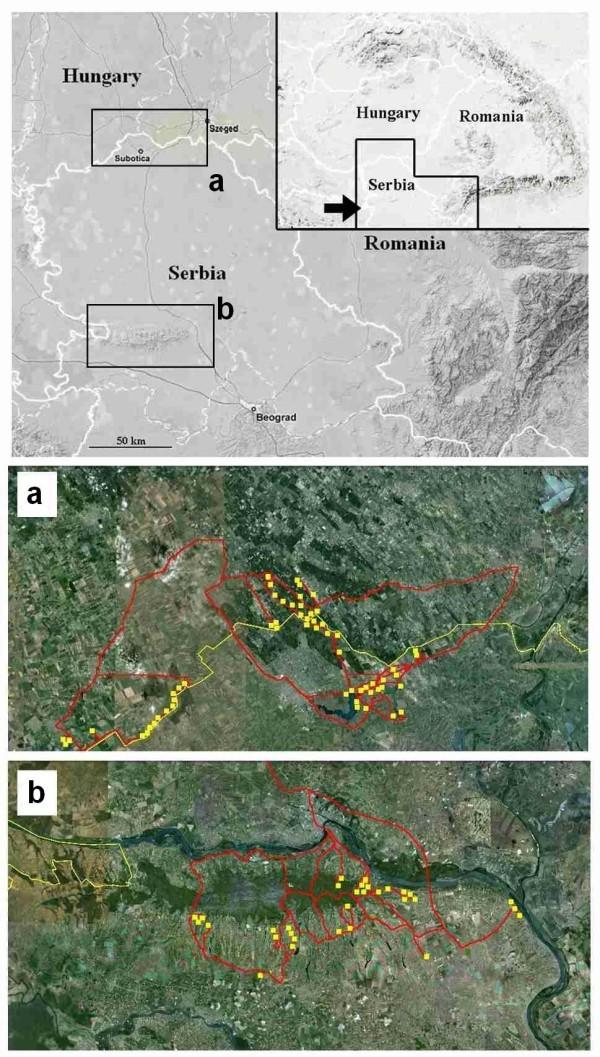
Recent research of blind mole rats of the species complex Nannospalax (superspecies leucodon) identified a small and fragmented population of these rodents on both sides of the Hungarian-Serbian border. Cytogenetic investigations proved that this population karyologically identical with the Vojvodina blind mole rat described earlier as Nannospalax (leucodon) montanosyrmiensis. Based on cytochrome b gene sequences obtained from three specimens originating from separate locations, these blind mole rats form a discrete phylogenetic clade which, with a difference of about 10%, is well separated from other blind mole rat taxa inhabiting the Carpathian Basin. The taxon has only two extant populations that are 150 km apart from each other. The combined occupied area is estimated to be less than 10 km(2), and the total estimated number of individuals is less than 300. These two remaining populations are heavily fragmented and under imminent threat by the establishment of tree plantations, small-scale and agro-industrial farms and land development. The situation is further aggravated by the fact that 80% of the individuals inhabit unprotected areas. A study of the landscape history of the wider area surrounding one of the populations - based on military maps spanning over the last 200 years - has shown a drastic decrease in the extent and quality of potential habitats. Based on our present knowledge, the Vojvodina blind mole rat is one of the most seriously threatened, rarest mammal in Europe, the remaining population of which can be wiped out within years unless immediate conservation action is taken.
近期对南鼹属(超级物种白齿鼹)盲鼹鼠的研究发现,在匈牙利与塞尔维亚边境两侧存在一小群且分布零散的这种啮齿动物。细胞遗传学研究证明,该种群在核型上与先前描述为南鼹(白齿鼹)蒙塔诺锡尔米亚盲鼹鼠相同。基于从三个来自不同地点的标本获得的细胞色素b基因序列,这些盲鼹鼠形成了一个离散的系统发育分支,与栖息在喀尔巴阡盆地的其他盲鼹鼠类群有大约10%的差异,且彼此分隔明显。该分类单元仅存两个种群,它们相距150公里。其合并的栖息地面积估计小于10平方公里,个体总数估计不到300只。这两个剩余种群严重分散,正受到树木种植园、小型和农工养殖场的建立以及土地开发的紧迫威胁。情况因80%的个体栖息在未受保护地区这一事实而进一步恶化。对其中一个种群周边更广泛区域的景观历史研究(基于过去200年的军事地图)表明,潜在栖息地的范围和质量急剧下降。根据我们目前的了解,伏伊伏丁那盲鼹鼠是欧洲受威胁最严重、最稀有的哺乳动物之一,除非立即采取保护行动,否则其剩余种群可能在数年内灭绝。


 Zotero 插件