Division of Hematology, College of Medicine, Mayo Clinic, Rochester, MN 55905, USA.
Clin Lymphoma Myeloma Leuk. 2013 Apr;13(2):184-6. doi: 10.1016/j.clml.2013.02.005. Epub 2013 Mar 13.
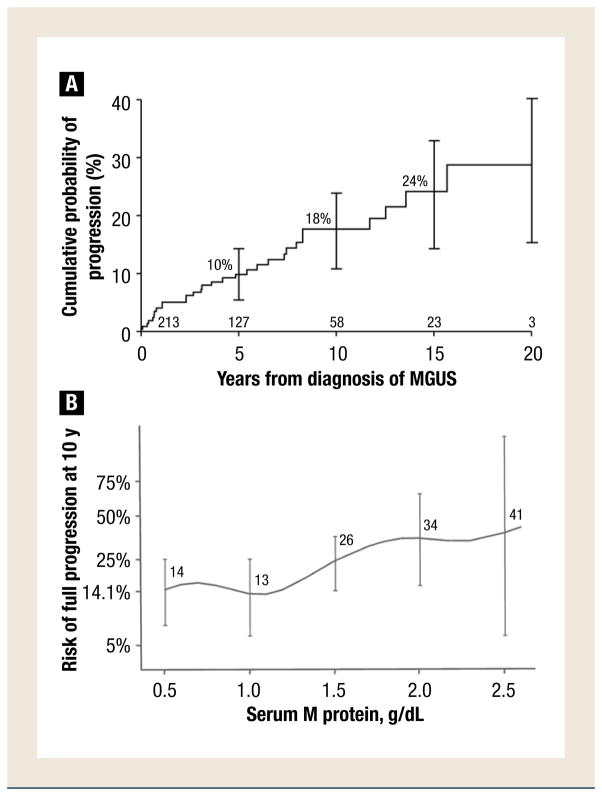
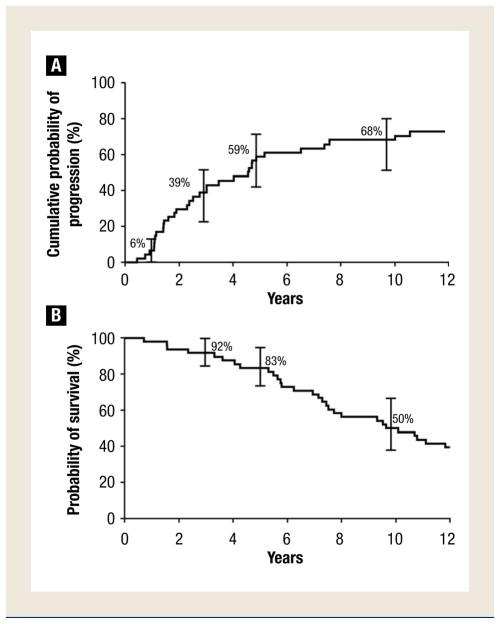
Monoclonal gammopathy of undetermined significance of the immunoglobulin M class was diagnosed in 213 patients at the Mayo Clinic, 29 (14%) of whom developed lymphoma, Waldenström macroglobulinemia, or a related disorder over 1567 person-years of follow-up. The cumulative probability of progression was 10% at 5 years, 18% at 10 years, and 24% at 15 years, or approximately 1.5% per year. The concentration of serum monoclonal protein at diagnosis and the initial serum albumin value were the only independent predictors of progression with multivariate analysis. By contrast, during 285 person-years of follow-up, 34 (71%) of 48 patients with smoldering Waldenström macroglobulinemia (SWM) progressed to Waldenström macroglobulinemia (WM), which required therapy, along with amyloid light chain (AL) amyloidosis (1) and lymphoma (1). The cumulative probability of progression was 6% at 1 year, 39% at 3 years, 59% at 5 years, and 65% at 10 years. The percentage of lymphoplasmacytic cells in the bone marrow, size of the serum monoclonal (M) spike, and hemoglobin value were significant independent risk factors for progression.
213 例在梅奥诊所诊断为免疫球蛋白 M 类意义未明的单克隆丙种球蛋白病患者中,29 例(14%)在 1567 人年的随访中发展为淋巴瘤、华氏巨球蛋白血症或相关疾病。进展的累积概率为 5 年时 10%,10 年时 18%,15 年时 24%,即每年约 1.5%。多变量分析显示,诊断时血清单克隆蛋白浓度和初始血清白蛋白值是唯一独立的进展预测因子。相比之下,在 285 人年的随访中,48 例冒烟型华氏巨球蛋白血症(SWM)患者中有 34 例(71%)进展为需要治疗的华氏巨球蛋白血症(WM),同时伴有淀粉样轻链(AL)淀粉样变性(1 例)和淋巴瘤(1 例)。进展的累积概率为 1 年时 6%,3 年时 39%,5 年时 59%,10 年时 65%。骨髓中淋巴浆细胞的百分比、血清单克隆(M)峰的大小和血红蛋白值是进展的显著独立危险因素。