Strati Areti, Kasimir-Bauer Sabine, Markou Athina, Parisi Cleo, Lianidou Evi S
Breast Cancer Res. 2013 Mar 7;15(2):R20. doi: 10.1186/bcr3395.
Comparison studies between different analytical methodologies for circulating tumor cells (CTC) detection and molecular characterization are urgently needed, since standardization of assays is essential before their use in clinical practice.
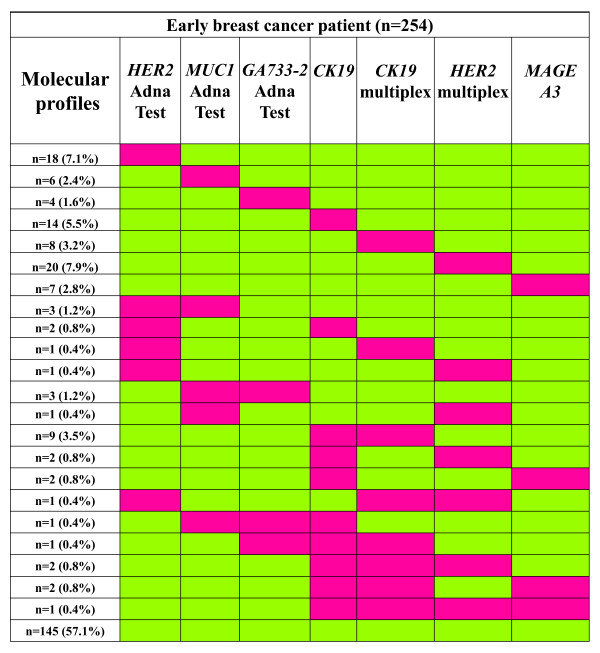
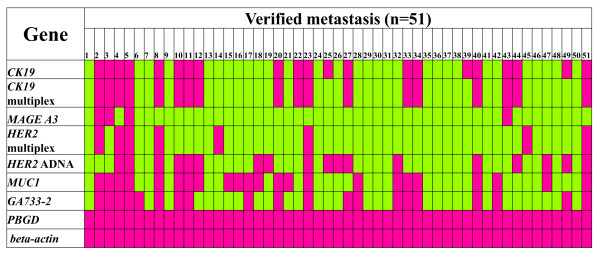
We compared three different CTC molecular assays. To avoid discrepancies due to pre-analytical errors we used the same cDNAs throughout our study. CTC were isolated using anti-EpCAM and anti-MUC1 coated magnetic beads from 2 × 5 ml of peripheral blood of 254 early and 51 metastatic breast cancer patients and 30 healthy individuals. The same cDNAs were analyzed by: a) singleplex RT-qPCR assay for CK-19; b) multiplex RT-qPCR for CK-19, HER-2, MAGE- A3, and PBGD; and c) a commercially available molecular assay (AdnaTest BreastCancer) for GA733-2, MUC-1, HER-2 and beta-actin.
In early breast cancer, CK-19 RT-qPCR, multiplex RT-qPCR and the AdnaTest, were positive for the presence of CTC in 14.2%, 22.8% and 16.5% subjects, respectively. The concordance between the AdnaTest and CK-19 RT-qPCR was 72.4% while between the AdnaTest and multiplex RT-qPCR was 64.6%. In patients with overt metastasis, CK-19 RT-qPCR, multiplex RT-qPCR and the AdnaTest were positive in 41.2%, 39.2% and 54.9% patients, respectively. The concordance between the AdnaTest and CK-19 RT-qPCR was 70.6% while between the AdnaTest and multiplex RT-qPCR was 68.6%.
All CTC assays gave similar results in about 70% of cases. Better agreement was found in the metastatic setting, possibly explained by the higher tumor load in this group. Discordances could be attributed to the different gene transcripts used to evaluate CTC positivity. Our results indicate the importance of CTC heterogeneity for their detection by different analytical methodologies.
由于在临床实践中使用循环肿瘤细胞(CTC)检测和分子特征分析的不同分析方法之前,检测方法的标准化至关重要,因此迫切需要对这些方法进行比较研究。
我们比较了三种不同的CTC分子检测方法。为避免因分析前误差导致的差异,我们在整个研究中使用相同的cDNA。使用抗EpCAM和抗MUC1包被的磁珠从254例早期和51例转移性乳腺癌患者以及30名健康个体的2×5ml外周血中分离CTC。相同的cDNA通过以下方法进行分析:a)针对CK-19的单重RT-qPCR检测;b)针对CK-19、HER-2、MAGE-A3和PBGD的多重RT-qPCR检测;c)用于检测GA733-2、MUC-1、HER-2和β-肌动蛋白的市售分子检测方法(AdnaTest BreastCancer)。
在早期乳腺癌中,CK-19 RT-qPCR、多重RT-qPCR和AdnaTest检测中,CTC阳性的受试者比例分别为14.2%、22.8%和16.5%。AdnaTest与CK-19 RT-qPCR之间的一致性为72.4%,而AdnaTest与多重RT-qPCR之间的一致性为64.6%。在有明显转移的患者中,CK-19 RT-qPCR、多重RT-qPCR和AdnaTest检测的阳性患者比例分别为41.2%、39.2%和54.9%。AdnaTest与CK-19 RT-qPCR之间的一致性为70.6%,而AdnaTest与多重RT-qPCR之间的一致性为68.6%。
在约70%的病例中,所有CTC检测方法都给出了相似的结果。在转移情况下发现了更好的一致性,这可能是由于该组中较高的肿瘤负荷所致。差异可能归因于用于评估CTC阳性的不同基因转录本。我们的结果表明CTC异质性对于通过不同分析方法进行检测的重要性。