Drosatos Konstantinos, Schulze P Christian
Division of Preventive Medicine and Nutrition, Department of Medicine, Columbia University College of Physicians & Surgeons, 630 West 168th Street, New York, NY 10032, USA.
Curr Heart Fail Rep. 2013 Jun;10(2):109-21. doi: 10.1007/s11897-013-0133-0.
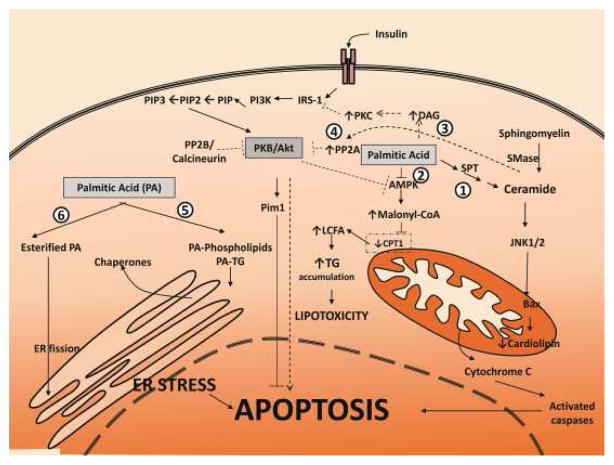
Diabetes and obesity are both associated with lipotoxic cardiomyopathy exclusive of coronary artery disease and hypertension. Lipotoxicities have become a public health concern and are responsible for a significant portion of clinical cardiac disease. These abnormalities may be the result of a toxic metabolic shift to more fatty acid and less glucose oxidation with concomitant accumulation of toxic lipids. Lipids can directly alter cellular structures and activate downstream pathways leading to toxicity. Recent data have implicated fatty acids and fatty acyl coenzyme A, diacylglycerol, and ceramide in cellular lipotoxicity, which may be caused by apoptosis, defective insulin signaling, endoplasmic reticulum stress, activation of protein kinase C, MAPK activation, or modulation of PPARs.
糖尿病和肥胖均与不伴有冠状动脉疾病和高血压的脂毒性心肌病相关。脂毒性已成为一个公共卫生问题,并且是临床心脏疾病的一大部分原因。这些异常可能是由于代谢向更多脂肪酸氧化和更少葡萄糖氧化转变并伴有有毒脂质蓄积的毒性结果。脂质可直接改变细胞结构并激活导致毒性的下游通路。最近的数据表明脂肪酸、脂肪酰基辅酶A、二酰基甘油和神经酰胺与细胞脂毒性有关,这可能由细胞凋亡、胰岛素信号缺陷、内质网应激、蛋白激酶C激活、丝裂原活化蛋白激酶(MAPK)激活或过氧化物酶体增殖物激活受体(PPARs)的调节引起。