Department of Nuclear Engineering, Texas A&M University, College Station, TX 77843, USA.
Sci Rep. 2013;3:1450. doi: 10.1038/srep01450.
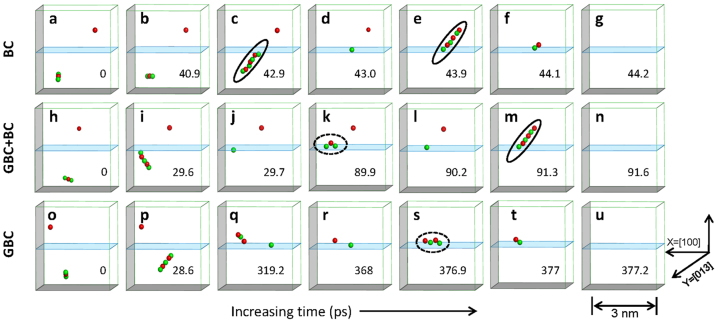
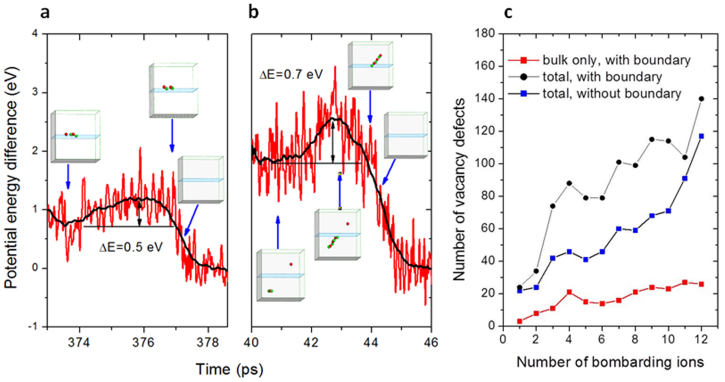
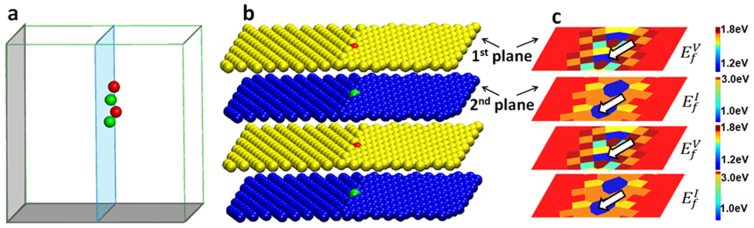
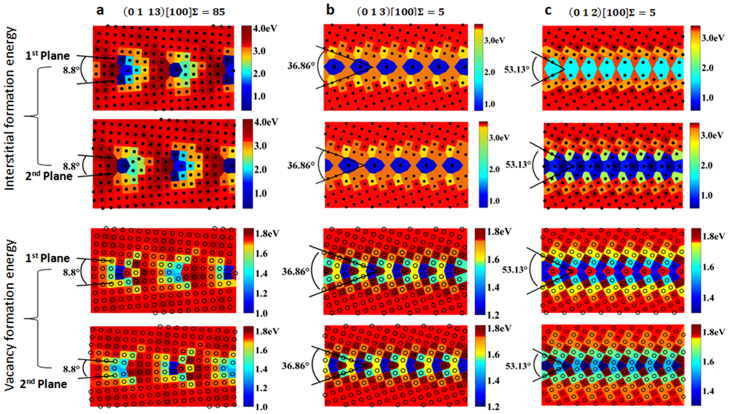
Understanding radiation responses of Fe-based metals is essential to develop radiation tolerant steels for longer and safer life cycles in harsh reactor environments. Nanograined metals have been explored as self-healing materials due to point-defect recombination at grain boundaries. The fundamental defect-boundary interactions, however, are not yet well understood. We discover that the interactions are always mediated by formation and annealing of chain-like defects, which consist of alternately positioned interstitials and vacancies. These chain-like defects are closely correlated to the patterns of defect formation energy minima on the grain boundary, which depend on specific boundary configurations. Through chain-like defects, a point defect effectively translates large distances, to annihilate with its opposite, thus grain boundaries act as highly efficient defect sinks that cannot saturate under extreme radiation conditions.
了解铁基金属的辐射响应对于开发在恶劣反应堆环境中具有更长和更安全生命周期的耐辐射钢至关重要。由于晶界处的点缺陷复合,纳米晶金属已被探索作为自修复材料。然而,基本的缺陷-晶界相互作用尚不清楚。我们发现,这些相互作用总是通过链状缺陷的形成和退火来介导的,这些缺陷由交替排列的间隙原子和空位组成。这些链状缺陷与晶界上缺陷形成能极小值的模式密切相关,这些模式取决于特定的边界构型。通过链状缺陷,点缺陷可以有效地移动很大的距离,与相反的点缺陷湮灭,因此晶界作为高效的缺陷阱,在极端辐射条件下不会饱和。