Richard Gilder Graduate School, American Museum of Natural History, New York, New York, United States of America.
PLoS One. 2013;8(3):e59736. doi: 10.1371/journal.pone.0059736. Epub 2013 Mar 19.
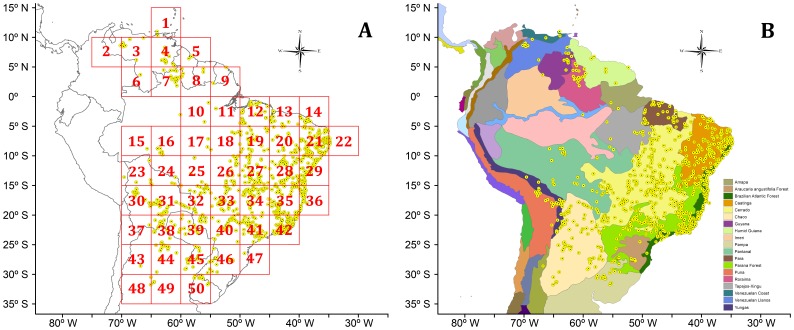
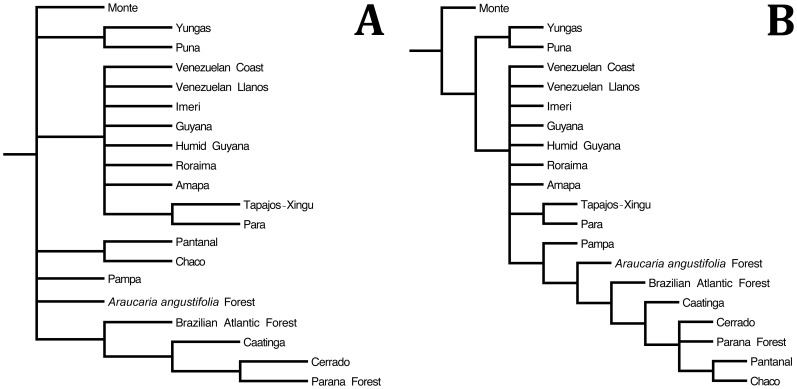
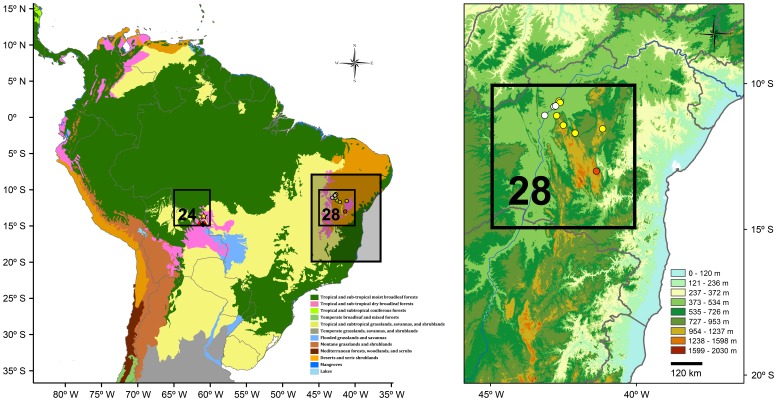
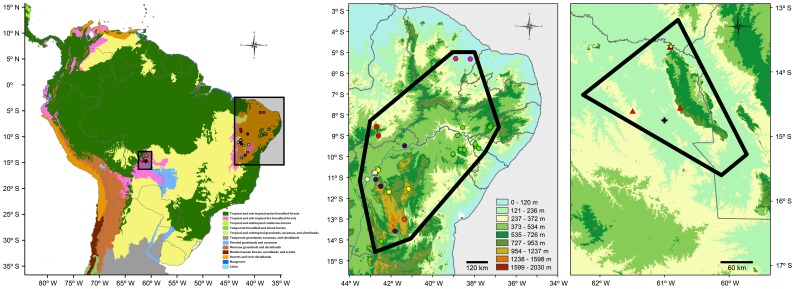
Based on comprehensive distributional records of the 23 species currently assigned to the lizard genus Tropidurus, we investigated patterns of endemism and area relationships in South America. Two biogeographic methods were applied, Parsimony Analysis of Endemicity (PAE) and Brooks Parsimony Analysis (BPA). Two areas of endemism were detected by PAE: the first within the domains of the semiarid Brazilian Caatinga, which includes seven endemic species, and the second in the region of the Serranía de Huanchaca, eastern Bolivia, in which three endemic species are present. The area cladograms recovered a close relationship between the Atlantic Forest and areas of the South American open corridor. The results revealed a close relationship among the provinces Caatinga (Cerrado, Parana Forest (Pantanal+Chaco)). The uplift of the Brazilian Central Plateau in the Late Pliocene-Early Pleistocene (4-2 Myr BP) has been interpreted as a major event responsible for isolation and differentiation of biotas along these areas. However, we emphasize that without the establishment of a temporal framework concerning the diversification history of Tropidurus it is premature to correlate cladogenetic events with specific time periods or putative vicariant scenarios. The limiting factors hampering the understanding of the biogeographic history of this genus include (1) the absence of temporal references in relation to the diversification of distinct clades within Tropidurus; (2) the lack of an appropriate taxonomic resolution of the species complexes currently represented by widely distributed forms; and (3) the need for a comprehensive phylogenetic hypothesis. We suggest that these three important aspects should be prioritized in future investigations.
基于目前分配给蜥蜴属 Tropidurus 的 23 个物种的综合分布记录,我们调查了南美洲特有种和面积关系的模式。应用了两种生物地理方法,即特有种简约分析(PAE)和布鲁克斯简约分析(BPA)。PAE 检测到两个特有种区:第一个在巴西半干旱 Caatinga 地区,包括七个特有种;第二个在玻利维亚东部 Huanchaca 山脉地区,有三个特有种。区系 cladogram 恢复了大西洋森林与南美开放走廊地区之间的密切关系。结果表明,Caatinga 省(Cerrado、Parana 森林(潘塔纳尔+查科))之间存在密切关系。上新世晚期-更新世早期(4-2 百万年前)巴西中央高原的隆起被解释为导致这些地区生物隔离和分化的主要事件。然而,我们强调,在没有建立关于 Tropidurus 多样化历史的时间框架的情况下,将分支发生事件与特定时期或假定的隔离情景相关联还为时过早。阻碍我们理解该属生物地理历史的限制因素包括:(1)与 Tropidurus 内不同支系的多样化相关的时间参考缺失;(2)缺乏目前广泛分布形式的物种复合体的适当分类分辨率;(3)需要一个全面的系统发育假说。我们建议,在未来的研究中应优先考虑这三个重要方面。