Department of Molecular Biology and Genetics, Aarhus University, Aarhus C 8000, Denmark.
Sensors (Basel). 2013 Mar 25;13(4):4017-28. doi: 10.3390/s130404017.
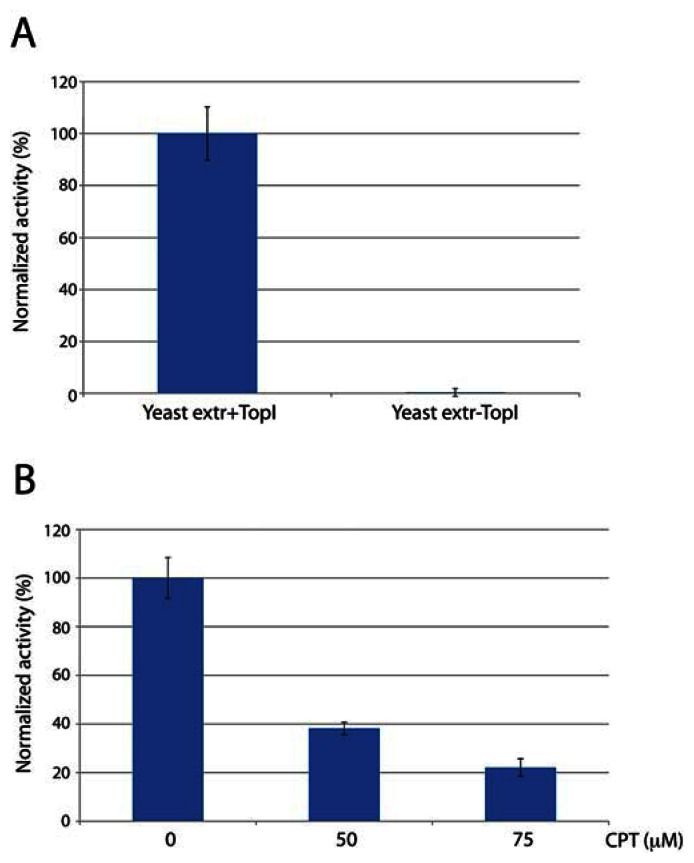
Sensors capable of quantitative real-time measurements may present the easiest and most accurate way to study enzyme activities. Here we present a novel DNA-based sensor for specific and quantitative real-time measurement of the enzymatic activity of the essential human enzyme, topoisomerase I. The basic design of the sensor relies on two DNA strands that hybridize to form a hairpin structure with a fluorophore-quencher pair. The quencher moiety is released from the sensor upon reaction with human topoisomerase I thus enabling real-time optical measurement of enzymatic activity. The sensor is specific for topoisomerase I even in raw cell extracts and presents a simple mean of following enzyme kinetics using standard laboratory equipment such as a qPCR machine or fluorimeter. Human topoisomerase I is a well-known target for the clinically used anti-cancer drugs of the camptothecin family. The cytotoxic effect of camptothecins correlates directly with the intracellular topoisomerase I activity. We therefore envision that the presented sensor may find use for the prediction of cellular drug response. Moreover, inhibition of topoisomerase I by camptothecin is readily detectable using the presented DNA sensor, suggesting a potential application of the sensor for first line screening for potential topoisomerase I targeting anti-cancer drugs.
能够进行定量实时测量的传感器可能提供了研究酶活性的最简单、最准确的方法。在这里,我们提出了一种新颖的基于 DNA 的传感器,用于特异性和定量实时测量人类必需酶拓扑异构酶 I 的酶活性。传感器的基本设计依赖于两条杂交形成发夹结构的 DNA 链,该结构带有荧光团猝灭剂对。与人类拓扑异构酶 I 反应后,猝灭部分从传感器中释放出来,从而能够实时进行酶活性的光学测量。该传感器对拓扑异构酶 I 具有特异性,即使在原始细胞提取物中也是如此,并且提供了一种简单的方法来使用标准实验室设备(如 qPCR 机器或荧光计)来跟踪酶动力学。人类拓扑异构酶 I 是临床使用的喜树碱类抗癌药物的已知靶标。喜树碱的细胞毒性作用与细胞内拓扑异构酶 I 活性直接相关。因此,我们设想所提出的传感器可用于预测细胞药物反应。此外,使用所提出的 DNA 传感器可以很容易地检测到喜树碱对拓扑异构酶 I 的抑制作用,这表明该传感器可能用于一线筛选潜在的拓扑异构酶 I 靶向抗癌药物。