Institute of Oceanology, Polish Academy of Sciences, Sopot, Poland ; Natural History Museum, London, United Kingdom.
PLoS One. 2013;8(3):e59152. doi: 10.1371/journal.pone.0059152. Epub 2013 Mar 25.
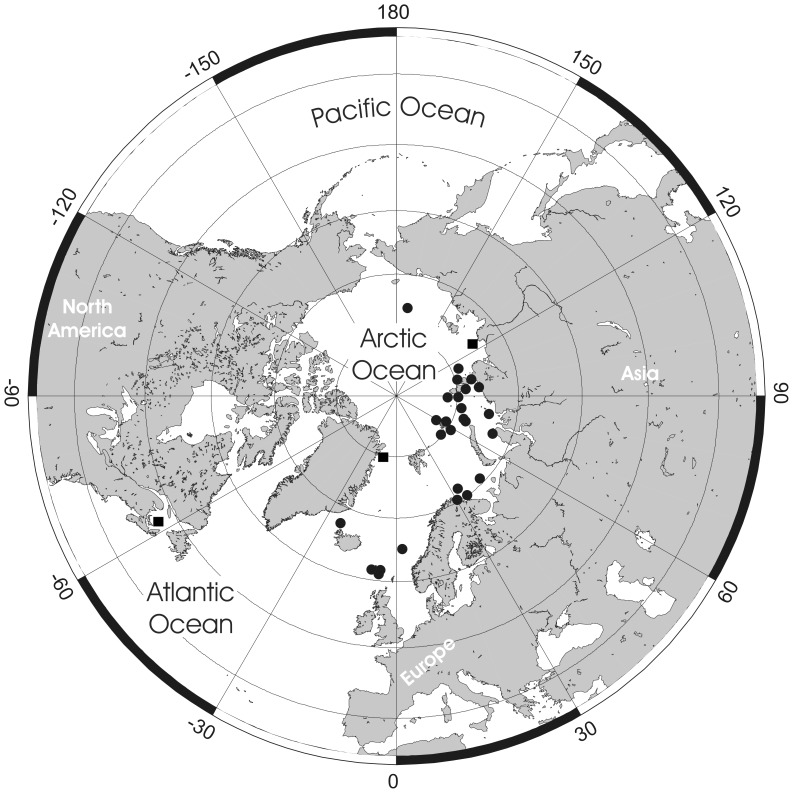
The intricate geological evolution of the Arctic Ocean is paralleled by complexities in the biogeographical and phylogenetical histories of the Arctic biota, including bryozoans. Here we present revised taxonomic descriptions for all known species of the bryozoan genus Pseudoflustra, and use the present-day distributions and phylogenetic relationships between these species to infer the historical biogeography of the genus. Nine species belonging to the genus Pseudoflustra are recognized in the Arctic and North Atlantic. One new species, previously identified as Ichthyaria aviculata, is described as Pseudoflustra radeki sp. nov. Another species, previously assigned to Smittoidea as S. perrieri, is transferred to Pseudoflustra. Biogeographical analysis of Pseudoflustra reveals that species distributions mostly match current patterns pertaining in the North Atlantic and Arctic Ocean. Distributions were probably shaped by recent geological history as present-day current directions in the Arctic Ocean are believed to have been similar for at least the last 120 000 years. Phylogenetic analysis of Pseudoflustra places the five Arctic-North Atlantic species in a clade crownward of a paraphyletic grouping of North Atlantic species. Given that the Arctic Ocean was fully glaciated until 18 000 years, the most likely explanation for this phylogeographical pattern is that species of Pseudoflustra colonized the Arctic relatively recently from North Atlantic sources. However, a fuller understanding of the origin of Pseudoflustra in the Arctic will require molecular and fossil data, neither of which are currently available.
北极海洋的地质演化过程十分复杂,与之相似的,北极生物群的生物地理学和系统发育历史也十分复杂,苔藓动物就是其中之一。本文对所有已知的北极苔藓动物拟石枝属物种进行了修订的分类描述,并利用这些物种的现代分布和系统发育关系来推断该属的历史生物地理学。在北极和北大西洋地区共识别出 9 种拟石枝属物种。其中一种先前被鉴定为 Ichthyaria aviculata 的物种被描述为拟石枝属的新种 Pseudoflustra radeki sp. nov. 另一种先前被归入 Smittoidea 属的物种 S. perrieri 被归入拟石枝属。对拟石枝属的生物地理学分析表明,物种分布主要与北大西洋和北极海洋的当前模式相匹配。这些分布可能是由最近的地质历史形成的,因为人们相信,北极海洋的当前水流方向在过去至少 120000 年内是相似的。对拟石枝属的系统发育分析将五个北极-北大西洋物种置于一个分支之上,该分支是一个北大西洋物种的并系群。鉴于北极海洋在 18000 年前一直完全被冰川覆盖,这种系统地理模式最有可能的解释是,拟石枝属的物种是从北大西洋的来源相对较近的时间才在北极地区殖民的。然而,要更全面地了解拟石枝属在北极的起源,还需要分子和化石数据,但目前这两种数据都不可用。