School of Biological Sciences, Victoria University of Wellington, Wellington, New Zealand.
PLoS One. 2013;8(3):e59938. doi: 10.1371/journal.pone.0059938. Epub 2013 Mar 25.
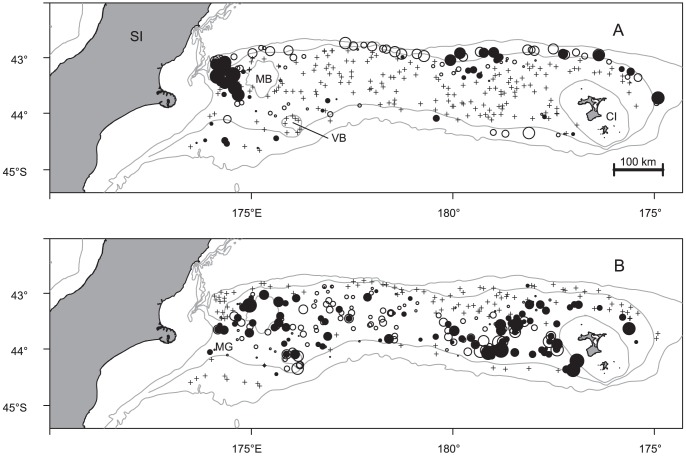
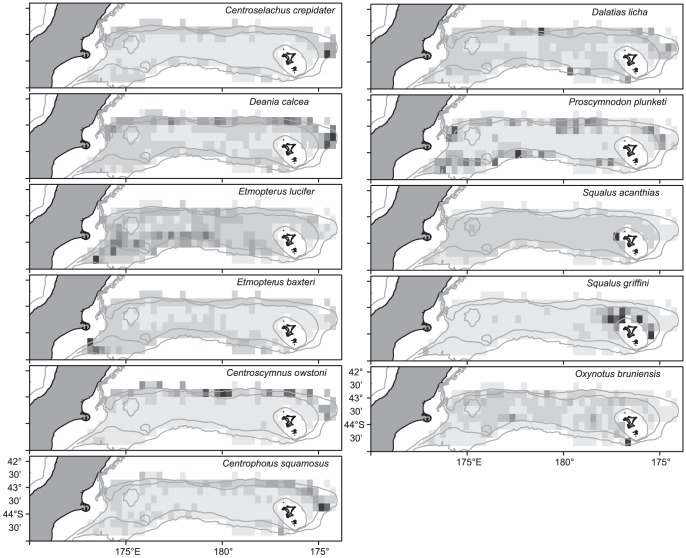
Squaliforme sharks are a common but relatively vulnerable bycatch in many deep water fisheries. Eleven species of squaliforme shark are commonly caught at depths of 200-1200 m on Chatham Rise, New Zealand, and their diversity suggests they might occupy different niches. The diets of 133 Deania calcea and 295 Squalus acanthias were determined from examination of stomach contents. The diet of D. calcea was characterised by mesopelagic fishes, and S. acanthias by benthic to pelagic fishes, but was more adaptive and included likely scavenging. Multivariate analyses found the most important predictors of diet variability in S. acanthias were year, bottom temperature, longitude, and fish weight. The diet of the nine other commonly caught squaliforme sharks was reviewed, and the spatial and depth distribution of all species on Chatham Rise described from research bottom trawl survey catches. The eleven species had a variety of different diets, and depth and location preferences, consistent with niche separation to reduce interspecific competition. Four trophic groups were identified, characterised by: mesopelagic fishes and invertebrates (Centroselachus crepidater, D. calcea, and Etmopterus lucifer); mesopelagic and benthopelagic fishes and invertebrates (Centroscymnus owstoni, Etmopterus baxteri); demersal and benthic fishes (Centrophorus squamosus, Dalatias licha, Proscymnodon plunketi); and a generalist diet of fishes and invertebrates (S. acanthias). The trophic levels of the species in each of the four groups were estimated as 4.18-4.24, 4.20-4.23, 4.24-4.48, and 3.84 respectively. The diet of Oxynotus bruniensis and Squalus griffini are unknown. The different niches occupied by different species are likely to influence their vulnerability to bottom trawl fisheries. Some species may benefit from fisheries through an increased availability of scavenged prey.
沙条鲛是许多深海渔业中常见但相对脆弱的兼捕种。在新西兰查塔姆海隆,水深 200-1200 米处,通常会捕获到 11 种沙条鲛,它们的多样性表明它们可能占据不同的生态位。通过检查胃内容物,确定了 133 条 Deania calcea 和 295 条 Squalus acanthias 的饮食情况。D. calcea 的饮食以中层鱼类为特征,S. acanthias 的饮食以底栖和洄游鱼类为特征,但更具适应性,包括可能的食腐。多元分析发现,S. acanthias 饮食可变性的最重要预测因子是年份、底层温度、经度和鱼体重。审查了其他 9 种常见沙条鲛的饮食,并从研究底拖网调查渔获中描述了查塔姆海隆所有物种的空间和深度分布。这 11 个物种的饮食种类繁多,深度和位置偏好也各不相同,这与减少种间竞争的生态位分离一致。确定了四个营养组,其特征为:中层鱼类和无脊椎动物(Centroselachus crepidater、D. calcea 和 Etmopterus lucifer);中层和底栖鱼类和无脊椎动物(Centroscymnus owstoni、Etmopterus baxteri);底层和底栖鱼类(Centrophorus squamosus、Dalatias licha、Proscymnodon plunketi);以及鱼类和无脊椎动物的杂食性饮食(S. acanthias)。每个营养组中四个物种的营养水平估计分别为 4.18-4.24、4.20-4.23、4.24-4.48 和 3.84。Oxynotus bruniensis 和 Squalus griffini 的饮食未知。不同物种占据的不同生态位可能会影响它们对底拖网渔业的脆弱性。一些物种可能会通过增加可获得的腐肉猎物而受益于渔业。