Department of Gastroenterology, Ruijin Hospital, Shanghai Jiaotong University School of Medicine, Shanghai 200025, China.
Mol Pain. 2013 Mar 28;9:15. doi: 10.1186/1744-8069-9-15.
Visceral pain is common symptom involved in many gastrointestinal disorders such as inflammatory bowel disease. The underlying molecular mechanisms remain elusive. We investigated the molecular mechanisms and the role for voltage gated calcium channel (VGCC) in the pathogenesis in a rat model of 2,4,6-trinitrobenzenesulfonic acid (TNBS) induced visceral inflammatory hypersensitivity.
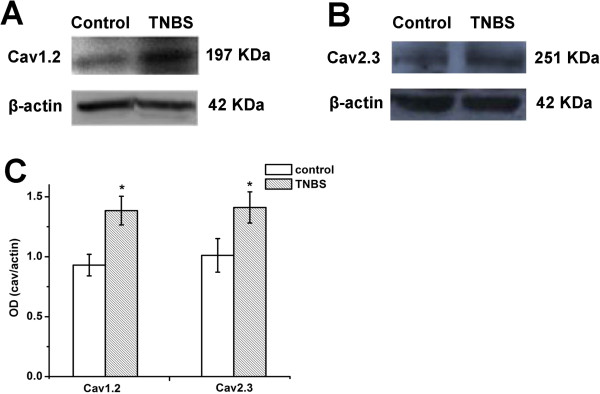
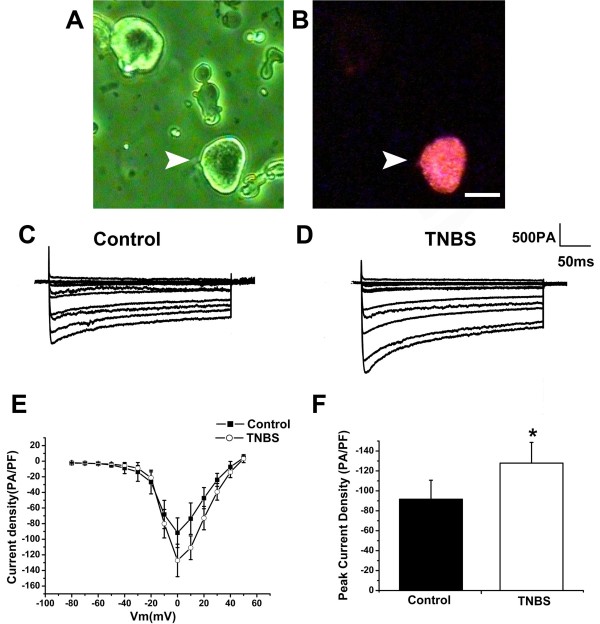
Using Agilent cDNA arrays, we found 172 genes changed significantly in dorsal root ganglia (DRG) of TNBS treated rats. Among these changed genes, Cav1.2 and Cav2.3 were significantly up-regulated. Then the RT-PCR and Western blot further confirmed the up-regulation of Cav1.2 and Cav2.3. The whole cell patch clamp recording of acutely dissociated colonic specific DRG neurons showed that the peak IBa density was significantly increased in colonic neurons of TNBS treated rats compared with control rats (-127.82 ± 20.82 pA/pF Vs -91.67 ± 19.02 pA/pF, n = 9, *P < 0.05). To distinguish the different type of calcium currents with the corresponding selective channel blockers, we found that L-type (-38.56 ± 3.97 pA/pF Vs -25.75 ± 3.35 pA/pF, n = 9, * P < 0.05) and R-type (-13.31 ± 1.36 pA/pF Vs -8.60 ± 1.25 pA/pF, n = 9, * P < 0.05) calcium current density were significantly increased in colonic DRG neurons of TNBS treated rats compared with control rats. In addition, pharmacological blockade with L-type antagonist (nimodipine) and R-type antagonist (SNX-482) with intrathecal injection attenuates visceral pain in TNBS induced inflammatory visceral hypersensitivity.
Cav1.2 and Cav2.3 in colonic primary sensory neurons play an important role in visceral inflammatory hyperalgesia, which maybe the potential therapeutic targets.
内脏痛是许多胃肠道疾病(如炎症性肠病)的常见症状。其潜在的分子机制仍不清楚。我们研究了电压门控钙通道(VGCC)在 2,4,6-三硝基苯磺酸(TNBS)诱导的内脏炎症性高敏反应大鼠模型中的发病机制中的分子机制和作用。
使用 Agilent cDNA 芯片,我们发现 TNBS 处理大鼠背根神经节(DRG)中 172 个基因发生明显变化。在这些变化的基因中,Cav1.2 和 Cav2.3 明显上调。然后 RT-PCR 和 Western blot 进一步证实了 Cav1.2 和 Cav2.3 的上调。急性分离结肠特异性 DRG 神经元的全细胞膜片钳记录显示,与对照组相比,TNBS 处理大鼠结肠神经元的峰值 IBa 密度显著增加(-127.82±20.82 pA/pF 与-91.67±19.02 pA/pF,n=9,* P<0.05)。为了区分不同类型的钙电流及其相应的选择性通道阻滞剂,我们发现 L 型(-38.56±3.97 pA/pF 与-25.75±3.35 pA/pF,n=9,* P<0.05)和 R 型(-13.31±1.36 pA/pF 与-8.60±1.25 pA/pF,n=9,* P<0.05)钙电流密度在 TNBS 处理大鼠结肠 DRG 神经元中均显著增加。此外,鞘内注射 L 型拮抗剂(尼莫地平)和 R 型拮抗剂(SNX-482)可阻断 Cav1.2 和 Cav2.3,减轻 TNBS 诱导的内脏炎症性高敏反应引起的内脏痛。
结肠初级感觉神经元中的 Cav1.2 和 Cav2.3 在内脏炎症性痛觉过敏中起重要作用,这可能是潜在的治疗靶点。