Research Institute, KAGOME Co., Ltd., Nasushiobara, Tochigi, Japan.
PLoS One. 2013;8(3):e60521. doi: 10.1371/journal.pone.0060521. Epub 2013 Mar 27.
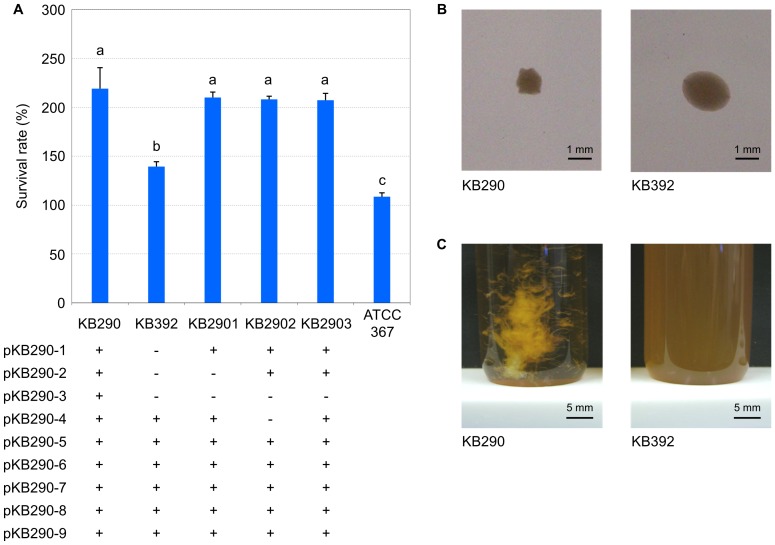
We determined the complete genome sequence of Lactobacillus brevis KB290, a probiotic lactic acid bacterium isolated from a traditional Japanese fermented vegetable. The genome contained a 2,395,134-bp chromosome that housed 2,391 protein-coding genes and nine plasmids that together accounted for 191 protein-coding genes. KB290 contained no virulence factor genes, and several genes related to presumptive cell wall-associated polysaccharide biosynthesis and the stress response were present in L. brevis KB290 but not in the closely related L. brevis ATCC 367. Plasmid-curing experiments revealed that the presence of plasmid pKB290-1 was essential for the strain's gastrointestinal tract tolerance and tendency to aggregate. Using next-generation deep sequencing of current and 18-year-old stock strains to detect low frequency variants, we evaluated genome stability. Deep sequencing of four periodic KB290 culture stocks with more than 1,000-fold coverage revealed 3 mutation sites and 37 minority variation sites, indicating long-term stability and providing a useful method for assessing the stability of industrial bacteria at the nucleotide level.
我们确定了从一种传统的日本发酵蔬菜中分离出的益生菌短乳杆菌 KB290 的全基因组序列。基因组包含一个 2,395,134-bp 的染色体,其中包含 2,391 个蛋白质编码基因和九个质粒,这些质粒共编码 191 个蛋白质编码基因。KB290 不含毒力因子基因,而与假定的细胞壁相关多糖生物合成和应激反应相关的几个基因存在于 KB290 中,但不存在于密切相关的 L. brevis ATCC 367 中。质粒消除实验表明,质粒 pKB290-1 的存在对于菌株的胃肠道耐受性和聚集倾向是必需的。使用新一代深度测序技术对当前和 18 年前的库存菌株进行检测,以发现低频变异,从而评估基因组的稳定性。对四个经过周期性培养的 KB290 菌株进行深度测序,覆盖度超过 1000 倍,共发现 3 个突变位点和 37 个少数变异位点,表明其长期稳定性,并提供了一种有用的方法,可在核苷酸水平上评估工业细菌的稳定性。