Department of Surgery, Division of Ophthalmology, Kobe University Graduate School of Medicine, Kobe 650-0017, Japan.
BMC Ophthalmol. 2013 Apr 4;13:10. doi: 10.1186/1471-2415-13-10.
The effects of intravitreal ranibizumab (IVR) against exudative age-related macular degeneration (AMD) may be different associated with the lesion phenotype. This study was conducted to compare the outcomes of IVR between two different phenotypes of exudative AMD: typical neovascular AMD (tAMD) and polypoidal choroidal vasculopathy (PCV).
This is a retrospective cohort study of 54 eyes from 54 subfoveal exudative AMD patients (tAMD 24, PCV 30 eyes). Three consecutive IVR treatments (0.5 mg) were performed every month, followed by re-injections as needed. Change in the best-corrected visual acuity (BCVA) and central retinal thickness (CRT) were then compared between the tAMD and PCV groups over 12 months of follow-up.
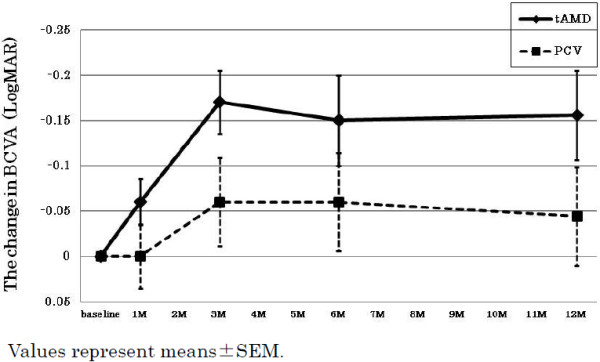
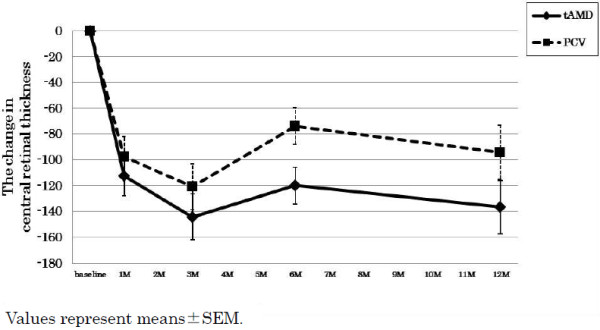
The mean BCVA was significantly improved (-0.11 logMAR units) at month 3 after the initial IVR (p <0 .001, Wilcoxon signed-rank test), and was sustained up to 12 months in all AMD patients (p =0.02). In the subgroup analysis, the tAMD group showed a significant improvement in their mean BCVA (-0.06, -0.17, -0.15 and -0.16 logMAR units at 1, 3, 6 and 12 months, respectively), but there was only a slight but non-significant improvement in the PCV group. The improvement in the BCVA was significantly greater in the tAMD group than in the PCV group (p = 0.043, repeated measures ANOVA) over 12 months. Both phenotypes showed significant improvements in the CRT during 12 months after the initial IVR.
IVR is an effective therapy for tAMD and PCV in the BCVA improvement in Japanese patients over 12 months of follow-up. The phenotype of tAMD showed a significantly better outcome with IVR than PCV in terms of BCVA improvement.
玻璃体内注射雷珠单抗(IVR)对渗出性年龄相关性黄斑变性(AMD)的疗效可能与病变表型有关。本研究旨在比较两种不同渗出性 AMD 表型(典型新生血管性 AMD(tAMD)和息肉样脉络膜血管病变(PCV))接受 IVR 治疗的结果。
这是一项回顾性队列研究,纳入了 54 例(24 只眼为 tAMD,30 只眼为 PCV)接受治疗的中心凹下渗出性 AMD 患者。所有患者均接受每月连续 3 次(每次 0.5mg)的 IVR 治疗,然后根据需要进行再注射。在 12 个月的随访中,比较 tAMD 组和 PCV 组的最佳矫正视力(BCVA)和中心视网膜厚度(CRT)变化。
初次 IVR 后 3 个月,平均 BCVA 显著提高(-0.11 logMAR 单位,p <0.001,Wilcoxon 符号秩检验),并且在所有 AMD 患者中持续至 12 个月(p = 0.02)。在亚组分析中,tAMD 组的平均 BCVA 显著提高(分别为 1、3、6 和 12 个月时为-0.06、-0.17、-0.15 和-0.16 logMAR 单位),而 PCV 组仅略有改善,但无统计学意义。12 个月时,tAMD 组的 BCVA 改善明显大于 PCV 组(p = 0.043,重复测量方差分析)。两种表型在初次 IVR 后 12 个月 CRT 均显著改善。
IVR 是日本患者治疗 tAMD 和 PCV 的有效方法,可在 12 个月的随访中提高 BCVA。在 BCVA 改善方面,tAMD 表型的疗效明显优于 PCV。