Department of Pharmaceutics, Virginia Commonwealth University, 410 N 12th Street, Richmond, VA 23298, USA.
Evid Based Complement Alternat Med. 2013;2013:612527. doi: 10.1155/2013/612527. Epub 2013 Mar 21.
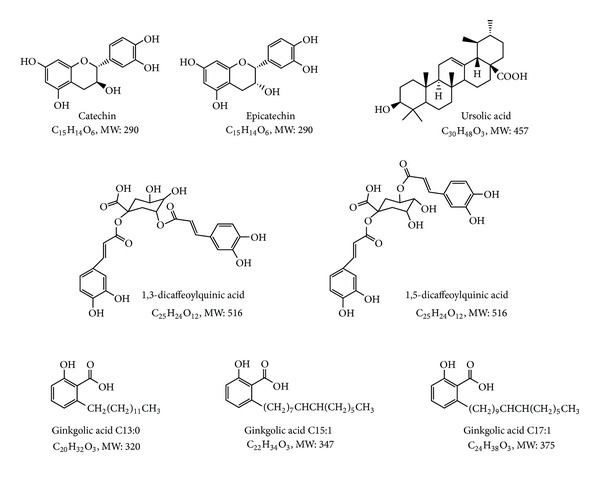
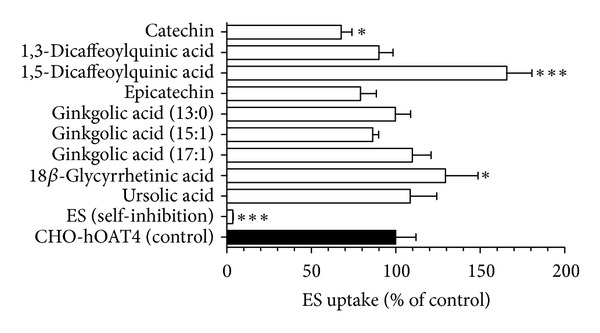
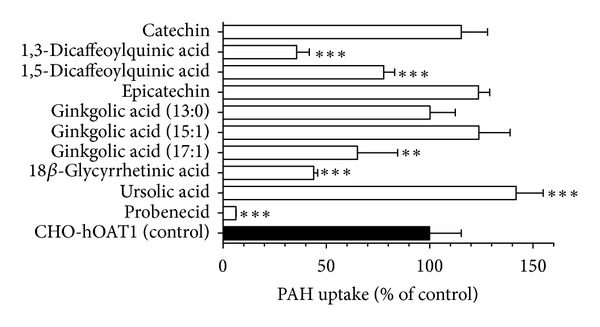
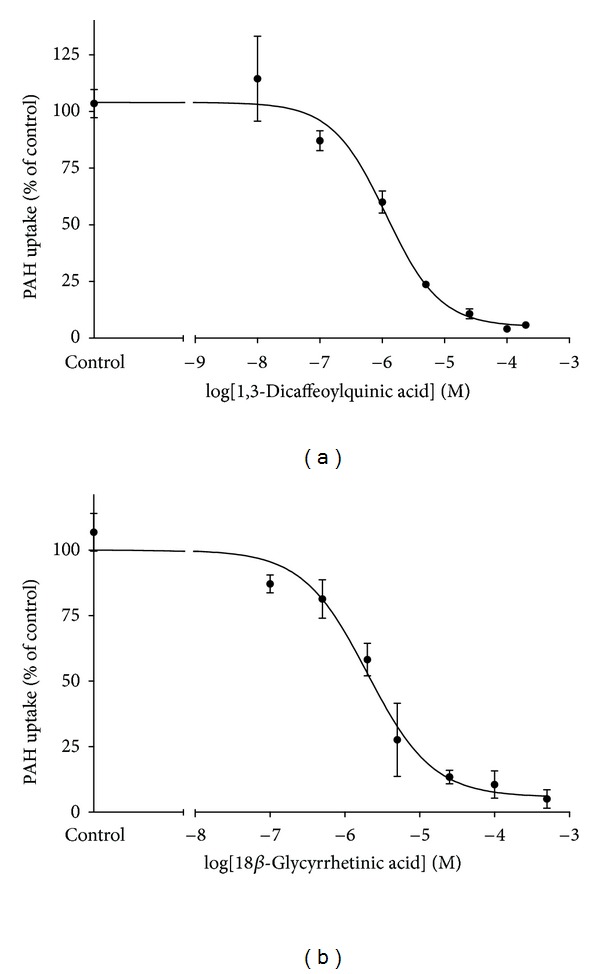
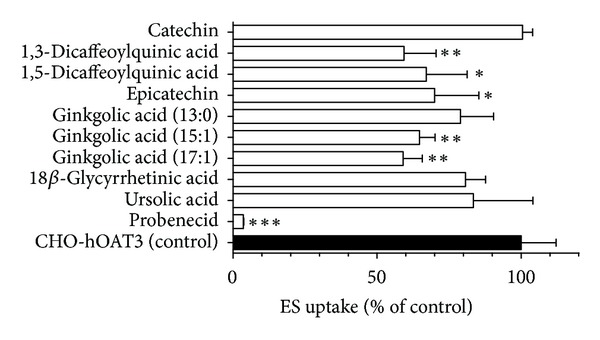
Active components of complementary/alternative medicines and natural supplements are often anionic compounds and flavonoids. As such, organic anion transporters (OATs) may play a key role in their pharmacokinetic and pharmacological profiles, and represent sites for adverse drug-drug interactions. Therefore, we assessed the inhibitory effects of nine natural products, including flavonoids (catechin and epicatechin), chlorogenic acids (1,3- and 1,5-dicaffeoylquinic acid), phenolic acids (ginkgolic acids (13 : 0), (15 : 1), and (17 : 1)), and the organic acids ursolic acid and 18 β -glycyrrhetinic acid, on the transport activity of the human OATs, hOAT1 (SLC22A6), hOAT3 (SLC22A8), and hOAT4 (SLC22A11). Four compounds, 1,3- and 1,5-dicaffeoylquinic acid, ginkgolic acid (17 : 1), and 18 β -glycyrrhetinic acid, significantly inhibited hOAT1-mediated transport (50 μ M inhibitor versus 1 μ M substrate). Five compounds, 1,3- and 1,5-dicaffeoylquinic acid, ginkgolic acids (15 : 1) and (17 : 1), and epicatechin, significantly inhibited hOAT3 transport under similar conditions. Only catechin inhibited hOAT4. Dose-dependency studies were conducted for 1,3-dicaffeoylquinic acid and 18 β -glycyrrhetinic acid on hOAT1, and IC50 values were estimated as 1.2 ± 0.4 μ M and 2.7 ± 0.2 μ M, respectively. These data suggest that 1,3-dicaffeoylquinic acid and 18 β -glycyrrhetinic acid may cause significant hOAT1-mediated DDIs in vivo; potential should be considered for safety issues during use and in future drug development.
互补/替代医学和天然补充剂的活性成分通常是阴离子化合物和类黄酮。因此,有机阴离子转运体 (OAT) 可能在其药代动力学和药理学特征中发挥关键作用,并代表药物相互作用的部位。因此,我们评估了九种天然产物对人类 OAT 的抑制作用,包括类黄酮(儿茶素和表儿茶素)、绿原酸(1,3-和 1,5-二咖啡酰奎宁酸)、酚酸(银杏酸 (13:0)、(15:1) 和 (17:1)),以及有机酸熊果酸和 18β-甘草次酸。四种化合物,1,3-和 1,5-二咖啡酰奎宁酸、银杏酸 (17:1) 和 18β-甘草次酸,显著抑制 hOAT1 介导的转运(50μM 抑制剂与 1μM 底物)。五种化合物,1,3-和 1,5-二咖啡酰奎宁酸、银杏酸 (15:1) 和 (17:1) 以及表儿茶素,在类似条件下显著抑制 hOAT3 转运。只有儿茶素抑制 hOAT4。对 hOAT1 进行了 1,3-二咖啡酰奎宁酸和 18β-甘草次酸的剂量依赖性研究,并估计 IC50 值分别为 1.2±0.4μM 和 2.7±0.2μM。这些数据表明,1,3-二咖啡酰奎宁酸和 18β-甘草次酸可能在体内引起显著的 hOAT1 介导的药物相互作用;在使用过程中和未来的药物开发中应考虑安全性问题。