Gao Yin, Aryal Rajindra P, Ju Tongzhong, Cummings Richard D, Gahlay Gagandeep, Jarvis Donald L, Matta Khushi L, Vlahakis Jason Z, Szarek Walter A, Brockhausen Inka
Department of Biomedical and Molecular Sciences, Queen's University, Kingston, Ontario, Canada.
Biochim Biophys Acta. 2013 Aug;1830(8):4274-81. doi: 10.1016/j.bbagen.2013.04.001. Epub 2013 Apr 8.
Modifications of proteins by O-glycosylation determine many of the properties and functions of proteins. We wish to understand the mechanisms of O-glycosylation and develop inhibitors that could affect glycoprotein functions and alter cellular behavior.
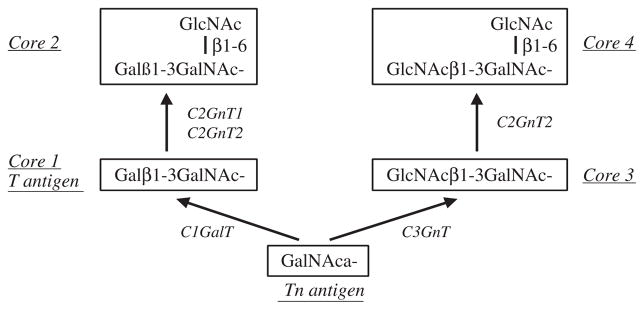
We expressed recombinant soluble human Gal- and GlcNAc-transferases that synthesize the O-glycan cores 1 to 4 and are critical for the overall structures of O-glycans. We determined the properties and substrate specificities of these enzymes using synthetic acceptor substrate analogs. Compounds that were inactive as substrates were tested as inhibitors.
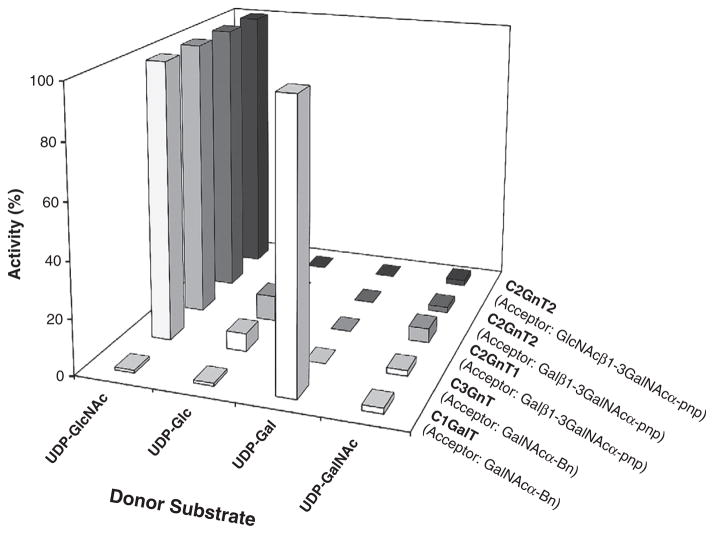
Enzymes significantly differed in their recognition of the sugar moieties and aglycone groups of substrates. Core 1 synthase was active with glycopeptide substrates but GlcNAc-transferases preferred substrates with hydrophobic aglycone groups. Chemical modifications of the acceptors shed light on enzyme-substrate interactions. Core 1 synthase was weakly inhibited by its substrate analog benzyl 2-butanamido-2-deoxy-α-d-galactoside while two of the three GlcNAc-transferases were selectively and potently inhibited by bis-imidazolium salts which are not substrate analogs.
This work delineates the distinct specificities and properties of the enzymes that synthesize the common O-glycan core structures 1 to 4. New inhibitors were found that could selectively inhibit the synthesis of cores 1, 2 and 3 but not core 4.
These studies help our understanding of the mechanisms of action of enzymes critical for O-glycosylation. The results may be useful for the re-engineering of O-glycosylation to determine the roles of O-glycans and the enzymes critical for O-glycosylation, and for biotechnology with potential therapeutic applications.
蛋白质的O-糖基化修饰决定了蛋白质的许多特性和功能。我们希望了解O-糖基化的机制,并开发能够影响糖蛋白功能和改变细胞行为的抑制剂。
我们表达了重组可溶性人半乳糖基转移酶和N-乙酰葡糖胺基转移酶,它们合成O-聚糖核心1至4,对O-聚糖的整体结构至关重要。我们使用合成受体底物类似物确定了这些酶的特性和底物特异性。将无底物活性的化合物作为抑制剂进行测试。
这些酶在对底物的糖部分和糖苷配基的识别上存在显著差异。核心1合酶对糖肽底物有活性,但N-乙酰葡糖胺基转移酶更喜欢具有疏水糖苷配基的底物。受体的化学修饰揭示了酶-底物相互作用。核心1合酶被其底物类似物苄基2-丁酰胺基-2-脱氧-α-D-半乳糖苷弱抑制,而三种N-乙酰葡糖胺基转移酶中的两种被非底物类似物双咪唑盐选择性地强效抑制。
这项工作描述了合成常见O-聚糖核心结构1至4的酶的不同特异性和特性。发现了新的抑制剂,它们可以选择性地抑制核心1、2和3的合成,但不能抑制核心4的合成。
这些研究有助于我们理解对O-糖基化至关重要的酶的作用机制。这些结果可能有助于O-糖基化的重新设计,以确定O-聚糖和对O-糖基化至关重要的酶的作用,以及用于具有潜在治疗应用的生物技术。