Department of Neurological Surgery, University of California San Francisco, San Francisco, CA 94143-0112, USA.
Prog Neurobiol. 2013 Jul-Aug;106-107:1-16. doi: 10.1016/j.pneurobio.2013.04.001. Epub 2013 Apr 11.
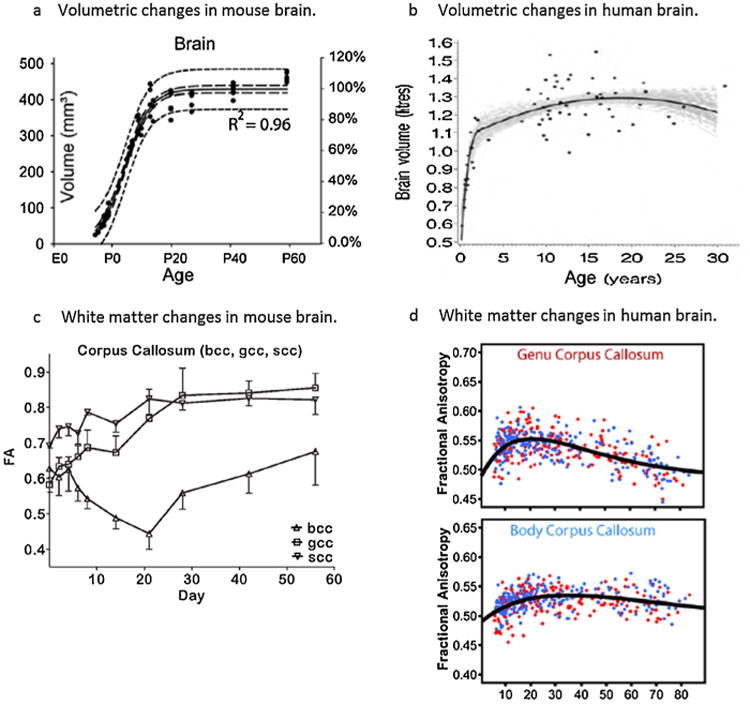
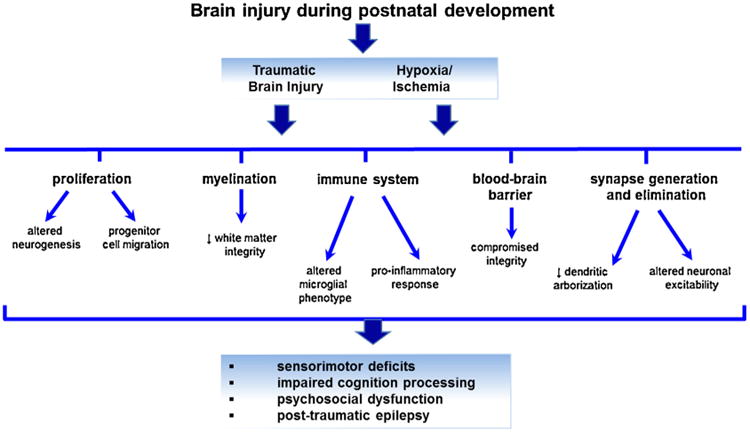
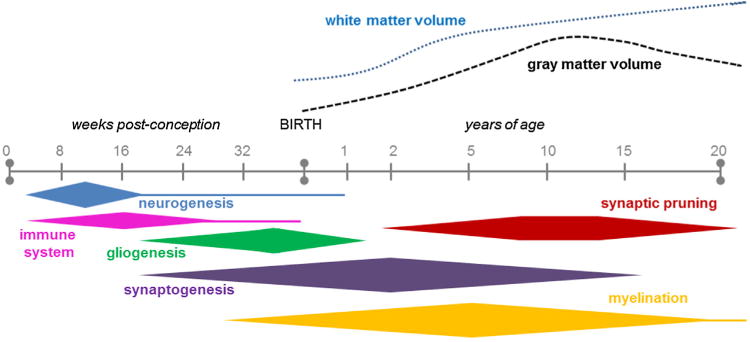
Hypoxic-ischemic and traumatic brain injuries are leading causes of long-term mortality and disability in infants and children. Although several preclinical models using rodents of different ages have been developed, species differences in the timing of key brain maturation events can render comparisons of vulnerability and regenerative capacities difficult to interpret. Traditional models of developmental brain injury have utilized rodents at postnatal day 7-10 as being roughly equivalent to a term human infant, based historically on the measurement of post-mortem brain weights during the 1970s. Here we will examine fundamental brain development processes that occur in both rodents and humans, to delineate a comparable time course of postnatal brain development across species. We consider the timing of neurogenesis, synaptogenesis, gliogenesis, oligodendrocyte maturation and age-dependent behaviors that coincide with developmentally regulated molecular and biochemical changes. In general, while the time scale is considerably different, the sequence of key events in brain maturation is largely consistent between humans and rodents. Further, there are distinct parallels in regional vulnerability as well as functional consequences in response to brain injuries. With a focus on developmental hypoxic-ischemic encephalopathy and traumatic brain injury, this review offers guidelines for researchers when considering the most appropriate rodent age for the developmental stage or process of interest to approximate human brain development.
缺氧缺血性脑损伤和创伤性脑损伤是导致婴儿和儿童长期死亡和残疾的主要原因。尽管已经开发出了几种使用不同年龄啮齿动物的临床前模型,但由于关键脑成熟事件的时间在物种间存在差异,因此比较易感性和再生能力的难度较大。传统的发育性脑损伤模型通常使用出生后 7-10 天的啮齿动物来模拟足月人类婴儿,这一方法基于 20 世纪 70 年代对死后大脑重量的测量。在这里,我们将研究在啮齿动物和人类中都发生的基本脑发育过程,以阐明跨物种的产后大脑发育的可比时间过程。我们考虑了神经发生、突触发生、胶质发生、少突胶质细胞成熟以及与发育相关的分子和生化变化相一致的年龄依赖性行为的时间。总的来说,虽然时间尺度有很大的不同,但大脑成熟的关键事件的顺序在人类和啮齿动物之间基本一致。此外,在区域易感性以及对脑损伤的反应方面也存在明显的相似之处。本文重点关注发育性缺氧缺血性脑病和创伤性脑损伤,为研究人员提供了在考虑最适合研究的啮齿动物年龄时的指导,以便近似人类大脑发育的发育阶段或过程。