
重组人促红细胞生成素对 4 期慢性肾脏病患者阻力小动脉内皮功能的影响。
Effects of recombinant human erythropoietin on resistance artery endothelial function in stage 4 chronic kidney disease.
机构信息
Lady Davis Institute for Medical Research, Sir Mortimer B. Davis-Jewish General Hospital, McGill University, Montreal, Quebec, Canada.
出版信息
J Am Heart Assoc. 2013 Apr 12;2(2):e000128. doi: 10.1161/JAHA.113.000128.
BACKGROUND
Recent studies have raised concern about the safety of erythropoiesis-stimulating agents because of evidence of increased risk of hypertension and cardiovascular morbidity and mortality in chronic kidney disease (CKD) patients. In the present study, we investigated the effects of recombinant human erythropoietin (EPO) on endothelial function of gluteal subcutaneous resistance arteries isolated from 17 stage 4 patients (estimated glomerular filtration rate 21.9±7.4 mL/min per 1.73 m(2)) aged 63±13 years.
METHODS AND RESULTS
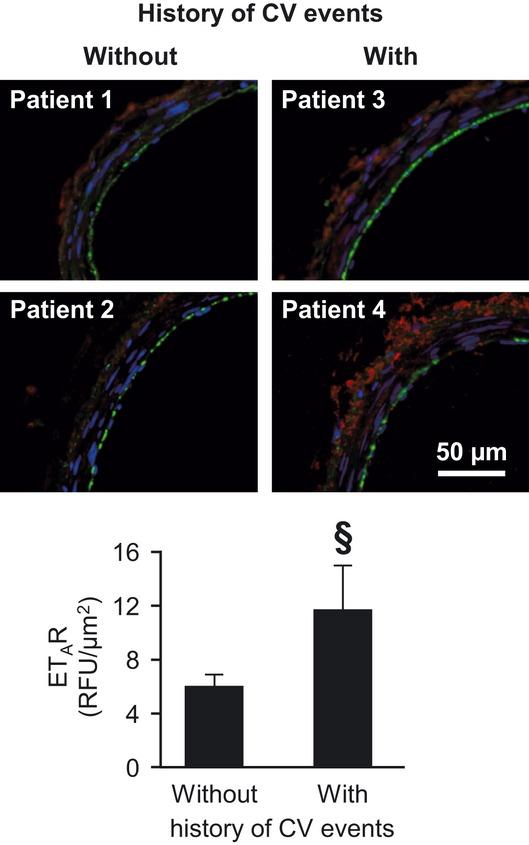
Arteries were mounted on a pressurized myograph. EPO impaired endothelium-dependent relaxation in a concentration-dependent manner. The maximal response to acetylcholine with EPO at 1, 10, and 20 IU/mL was reduced by 12%, 34%, and 43%, respectively, compared with the absence of EPO (P<0.001). EPO-induced endothelial dysfunction was significantly associated with carotid stiffness and history of cardiovascular events. EPO had no effect on norepinephrine-induced vasoconstriction or sodium nitroprusside-induced relaxation. ABT-627, an endothelin type A receptor antagonist, and tempol, a superoxide dismutase mimetic, partially reversed the altered endothelial function in the presence of EPO (P<0.01). Increased expression of endothelin-1 was found in the vessel wall after incubation with EPO.
CONCLUSIONS
EPO alters endothelial function of resistance arteries in CKD patients via a mechanism involving in part oxidative stress and signaling through an endothelin type A receptor. EPO-induced endothelial dysfunction could contribute to deleterious effects of EPO described in large interventional trials.
背景
最近的研究引起了人们对促红细胞生成素刺激剂安全性的关注,因为有证据表明慢性肾脏病(CKD)患者的高血压和心血管发病率和死亡率风险增加。在本研究中,我们研究了重组人促红细胞生成素(EPO)对来自 17 名 4 期患者(估计肾小球滤过率 21.9±7.4 mL/min per 1.73 m(2))的臀皮下阻力动脉内皮功能的影响,这些患者年龄为 63±13 岁。
方法和结果
动脉被安装在压力测功仪上。EPO 以浓度依赖性方式损害内皮依赖性松弛。与不存在 EPO 时相比,用 1、10 和 20 IU/mL 的 EPO 处理时,乙酰胆碱的最大反应分别降低了 12%、34%和 43%(P<0.001)。EPO 诱导的内皮功能障碍与颈动脉僵硬度和心血管事件史显著相关。EPO 对去甲肾上腺素引起的血管收缩或硝普钠引起的松弛没有影响。内皮素 A 型受体拮抗剂 ABT-627 和超氧化物歧化酶模拟物 tempol 在存在 EPO 的情况下部分逆转了改变的内皮功能(P<0.01)。在用 EPO 孵育后,在血管壁中发现了内皮素-1 的表达增加。
结论
EPO 通过部分涉及氧化应激的机制改变 CKD 患者的阻力动脉内皮功能,并通过内皮素 A 型受体信号转导。EPO 诱导的内皮功能障碍可能导致大型干预试验中描述的 EPO 的有害作用。


 Zotero 插件