Department of Pathophysiology, Second Military Medical University, Shanghai 200433, China
Reprod Biol Endocrinol. 2013 Apr 15;11:30. doi: 10.1186/1477-7827-11-30.
Placental production of corticotrophin releasing hormone (CRH) rises exponentially as pregnancy progresses, and has been linked with the onset of normal and preterm labour. CRH is produced in syncytiotrophoblast cells and production is increased by glucocorticoids and cAMP. It remains unclear whether cAMP acts by inducing differentiation of cytotrophoblasts and/or through induction of syncytialisation. As CRH can stimulate cAMP pathways we have tested whether a feed-forward system may exist in placental cells during syncytialisation.
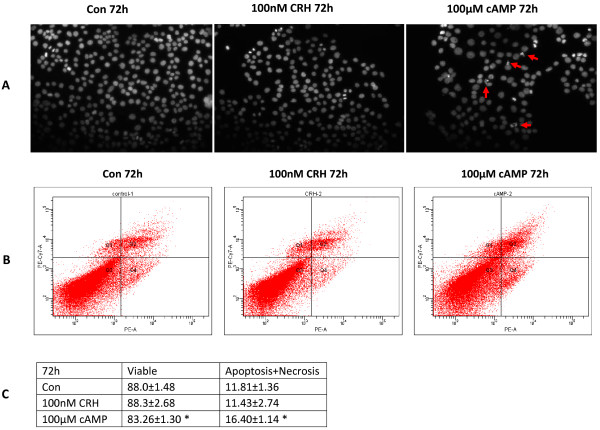
The choriocarcinoma BeWo cell line was treated with cAMP, CRH or vehicle. Cell viability was determined by MTT assay, while apoptosis was analysed by DAPI staining and by FACS. Differentiation was measured by assaying message for hCG and ERVW-1 (syncytin1) by qRT-PCR, as well as the respective protein by ELISA. Fusion of BeWo cells was assessed by co-staining cell membrane and nuclei with CellMask and Hoechst 33342. CRHR1 and CRHR2 mRNA levels were measured by qRT-PCR.
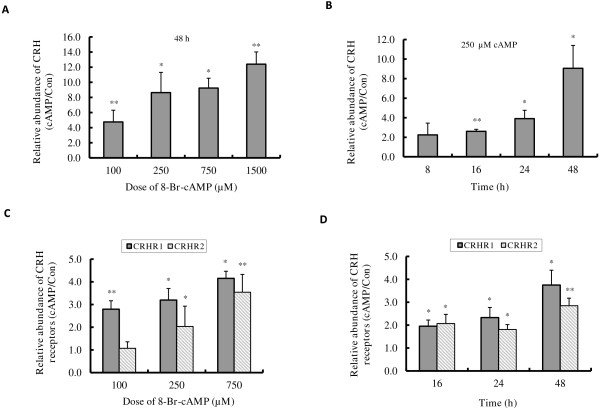
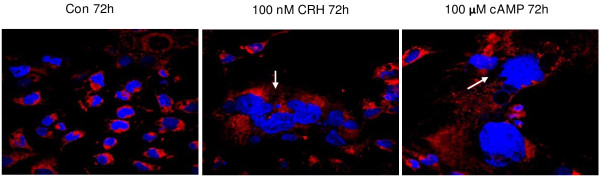
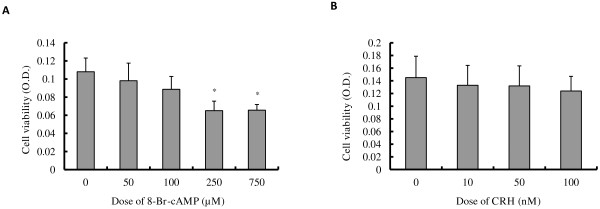
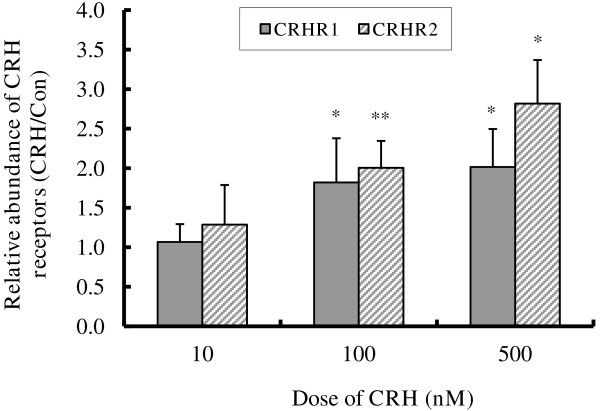
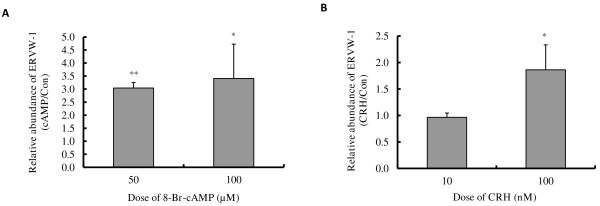
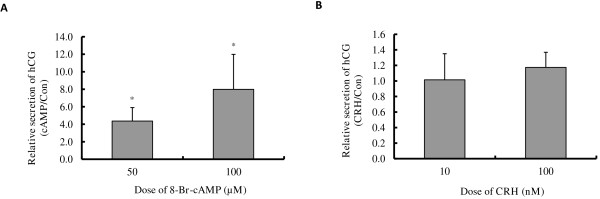
We show that cAMP has an inductive effect on syncytialisation, as evidenced by induction of hCG secretion, by ERVW-1 mRNA expression and by formation of multinuclear cells. CRH mRNA expression was found to increase prior to the changes in the other syncytialisation markers. cAMP had an inhibitory effect on BeWo cell viability, but exogenous CRH did not. However, CRH did mimic the differentiation inducing effect of cAMP, suggesting a link between CRH and cAMP signalling in syncytialisation. We also found that treatment of BeWo cells with exogenous CRH resulted in elevated cellular CRHR1 levels.
This study suggests a positive feed-forward role exists for CRH in trophoblast cell differentiation, which may underlie the exponential rise in CRH observed as gestation advances.
随着妊娠的进展,胎盘产生的促肾上腺皮质激素释放激素(CRH)呈指数级增长,与正常和早产劳动的发生有关。CRH 是在合体滋养细胞中产生的,其产生受糖皮质激素和 cAMP 的增加。目前尚不清楚 cAMP 是否通过诱导滋养细胞的分化和/或通过诱导合胞体化来发挥作用。由于 CRH 可以刺激 cAMP 途径,我们已经测试了在合胞体化过程中胎盘细胞中是否存在正反馈系统。
用 cAMP、CRH 或载体处理绒毛膜癌细胞系 BeWo。通过 MTT 测定法测定细胞活力,通过 DAPI 染色和 FACS 分析测定细胞凋亡。通过 qRT-PCR 测定 hCG 和 ERVW-1(syncytin1)的 mRNA 表达,以及通过 ELISA 测定相应的蛋白质来测量分化。通过用细胞膜和细胞核用 CellMask 和 Hoechst 33342 共同染色来评估 BeWo 细胞的融合。通过 qRT-PCR 测定 CRHR1 和 CRHR2 mRNA 水平。
我们表明,cAMP 对合胞体化具有诱导作用,这表现在 hCG 分泌的诱导、ERVW-1 mRNA 表达的增加以及多核细胞的形成。CRH mRNA 表达在其他合胞体化标志物发生变化之前增加。cAMP 对 BeWo 细胞活力有抑制作用,但外源性 CRH 没有。然而,CRH 确实模拟了 cAMP 的分化诱导作用,这表明 CRH 和 cAMP 信号转导在合胞体化中存在联系。我们还发现,用外源性 CRH 处理 BeWo 细胞会导致细胞内 CRHR1 水平升高。
这项研究表明,CRH 在滋养细胞分化中存在正反馈作用,这可能是妊娠进展时观察到 CRH 呈指数级增长的基础。