
PAM-RG4/apoptin 作为一种潜在的脑肿瘤治疗药物的体内非病毒基因治疗。
Nonviral gene therapy in vivo with PAM-RG4/apoptin as a potential brain tumor therapeutic.
机构信息
Department of Chemistry, Seoul National University, Seoul, Republic of Korea.
出版信息
Int J Nanomedicine. 2013;8:821-34. doi: 10.2147/IJN.S39072. Epub 2013 Feb 25.
BACKGROUND
Glioma is still one of the most complicated forms of brain tumor to remove completely due to its location and the lack of an efficient means to specifically eliminate tumor cells. For these reasons, this study has examined the effectiveness of a nonviral gene therapy approach utilizing a tumor-selective killer gene on a brain tumor xenograft model.
METHODS AND RESULTS
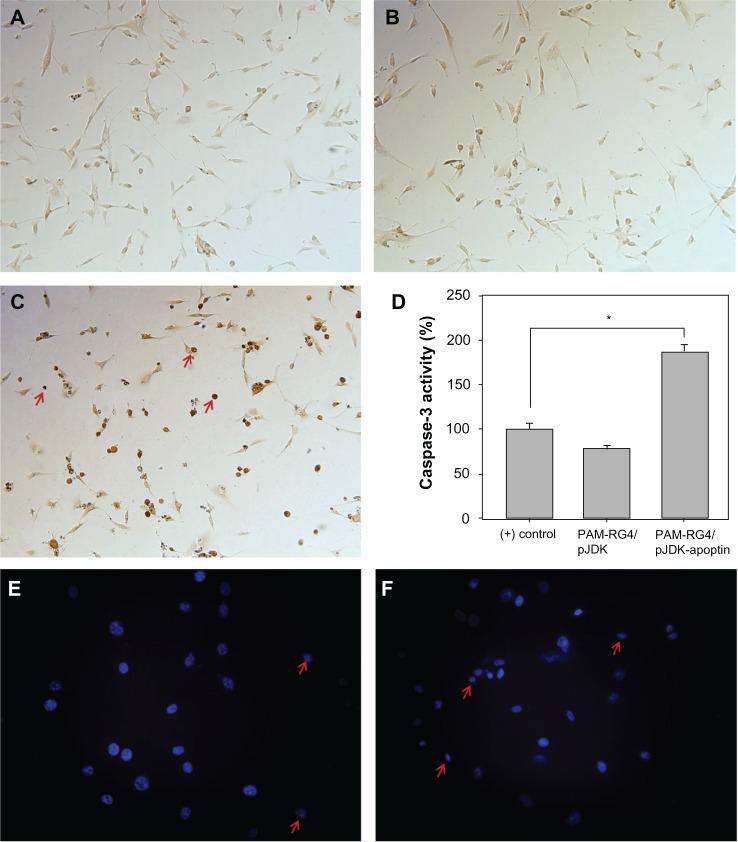
The therapeutic apoptin gene was recombined into the JDK plasmid and delivered into human brain tumor cells (U87MG) by using a polyamidoamine dendrimer with an arginine surface (PAM-RG4). Studies in vitro showed that the PAM-RG4/apoptin plasmid polyplex exhibited a particularly high transfection activity of .40%. Terminal deoxynucleotidyl transferase dUTP nick end labeling (TUNEL) assay, 4',6-Diamidino-2-phenylindole (DAPI) TUNEL assay, DAPI staining, and caspase-3 activity assay verified that the tumor cells had undergone apoptosis induced by apoptin. For in vivo studies, the polyplex was injected into tumors, which were induced by injecting U87MG cells intradermally into nude mice. Based on hematoxylin and eosin staining, epidermal growth factor receptor immunohistochemistry results and tumor volume measurement results, tumor growth was effectively inhibited and no specific edema, irritation, or other harm to the skin was observed after polyplex injection. The in vivo expression of apoptin and the induction of apoptosis were verified by reverse-transcription polymerase chain reaction analysis, TUNEL assay, and DAPI staining.
CONCLUSION
The PAM-RG4/apoptin gene polyplex is a strong candidate for brain tumor therapeutics because of the synergistic effect of the carrier's high transfection efficiency (35%-40%) in glioma cells and the selective apoptosis-inducing activity of apoptin in tumor cells.
背景
由于胶质瘤的位置以及缺乏有效手段特异性地消除肿瘤细胞,因此其仍然是最难完全切除的脑肿瘤之一。出于这些原因,本研究在脑肿瘤异种移植模型中检验了利用肿瘤选择性杀伤基因的非病毒基因治疗方法的有效性。
方法和结果
将治疗性凋亡素基因重组到 JDK 质粒中,并通过具有精氨酸表面的聚酰胺胺树枝状大分子(PAM-RG4)递送到人脑肿瘤细胞(U87MG)中。体外研究表明,PAM-RG4/凋亡素质粒超螺旋体显示出特别高的.40%转染活性。末端脱氧核苷酸转移酶 dUTP 缺口末端标记(TUNEL)测定、4',6-二脒基-2-苯基吲哚(DAPI)TUNEL 测定、DAPI 染色和 caspase-3 活性测定证实肿瘤细胞已发生凋亡素诱导的凋亡。对于体内研究,将超螺旋体注射到通过将 U87MG 细胞皮内注射到裸鼠中诱导的肿瘤中。基于苏木精和伊红染色、表皮生长因子受体免疫组织化学结果和肿瘤体积测量结果,发现肿瘤生长得到有效抑制,并且在超螺旋体注射后未观察到特异性水肿、刺激或对皮肤的其他伤害。通过逆转录聚合酶链反应分析、TUNEL 测定和 DAPI 染色验证了凋亡素的体内表达和诱导的凋亡。
结论
由于载体在神经胶质瘤细胞中具有 35%-40%的高转染效率以及凋亡素在肿瘤细胞中诱导选择性凋亡的协同作用,PAM-RG4/凋亡素基因超螺旋体是脑肿瘤治疗的有力候选物。


 Zotero 插件