Goodman Cancer Centre, McGill University, 1160 Pine avenue West, Montreal, Quebec H3A 1A3, Canada.
BMC Genomics. 2013 Apr 16;14:258. doi: 10.1186/1471-2164-14-258.
Overexpression of the Cut homeobox 1 gene, CUX1, inversely correlates with patient survival in breast cancers. Cell-based assays and molecular studies have revealed that transcriptional regulation by CUX1 involves mostly the proteolytically processed p110 isoform. As there is no antibody specific to p110 CUX1 only, an alternate strategy must be employed to identify its targets.
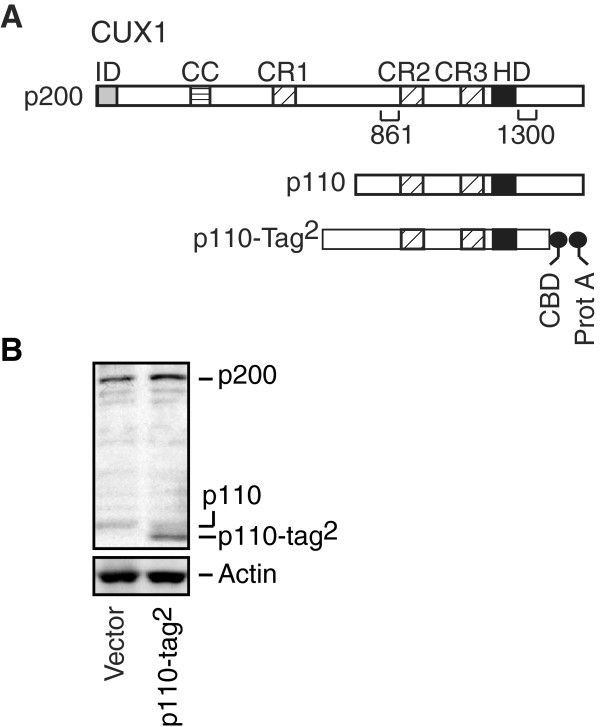
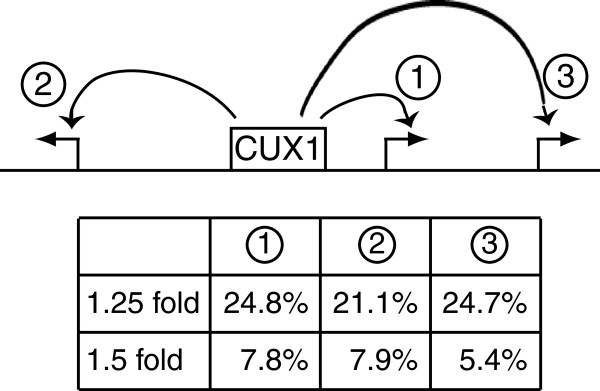
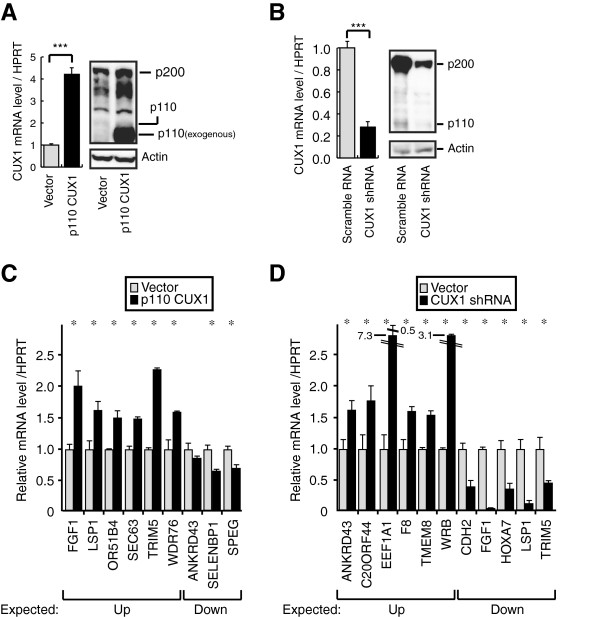
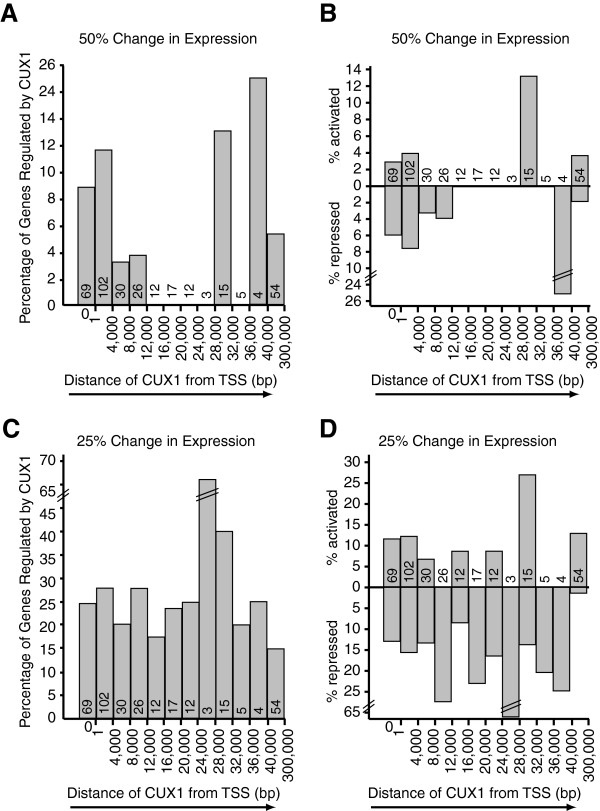
We expressed physiological levels of a tagged-p110 CUX1 protein and performed chromatin affinity purification followed by hybridization on ENCODE and promoter arrays. Targets were validated by chromatin immunoprecipitation and transcriptional regulation by CUX1 was analyzed in expression profiling and RT-qPCR assays following CUX1 knockdown or p110 CUX1 overexpression. Approximately 47% and 14% of CUX1 binding sites were respectively mapped less than 4 Kbp, or more than 40 Kbp, away from a transcription start site. More genes exhibited changes in expression following CUX1 knockdown than p110 CUX1 overexpression. CUX1 directly activated or repressed 7.4% and 8.4% of putative targets identified on the ENCODE and promoter arrays respectively. This proportion increased to 11.2% for targets with 2 binding sites or more. Transcriptional repression was observed in a slightly higher proportion of target genes. The CUX1 consensus binding motif, ATCRAT, was found at 47.2% of the CUX1 binding sites, yet only 8.3% of the CUX1 consensus motifs present on the array were bound in vivo. The presence of a consensus binding motif did not have an impact on whether a target gene was repressed or activated. Interestingly, the distance between a binding site and a transcription start site did not significantly reduced the ability of CUX1 to regulate a target gene. Moreover, CUX1 not only was able to regulate the next adjacent gene, but also regulated the gene located beyond this one as well as the gene located further away in the opposite direction.
Our results demonstrate that p110 CUX1 can activate or repress transcription when bound at a distance and can regulate more than one gene on certain genomic loci.
Cut 同源盒 1 基因(CUX1)的过表达与乳腺癌患者的生存呈负相关。基于细胞的检测和分子研究表明,CUX1 的转录调控主要涉及蛋白水解处理的 p110 同工型。由于没有针对 p110 CUX1 的特异性抗体,因此必须采用替代策略来识别其靶标。
我们表达了标记的 p110 CUX1 蛋白的生理水平,并进行了染色质亲和纯化,然后在 ENCODE 和启动子阵列上进行杂交。通过染色质免疫沉淀验证了靶标,并通过 CUX1 敲低或 p110 CUX1 过表达后的表达谱和 RT-qPCR 分析研究了 CUX1 的转录调控。约 47%和 14%的 CUX1 结合位点分别位于转录起始位点的 4 Kbp 以内或 40 Kbp 以外。与 p110 CUX1 过表达相比,CUX1 敲低后更多的基因表现出表达变化。CUX1 分别直接激活或抑制了 ENCODE 和启动子阵列上鉴定的约 7.4%和 8.4%的假定靶标。对于具有 2 个或更多结合位点的靶标,这一比例增加到 11.2%。在转录抑制方面,观察到靶基因的比例略高。CUX1 共有结合基序 ATCRAT 存在于 47.2%的 CUX1 结合位点中,但仅 8.3%的阵列上的 CUX1 共有基序在体内结合。靶基因是否被抑制或激活与存在共有结合基序无关。有趣的是,结合位点与转录起始位点之间的距离并不能显著降低 CUX1 调节靶基因的能力。此外,CUX1 不仅能够调节下一个相邻的基因,还能够调节位于该基因之外以及位于相反方向更远的基因。
我们的研究结果表明,当 p110 CUX1 结合在一定距离时,可以激活或抑制转录,并可以在某些基因组位点上调节多个基因。