Division of Mycobacterial Research, National Institute for Medical Research, London, United Kingdom.
PLoS One. 2013 Apr 12;8(4):e59883. doi: 10.1371/journal.pone.0059883. Print 2013.
Microarray analysis is a powerful technique for investigating changes in gene expression. Currently, results (r-values) are interpreted empirically as either unchanged or up- or down-regulated. We now present a mathematical framework, which relates r-values to the macromolecular properties of population-average cells. The theory is illustrated by the analysis of published data for two species; namely, Mycobacterium bovis BCG Pasteur and Mycobacterium smegmatis mc(2) 155. Each species was grown in a chemostat at two different growth rates. Application of the theory reveals the growth rate dependent changes in the mycobacterial proteomes.
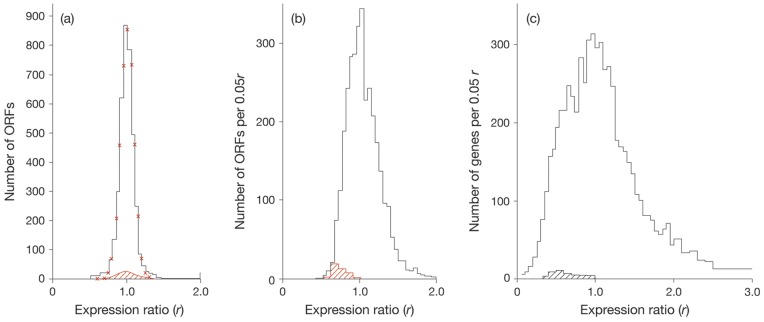
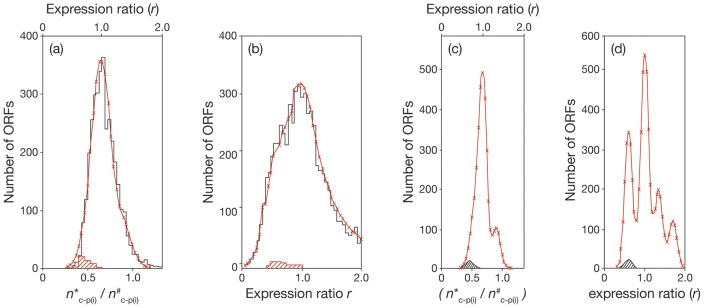
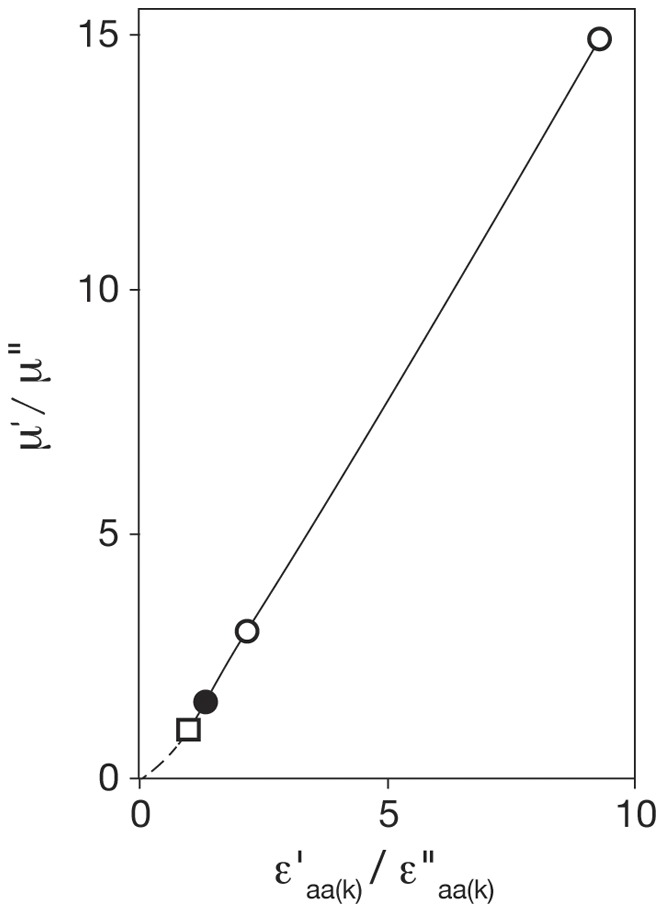
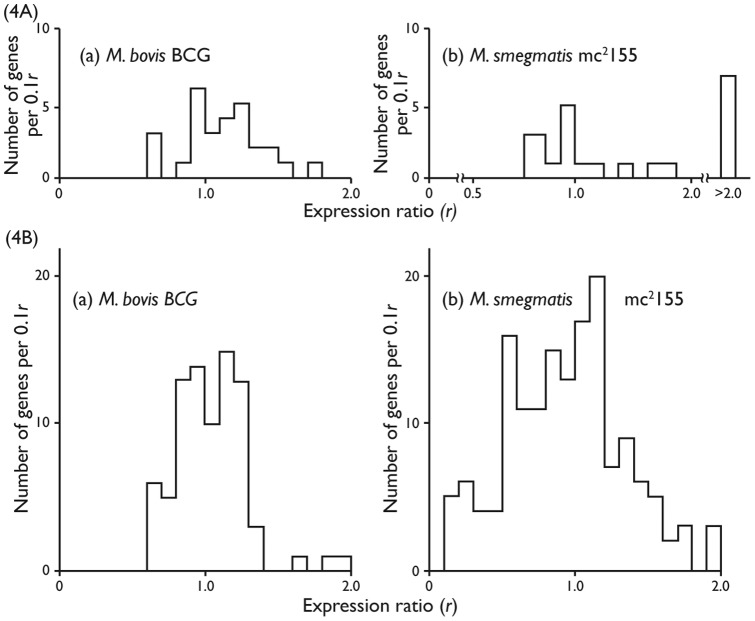
The r-value r (i) of any ORF (ORF(i)) encoding protein p (i) was shown to be equal to the ratio of the concentrations of p (i) and so directly proportional to the ratio of the numbers of copies of p (i) per population-average cells of the two cultures. The proportionality constant can be obtained from the ratios DNA: RNA: protein. Several subgroups of ORFs were identified because they shared a particular r-value. Histograms of the number of ORFs versus the expression ratio were simulated by combining the particular r-values of several subgroups of ORFs. The largest subgroup was ORF(j) (r (j) = 1.00± SD) which was estimated to comprise respectively 59% and 49% of ORFs of M. bovis BCG Pasteur and M. smegmatis mc(2) 155. The standard deviations reflect the properties of the cDNA preparations investigated.
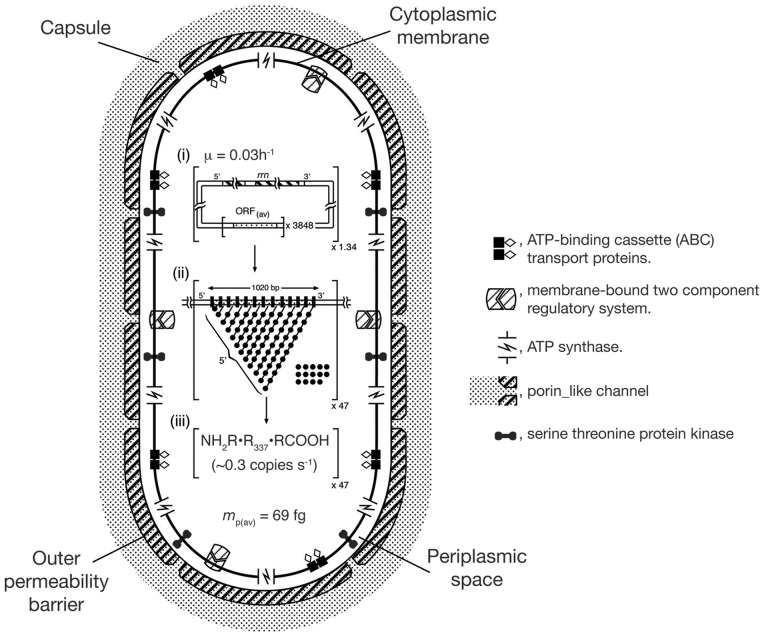
The analysis provided a quantitative view of growth rate dependent changes in the proteomes of the mycobacteria studied. The majority of the ORFs were found to be constitutively expressed. In contrast, the protein compositions of the outer permeability barriers and cytoplasmic membranes were found to be dependent on growth rate; thus illustrating the response of bacteria to their environment. The theoretical approach applies to any cultivatable bacterium under a wide range of growth conditions.
微阵列分析是一种强大的技术,可用于研究基因表达的变化。目前,结果(r 值)经验性地解释为不变或上调或下调。我们现在提出了一个数学框架,将 r 值与群体平均细胞的大分子性质联系起来。该理论通过对两种物种(即牛分枝杆菌卡介苗巴氏和耻垢分枝杆菌 mc(2)155)的已发表数据进行分析进行了说明。每种物种都在恒化器中以两种不同的生长速率生长。该理论的应用揭示了分枝杆菌蛋白质组与生长速率相关的变化。
任何编码蛋白质 p(i)的开放阅读框(ORF(i))的 r 值 r(i)被证明等于 p(i)的浓度比,因此与两个培养物的群体平均细胞中 p(i)的拷贝数的比例直接成正比。比例常数可以从 DNA:RNA:蛋白质的比值中获得。由于它们具有特定的 r 值,因此鉴定了几个 ORF 亚组。通过组合几个 ORF 亚组的特定 r 值来模拟 ORF 与表达比的数量的直方图。最大的亚组是 ORF(j)(r(j)= 1.00±SD),估计分别占牛分枝杆菌卡介苗巴氏和耻垢分枝杆菌 mc(2)155 的 ORF 的 59%和 49%。标准偏差反映了所研究的 cDNA 制剂的性质。
该分析提供了研究的分枝杆菌蛋白质组与生长速率相关变化的定量视图。发现大多数 ORF 是组成型表达的。相比之下,外渗透屏障和细胞质膜的蛋白质组成被发现依赖于生长速率;因此说明了细菌对其环境的反应。该理论方法适用于在广泛的生长条件下培养的任何可培养细菌。