Division of Stem Cell Regulation, Center for Molecular Medicine, Jichi Medical University, Shimotsuke, Tochigi, Japan.
PLoS One. 2013 Apr 11;8(4):e60649. doi: 10.1371/journal.pone.0060649. Print 2013.
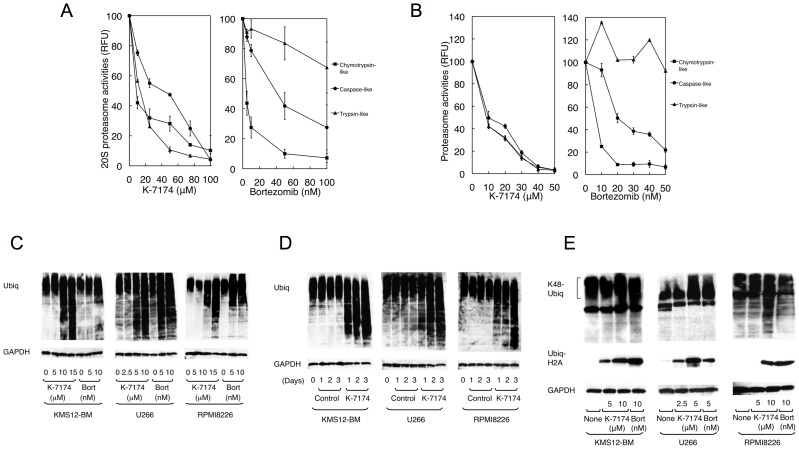
The proteasome is a proteolytic machinery that executes the degradation of polyubiquitinated proteins to maintain cellular homeostasis. Proteasome inhibition is a unique and effective way to kill cancer cells because they are sensitive to proteotoxic stress. Indeed, the proteasome inhibitor bortezomib is now indispensable for the treatment of multiple myeloma and other intractable malignancies, but is associated with patient inconvenience due to intravenous injection and emerging drug resistance. To resolve these problems, we attempted to develop orally bioavailable proteasome inhibitors with distinct mechanisms of action and identified homopiperazine derivatives (HPDs) as promising candidates. Biochemical and crystallographic studies revealed that some HPDs inhibit all three catalytic subunits (ß 1, ß 2 and ß 5) of the proteasome by direct binding, whereas bortezomib and other proteasome inhibitors mainly act on the ß5 subunit. Proteasome-inhibitory HPDs exhibited cytotoxic effects on cell lines from various hematological malignancies including myeloma. Furthermore, K-7174, one of the HPDs, was able to inhibit the growth of bortezomib-resistant myeloma cells carrying a ß5-subunit mutation. Finally, K-7174 had additive effects with bortezomib on proteasome inhibition and apoptosis induction in myeloma cells. Taken together, HPDs could be a new class of proteasome inhibitors, which compensate for the weak points of conventional ones and overcome the resistance to bortezomib.
蛋白酶体是一种蛋白水解机制,可执行多泛素化蛋白的降解,以维持细胞内稳态。蛋白酶体抑制是杀死癌细胞的一种独特而有效的方法,因为它们对蛋白毒性应激敏感。事实上,蛋白酶体抑制剂硼替佐米对于多发性骨髓瘤和其他难治性恶性肿瘤的治疗是不可或缺的,但由于静脉注射和新兴的耐药性,给患者带来了不便。为了解决这些问题,我们试图开发具有不同作用机制的口服生物利用的蛋白酶体抑制剂,并确定了同哌嗪衍生物(HPDs)作为有前途的候选药物。生化和晶体学研究表明,一些 HPDs 通过直接结合抑制蛋白酶体的所有三个催化亚基(β1、β2 和β5),而硼替佐米和其他蛋白酶体抑制剂主要作用于β5 亚基。蛋白酶体抑制性 HPDs 对包括骨髓瘤在内的各种血液恶性肿瘤的细胞系表现出细胞毒性作用。此外,HPD 之一的 K-7174 能够抑制携带β5 亚基突变的硼替佐米耐药骨髓瘤细胞的生长。最后,K-7174 与硼替佐米在骨髓瘤细胞中的蛋白酶体抑制和凋亡诱导方面具有相加作用。总之,HPD 可以成为一类新的蛋白酶体抑制剂,弥补了传统蛋白酶体抑制剂的弱点,并克服了对硼替佐米的耐药性。