Department of Biotechnology, Graduate School of Engineering, Nagoya University, Furo-cho, Chikusa-ku, Nagoya, 464-8603, Japan.
BMC Microbiol. 2013 Apr 17;13:86. doi: 10.1186/1471-2180-13-86.
For the disruption of a target gene in molecular microbiology, unmarked mutagenesis is preferable to marked mutagenesis because the former method raises no concern about the polar effect and leaves no selection marker. In contrast to naturally competent bacteria, there is no useful method for introducing an unmarked mutation into a large gene of non-competent bacteria. Nevertheless, large genes encoding huge proteins exist in diverse bacteria and are interesting and important for physiology and potential applications. Here we present a new method for introducing an unmarked mutation into such large genes of non-competent Gram-negative bacteria.
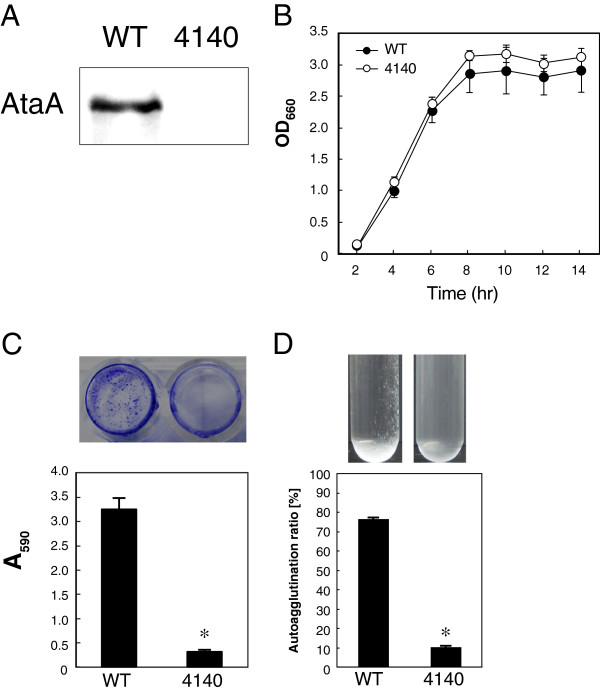
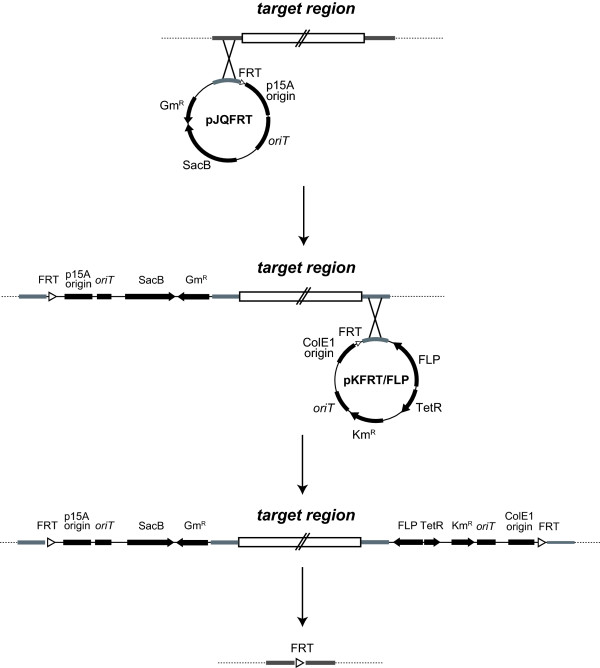
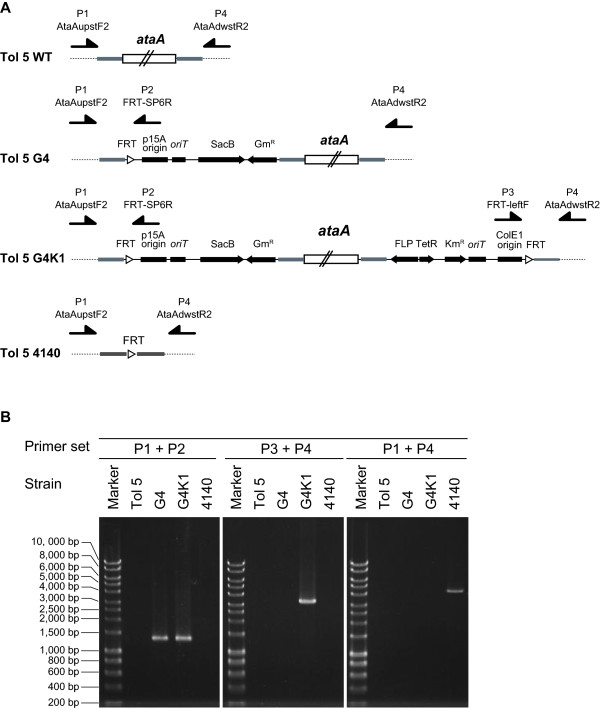
Two gene replacement plasmids, pJQFRT and pKFRT/FLP, were constructed to apply the FLP/FRT recombination system to introduce an unmarked mutation into a large gene of non-competent Gram-negative bacteria. In our methodology, pJQFRT and pKFRT/FLP are integrated into the upstream and the downstream regions of a target gene, respectively, through homologous recombination. The resultant mutant has antibiotic resistance markers, the sacB counter-selection marker, flp recombinase under the control of the tetR regulator, and identical FRT sites sandwiching the target gene and the markers on its chromosome. By inducing the expression of flp recombinase, the target gene is completely deleted together with the other genes derived from the integrated plasmids, resulting in the generation of an unmarked mutation. By this method, we constructed an unmarked mutant of ataA, which encodes the huge trimeric autotransporter adhesin (3,630 aa), in a non-competent Gram-negative bacterium, Acinetobacter sp. Tol 5. The unmarked ataA mutant showed the same growth rate as wild type Tol 5, but lost the adhesive properties of Tol 5, similar to the transposon-inserted mutant of ataA that we generated previously.
The feasibility of our methodology was evidenced by the construction of an unmarked ataA mutant in the Tol 5 strain. Since FLP/FRT recombination can excise a long region of DNA exceeding 100 kb, our method has the potential to selectively disrupt much larger genes or longer regions of gene clusters than ataA. Our methodology allows the straightforward and efficient introduction of an unmarked mutation into a large gene or gene cluster of non-enterobacterial Gram-negative bacteria.
在分子微生物学中,为了破坏靶基因,非标记诱变优于标记诱变,因为前者不会引起极性效应的担忧,也不会留下选择标记。与自然感受态细菌不同,对于非感受态细菌,没有有用的方法将非标记突变引入大基因中。然而,许多不同的细菌中都存在编码巨大蛋白质的大基因,这些基因对于生理学和潜在应用具有重要意义。这里我们提出了一种将非标记突变引入非感受态革兰氏阴性菌的大基因中的新方法。
构建了两个基因替换质粒 pJQFRT 和 pKFRT/FLP,以应用 FLP/FRT 重组系统将非标记突变引入非感受态革兰氏阴性菌的大基因中。在我们的方法中,pJQFRT 和 pKFRT/FLP 分别通过同源重组整合到靶基因的上下游区域。所得突变体具有抗生素抗性标记物、 sacB 反向选择标记物、受 tetR 调控的 flp 重组酶,以及位于染色体上靶基因和标记物之间的相同 FRT 位点。通过诱导 flp 重组酶的表达,靶基因及其来源于整合质粒的其他基因完全缺失,从而产生非标记突变。通过这种方法,我们在非感受态革兰氏阴性菌不动杆菌 Tol 5 中构建了一个编码巨大三聚体自转运黏附素(3630 个氨基酸)的非标记 ataA 突变体。非标记 ataA 突变体的生长速度与野生型 Tol 5 相同,但失去了 Tol 5 的黏附特性,与我们之前生成的 ataA 转座子插入突变体相似。
通过在 Tol 5 菌株中构建非标记 ataA 突变体,证明了我们方法的可行性。由于 FLP/FRT 重组可以切除超过 100kb 的长 DNA 区域,因此我们的方法有可能比 ataA 更有效地选择性地破坏更大的基因或基因簇。我们的方法允许直接且高效地将非标记突变引入非肠杆菌革兰氏阴性菌的大基因或基因簇中。