Recchia Francesco, Candeloro Giampiero, Necozione Stefano, Desideri Giovambattista, Cesta Alisia, Recchia Laura, Rea Silvio
Department of Oncology, Civilian Hospital, Avezzano; ; Carlo Ferri Foundation, Monterotondo, Rome;
Oncol Lett. 2013 Apr;5(4):1117-1122. doi: 10.3892/ol.2013.1142. Epub 2013 Jan 18.
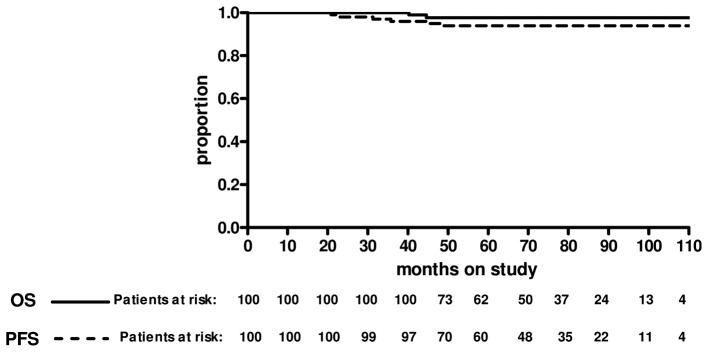
Estradiol (E2) plays a key role in human reproduction through the induction of vascular endothelial growth factor (VEGF) and T-regulatory cells (T-Regs), which are also important in breast cancer (BC) growth. The primary endpoint of the present study was the investigation of whether E2 suppression, chemotherapy and radiation therapy decreased the levels of VEGF and T-Regs of premenopausal patients with high-risk early BC. The secondary endpoints were toxicity, progression-free survival (PFS) and overall survival (OS). Between April 2003 and July 2008, 100 premenopausal women with early, high-risk BC were entered into the study. The characteristics of the patients were as follows: median age, 43 years (range, 26-45); median number of positive axillary nodes, 3.3; median Ki-67, 33%. Plasma E2, VEGF and T-Reg were measured at baseline and every year. Treatment comprised luteneizing hormone-releasing hormone (LH-RH) analogue, tailored chemotherapy, radiation therapy and hormonal therapy in oestrogen receptor-positive (ER) tumours. At 4 years, a statistically significant decrease in E2, VEGF and T-Reg levels was observed; the PFS and OS rates were 94 and 98%, respectively. Hot flushes and G1 osteopenia occurred following LH-RH analogue administration, while no unexpected toxicity was observed following chemotherapy. E2 deprivation with an LH-RH analogue, tailored chemotherapy, radiation therapy and hormonal therapy in ER tumours decreased plasma VEGF levels and T-Regs numbers in premenopausal high-risk ER and ER- BC patients. In addition, a favorable impact on PFS and OS was observed.
雌二醇(E2)通过诱导血管内皮生长因子(VEGF)和调节性T细胞(T-Regs)在人类生殖中发挥关键作用,而这些因子在乳腺癌(BC)生长中也很重要。本研究的主要终点是调查E2抑制、化疗和放疗是否能降低绝经前高危早期BC患者的VEGF和T-Regs水平。次要终点是毒性、无进展生存期(PFS)和总生存期(OS)。2003年4月至2008年7月,100名绝经前早期高危BC女性纳入本研究。患者特征如下:中位年龄43岁(范围26 - 45岁);腋窝淋巴结阳性中位数为3.3;Ki-67中位数为33%。在基线和每年测量血浆E2、VEGF和T-Reg。治疗包括促黄体生成素释放激素(LH-RH)类似物、个体化化疗、放疗以及雌激素受体阳性(ER)肿瘤的激素治疗。4年后,观察到E2、VEGF和T-Reg水平有统计学显著下降;PFS和OS率分别为94%和98%。LH-RH类似物给药后出现潮热和1级骨质减少,而化疗后未观察到意外毒性。在绝经前高危ER和ER- BC患者中,使用LH-RH类似物剥夺E2、个体化化疗、放疗和激素治疗可降低血浆VEGF水平和T-Regs数量。此外,观察到对PFS和OS有有利影响。