Department of Psychiatry and Psychotherapy, University Regensburg, Universitaetsstrasse 84, Regensburg 93042, Germany.
Health Qual Life Outcomes. 2013 Apr 22;11:65. doi: 10.1186/1477-7525-11-65.
The Regensburg Insomnia Scale (RIS) is a new self-rating scale to assess cognitive, emotional and behavioural aspects of psychophysiological insomnia (PI) with only ten items. A specific purpose of the new scale is the evaluation of the outcome of insomnia- specific cognitive behaviour therapy (CBT-I).
Internal consistency of the RIS has been validated in 218 patients with PI. For determining sensitivity and specificity, this sample has been compared to 94 healthy controls. Sensitivity to change and pre-post cross-validation with the Pittsburgh Sleep Quality Index (PSQI) has been tested in a separate sample of 38 patients with PI undergoing CBT-I.
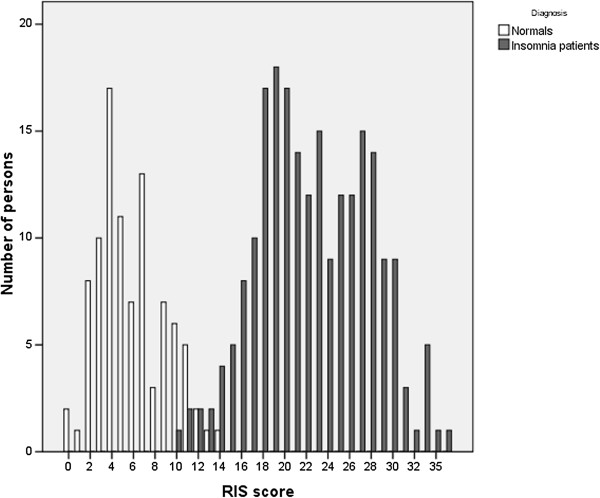
RIS distinguishes well between controls and patients with PI. Internal consistency was within a good range (Cronbach alpha = .890). RIS was sensitive for detecting improvements after CBT-I in sleep parameters and target symptoms such as sleep-related thinking.
The RIS is a valid and feasible instrument for assessing psychological PI-symptoms and sleep parameters.
雷根斯堡失眠量表(RIS)是一种新的自评量表,用于评估心理生理性失眠(PI)的认知、情感和行为方面,仅包含十个项目。该新量表的一个特定目的是评估失眠特异性认知行为疗法(CBT-I)的结果。
在 218 名 PI 患者中验证了 RIS 的内部一致性。为了确定敏感性和特异性,将该样本与 94 名健康对照进行了比较。在接受 CBT-I 的 38 名 PI 患者的另一个样本中,测试了对变化的敏感性以及与匹兹堡睡眠质量指数(PSQI)的前后交叉验证。
RIS 能很好地区分对照组和 PI 患者。内部一致性处于良好范围(Cronbach α=.890)。RIS 对 CBT-I 后睡眠参数和目标症状(如与睡眠相关的思维)的改善具有敏感性。
RIS 是评估心理性 PI 症状和睡眠参数的有效且可行的工具。