CEA, iBiTec-S, Service d'Ingénierie Moléculaire des Protéines, CEA Saclay, Gif sur Yvette F-91191, France.
Microb Cell Fact. 2013 Apr 22;12:37. doi: 10.1186/1475-2859-12-37.
Disulfide-rich proteins or DRPs are versatile bioactive compounds that encompass a wide variety of pharmacological, therapeutic, and/or biotechnological applications. Still, the production of DRPs in sufficient quantities is a major bottleneck for their complete structural or functional characterization. Recombinant expression of such small proteins containing multiple disulfide bonds in the bacteria E. coli is considered difficult and general methods and protocols, particularly on a high throughput scale, are limited.
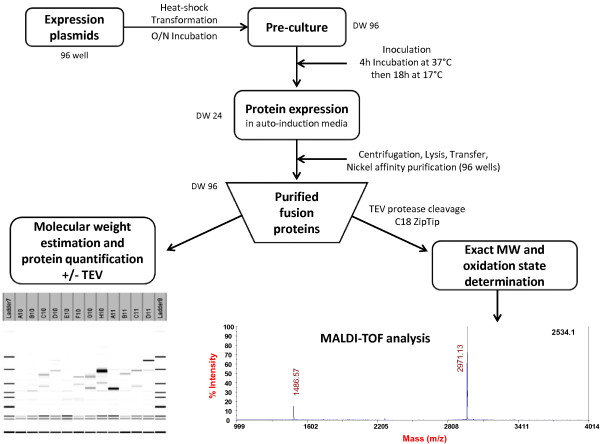
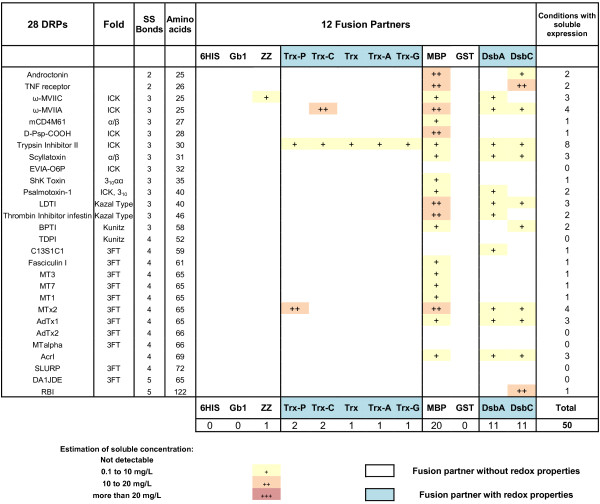
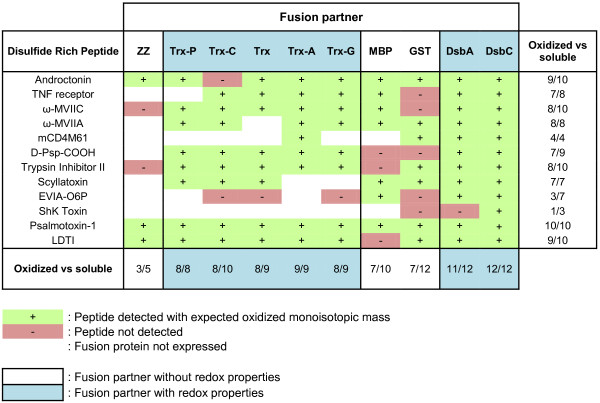
Here we report a high throughput screening approach that allowed the systematic investigation of the solubilizing and folding influence of twelve cytoplasmic partners on 28 DRPs in the strains BL21 (DE3) pLysS, Origami B (DE3) pLysS and SHuffle® T7 Express lysY (1008 conditions). The screening identified the conditions leading to the successful soluble expression of the 28 DRPs selected for the study. Amongst 336 conditions tested per bacterial strain, soluble expression was detected in 196 conditions using the strain BL21 (DE3) pLysS, whereas only 44 and 50 conditions for soluble expression were identified for the strains Origami B (DE3) pLysS and SHuffle® T7 Express lysY respectively. To assess the redox states of the DRPs, the solubility screen was coupled with mass spectrometry (MS) to determine the exact masses of the produced DRPs or fusion proteins. To validate the results obtained at analytical scale, several examples of proteins expressed and purified to a larger scale are presented along with their MS and functional characterization.
Our results show that the production of soluble and functional DRPs with cytoplasmic partners is possible in E. coli. In spite of its reducing cytoplasm, BL21 (DE3) pLysS is more efficient than the Origami B (DE3) pLysS and SHuffle® T7 Express lysY trxB(-)/gor(-) strains for the production of DRPs in fusion with solubilizing partners. However, our data suggest that oxidation of the proteins occurs ex vivo. Our protocols allow the production of a large diversity of DRPs using DsbC as a fusion partner, leading to pure active DRPs at milligram scale in many cases. These results open up new possibilities for the study and development of DRPs with therapeutic or biotechnological interest whose production was previously a limitation.
富含二硫键的蛋白质或 DRPs 是多功能的生物活性化合物,具有广泛的药理学、治疗学和/或生物技术应用。然而,大量生产 DRPs 是对其进行完整结构或功能表征的主要瓶颈。在细菌大肠杆菌中重组表达含有多个二硫键的此类小蛋白被认为是困难的,一般方法和方案,特别是在高通量规模上,受到限制。
在这里,我们报告了一种高通量筛选方法,该方法允许系统研究 12 种细胞质伴侣对 BL21(DE3)pLysS、Origami B(DE3)pLysS 和 SHuffle®T7 Express lysY 菌株中 28 种 DRPs 的溶解和折叠影响(1008 种条件)。筛选确定了导致研究中选择的 28 种 DRPs 成功可溶性表达的条件。在每个细菌菌株测试了 336 种条件中,使用 BL21(DE3)pLysS 菌株检测到 196 种条件下的可溶性表达,而 Origami B(DE3)pLysS 和 SHuffle®T7 Express lysY 菌株分别仅鉴定出 44 种和 50 种条件下的可溶性表达。为了评估 DRPs 的氧化还原状态,溶解度筛选与质谱(MS)相结合,以确定产生的 DRPs 或融合蛋白的确切质量。为了验证在分析规模上获得的结果,还呈现了几个在更大规模上表达和纯化的蛋白质的示例,以及它们的 MS 和功能表征。
我们的结果表明,在大肠杆菌中使用细胞质伴侣生产可溶性和功能性 DRPs 是可能的。尽管其细胞质具有还原性质,但与 Origami B(DE3)pLysS 和 SHuffle®T7 Express lysY trxB(-)/gor(-)菌株相比,BL21(DE3)pLysS 更有效地生产与可溶性伴侣融合的 DRPs。然而,我们的数据表明,蛋白质的氧化发生在体外。我们的方案允许使用 DsbC 作为融合伴侣生产大量不同的 DRPs,在许多情况下可以在毫克规模上获得纯活性 DRPs。这些结果为研究和开发具有治疗或生物技术兴趣的 DRPs 开辟了新的可能性,这些 DRPs 的生产以前是一个限制。