The Korea Central Cancer Registry, Division of Cancer Registration and Surveillance, National Cancer Center, Goyang, Korea.
Cancer Res Treat. 2013 Mar;45(1):1-14. doi: 10.4143/crt.2013.45.1.1. Epub 2013 Mar 31.
This article gives an overview of nationwide cancer statistics, including incidence, mortality, survival and prevalence, and their trends in Korea based on 2010 cancer incidence data.
Incidence data from 1993 to 2010 were obtained from the Korea National Cancer Incidence Database, and vital status was followed until 31 December 2011. Mortality data from 1983 to 2010 were obtained from Statistics Korea. Crude and age-standardized rates for incidence, mortality, prevalence, and relative survival were calculated.
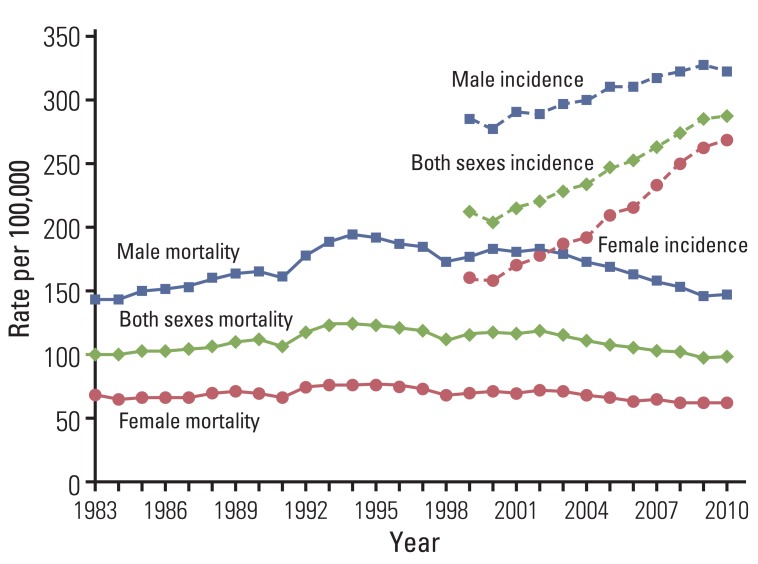
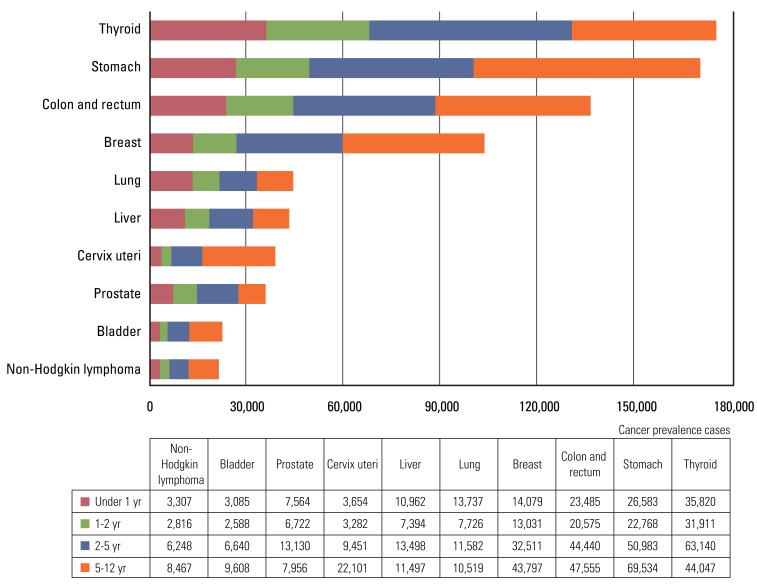
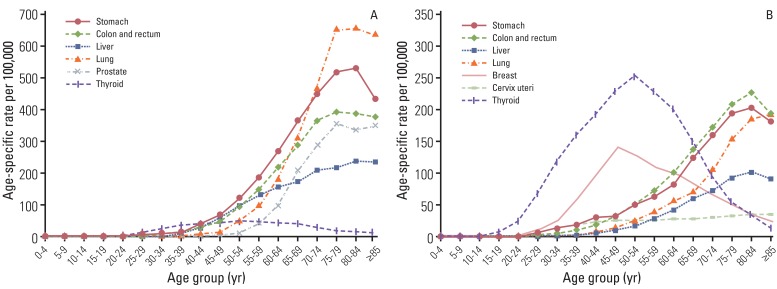
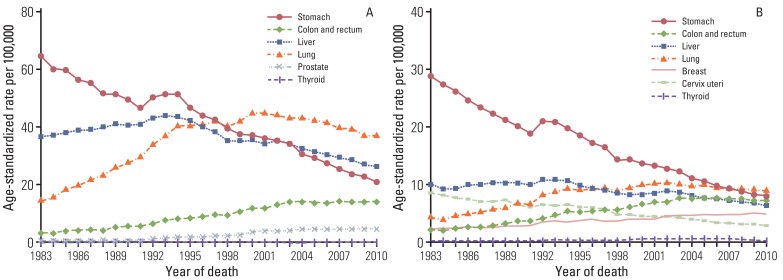
In total, 202,053 cancer cases and 72,046 cancer deaths occurred during 2010, and 960,654 prevalent cancer cases were identified in Korea as of 1 January 2011. The incidence of all cancers combined showed an annual increase of 3.3% from 1999 to 2010. The incidences of liver and cervical cancers have decreased while those of thyroid, breast, prostate and colorectal cancers have increased. Notably, thyroid cancer, which is the most common cancer in Korea, increased by 24.2% per year rapidly in both sexes. The mortality of all cancers combined showed a decrease by 2.7% annually from 2002 to 2010. Five-year relative survival rates of patients who were diagnosed with cancer from 2006 to 2011 had improved by 22.9% compared with those from 1993 to 1995.
While the overall cancer incidence in Korea has increased rapidly, age-standardized cancer mortality rates have declined since 2002 and survival has improved.
本文概述了韩国全国范围内的癌症统计数据,包括发病率、死亡率、生存率和患病率及其趋势,这些数据基于 2010 年的癌症发病率数据。
1993 年至 2010 年的发病率数据来自韩国国家癌症发病率数据库,生存状态一直跟踪到 2011 年 12 月 31 日。1983 年至 2010 年的死亡率数据来自韩国统计局。计算了发病率、死亡率、患病率和相对生存率的粗率和年龄标准化率。
2010 年共发生 202053 例癌症病例和 72046 例癌症死亡病例,截至 2011 年 1 月 1 日,韩国有 960654 例现患癌症病例。1999 年至 2010 年,所有癌症的发病率每年增加 3.3%。肝癌和宫颈癌的发病率有所下降,而甲状腺癌、乳腺癌、前列腺癌和结直肠癌的发病率有所上升。值得注意的是,甲状腺癌是韩国最常见的癌症,在两性中均以每年 24.2%的速度迅速增加。2002 年至 2010 年,所有癌症的死亡率每年下降 2.7%。2006 年至 2011 年诊断出癌症的患者的 5 年相对生存率与 1993 年至 1995 年相比提高了 22.9%。
尽管韩国的总体癌症发病率迅速上升,但自 2002 年以来,年龄标准化的癌症死亡率下降,生存率提高。