Centre de Fauna Salvatge de Torreferrussa, Catalan Wildlife-Service-Forestal Catalana, Santa Perpètua de la Mogoda, Barcelona, Spain.
PLoS One. 2013 Apr 17;8(4):e60242. doi: 10.1371/journal.pone.0060242. Print 2013.
Variability in reporting and classification methods in previous published data of the final dispositions in the rehabilitation of wild raptors makes use of this data limited in trying to audit the quality of the rehabilitation process. Crude as well as stratified disposition rates are needed if quality auditing of the rehabilitation process is to be adequately performed.
Final dispositions of 6221 hospitalized wild raptors admitted at a wildlife rehabilitation centre (WRC) of Catalonia during 1995-2007 were analyzed. These dispositions were calculated as the euthanasia (Er), unassisted mortality (Mr), release (Rr) and captivity rates (Cr)., time to death (Td) for dead and euthanized raptors, and length of stay for released (Tr) raptors was estimated. Stratified analyses by main causes of admission and clinical signs were performed.
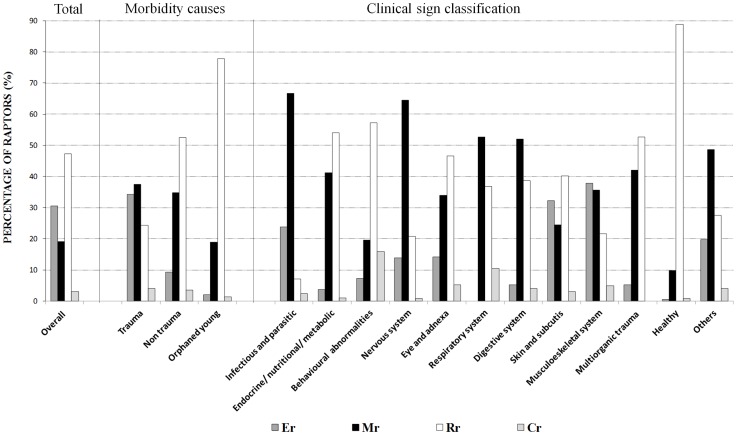
THE DISPOSITION FOR THE TOTAL POPULATION WERE: Er = 30.6%, Mr = 19.1%, Rr = 47.2%, and Cr = 3%. By main causes of admission, Er was higher in the trauma category (34.2%), whereas Mr was found similar between trauma (37.4%) and non-trauma categories (34.8%). The highest Rr was observed for the orphaned group (77.9%). Furthermore, Cr was low in all the categories (<4%). By clinical signs, the highest Er was found in animals suffering musculoskeletal (37.9%) or skin (32.3%) lesions; Mr was high in infectious/parasitic diseases (66.7%) and in case of neurological symptoms (64.5%). The euthanized birds had a median Td = 1 day (P10 = 0-P90 = 59) for both trauma and non-trauma categories, and Td = 36 days for the orphaned young group (P10 = 0; P90 = 596). The median Td in the unassisted dead birds was 2 days for all the categories (P10 = 0-P90 = 31). Finally, the median Tr in the centre was variable among categories.
CONCLUSIONS/SIGNIFICANCE: Reporting of final dispositions in wildlife rehabilitation should include the crude and stratified rates (Er, Mr, Rr, and Cr), by causes and clinical presentation, as well as Td and Tr, to allow meaningful auditing of the rehabilitation process quality.
在之前发表的关于猛禽康复最终处置的文献中,报告和分类方法存在差异,这使得利用这些数据来审核康复过程的质量受到限制。如果要充分审核康复过程的质量,则需要使用原始和分层的处置率。
分析了 1995 年至 2007 年在加泰罗尼亚野生动物康复中心(WRC)住院的 6221 只野生猛禽的最终处置情况。这些处置方式被计算为安乐死(Er)、非辅助性死亡率(Mr)、释放(Rr)和捕获率(Cr)。还计算了死亡和安乐死猛禽的死亡时间(Td),以及释放猛禽的逗留时间(Tr)。对主要入院原因和临床症状进行了分层分析。
总体人群的处置方式为:Er = 30.6%,Mr = 19.1%,Rr = 47.2%,Cr = 3%。按入院主要原因,创伤组的 Er 较高(34.2%),而创伤和非创伤组的 Mr 相似(37.4%和 34.8%)。孤儿组的 Rr 最高(77.9%)。此外,所有类别中的 Cr 都较低(<4%)。按临床症状,患有肌肉骨骼(37.9%)或皮肤(32.3%)损伤的动物的 Er 最高;患有传染病/寄生虫病(66.7%)和神经症状(64.5%)的动物的 Mr 较高。安乐死鸟类的中位数 Td 为 1 天(创伤和非创伤组的 P10 = 0-P90 = 59),孤儿幼鸟组的 Td 为 36 天(P10 = 0;P90 = 596)。所有类别中未辅助死亡鸟类的中位数 Td 为 2 天(P10 = 0-P90 = 31)。最后,中心的中位数 Tr 在各分类之间有所不同。
结论/意义:野生动物康复的最终处置报告应包括原始和分层的处置率(Er、Mr、Rr 和 Cr),按病因和临床表现分类,以及 Td 和 Tr,以便对康复过程的质量进行有意义的审核。