Computer Science Department, University Carlos III of Madrid, Leganés, Madrid 28911, Spain.
Sensors (Basel). 2013 Apr 24;13(5):5460-77. doi: 10.3390/s130505460.
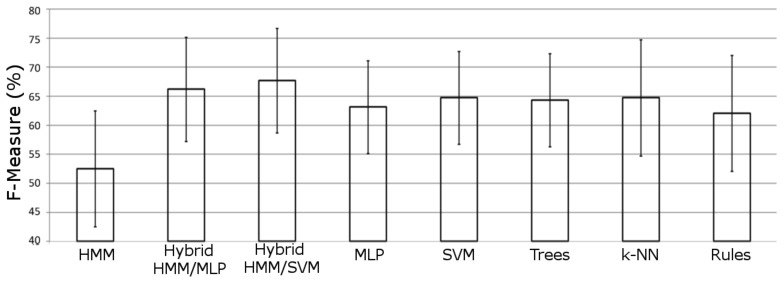
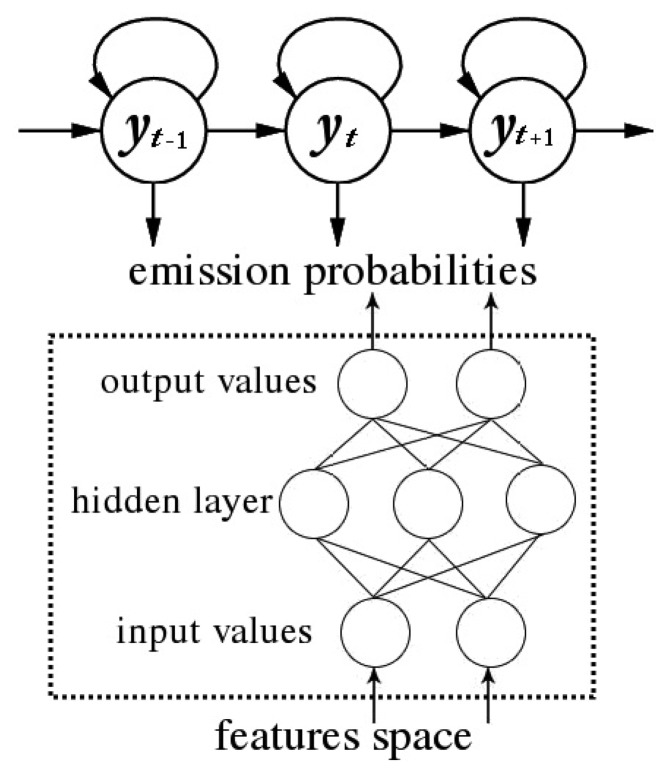
Activities of daily living are good indicators of elderly health status, and activity recognition in smart environments is a well-known problem that has been previously addressed by several studies. In this paper, we describe the use of two powerful machine learning schemes, ANN (Artificial Neural Network) and SVM (Support Vector Machines), within the framework of HMM (Hidden Markov Model) in order to tackle the task of activity recognition in a home setting. The output scores of the discriminative models, after processing, are used as observation probabilities of the hybrid approach. We evaluate our approach by comparing these hybrid models with other classical activity recognition methods using five real datasets. We show how the hybrid models achieve significantly better recognition performance, with significance level p < 0.05, proving that the hybrid approach is better suited for the addressed domain.
日常生活活动是老年人健康状况的良好指标,智能环境中的活动识别是一个众所周知的问题,已经有多项研究对此进行了探讨。在本文中,我们描述了在 HMM(隐马尔可夫模型)框架内使用两种强大的机器学习方案,即 ANN(人工神经网络)和 SVM(支持向量机),以解决家庭环境中的活动识别任务。经过处理后,判别模型的输出得分被用作混合方法的观测概率。我们通过使用五个真实数据集将这些混合模型与其他经典活动识别方法进行比较,评估了我们的方法。我们表明,混合模型如何实现显著更好的识别性能,具有显著水平 p < 0.05,证明混合方法更适合所涉及的领域。