Guangdong Cardiovascular Institute, Southern Medical University, Guangzhou 510080 Guangdong Province, China.
J Transl Med. 2013 Apr 24;11:102. doi: 10.1186/1479-5876-11-102.
Gamma-aminobutyric acid (GABA) is the main inhibitory neurotransmitter in the adult mammalian brain, but exerts physiologic effects other than that on neurotransmitter in non-neuronal peripheral tissues and organs. GABA may affect cancer growth through activation GABA receptors. We investigated the gene expression of GABA receptors in tissue of non-small cell lung cancers (NSCLC) and non-cancerous tissues, and found that the gene expression of GABA receptor phenotypes was correlated with tumorigenesis and clinical prognosis.
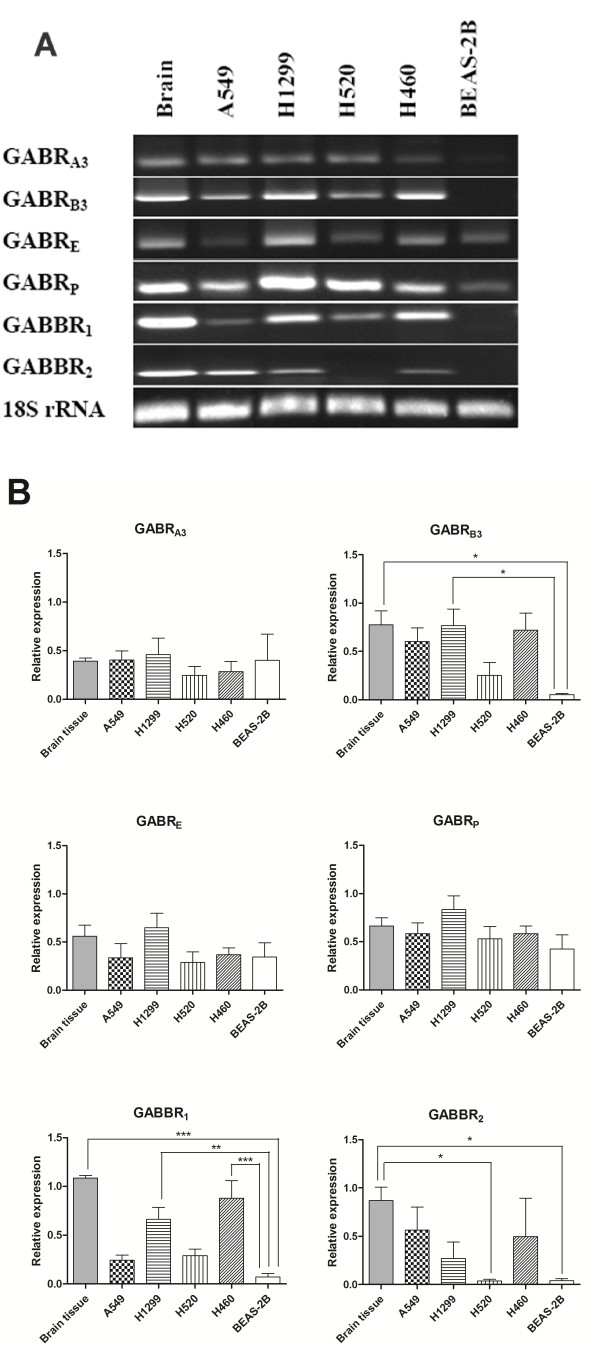
Sixty-one snap-frozen human samples of NSCLC tissues and paired non-cancerous tissues (5cm away from tumor) were analyzed. Gene expression of GABA receptors was detected by Real-time quantitative PCR (RT-qPCR). Survival times in relation to the expression of GABA receptor phenotypes were analyzed. Human NSCLC cell lines H1299, A549, H520, H460 and human bronchial epithelial cell line BEAS-2B were used to determine the phenotypes of GABA inhibitory effects on cancer cell growth. The effects of exogenous administration of GABA on H1299 cell growth were examined.
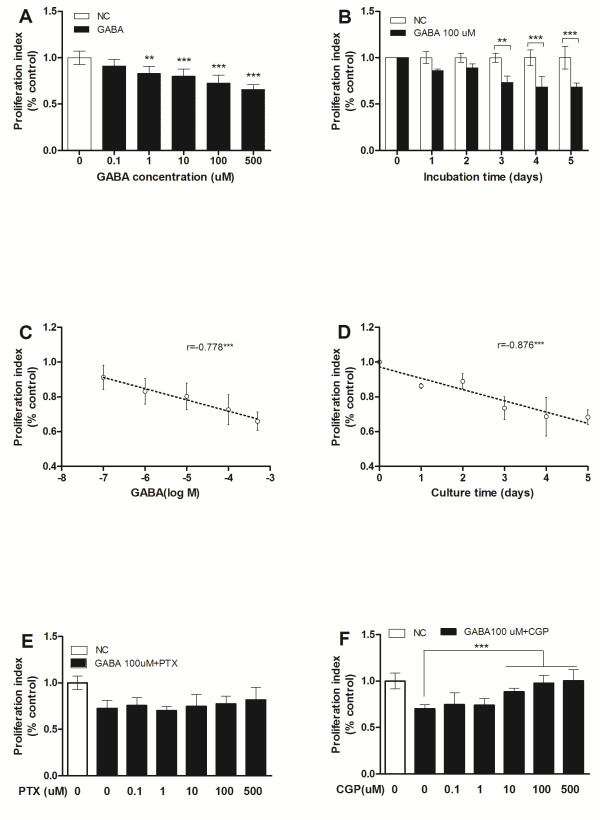
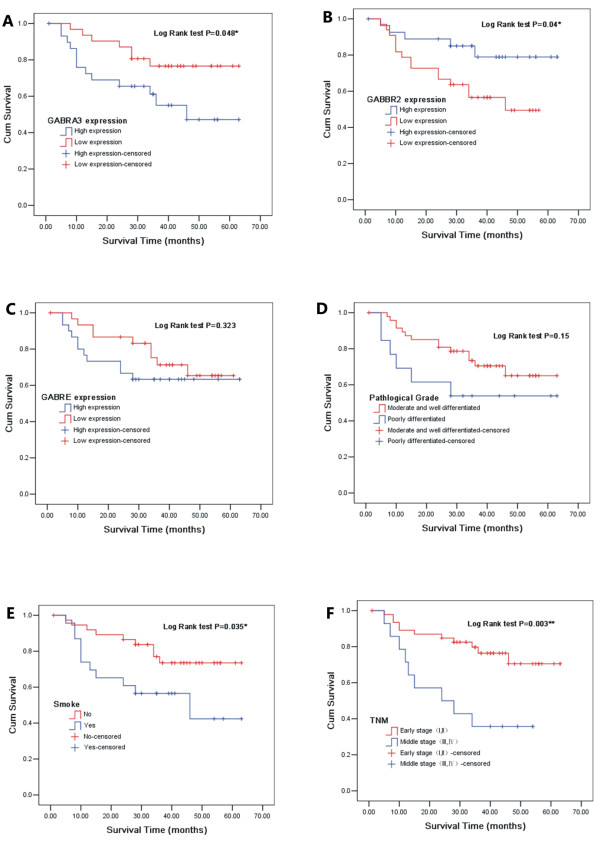
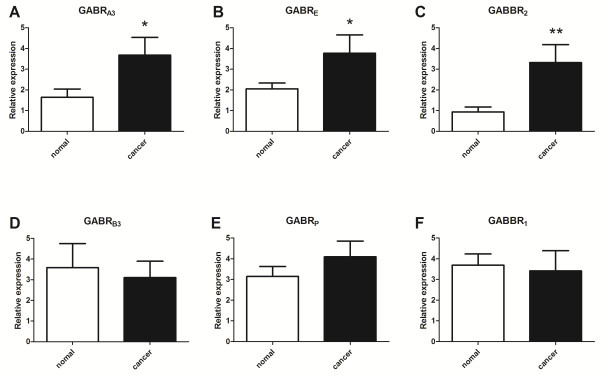
The gene expressions were significantly higher in NSCLC tissues than in the paired non-cancerous tissues for GABAA receptor subunit α3 (GABR(A3), P = 0.030); for GABAA receptor subunit epsilon (GABRE, P = 0.036); and GABAB receptor subunit 2 (GABBR2, P = 0.005). Kaplan-Meier curves showed that patients with high expression of GABBR2 gene and low expression of GABR(A3 )gene had a better prognosis (P < 0.05). The administration of GABA resulted in suppressed proliferation of NSCLC cell lines in a dose- and time-dependent manner. The use of the GABA receptor antagonist CGP35348 could reverse the inhibitory effect.
The pattern of GABA receptor gene phenotype expression may be involved in the regulation of tumorigenesis. A high expression of GABBR2 with a low expression of GABR(A3) may predict a better outcome. The treatment with GABA attenuates cancer cell growth in vitro. The expression of GABA receptor may be not only promising genetic therapeutic targets but may also serve as valuable prognostic markers for NSCLC.
γ-氨基丁酸(GABA)是成年哺乳动物大脑中的主要抑制性神经递质,但在非神经元外周组织和器官中除了作为神经递质外,还具有其他生理作用。GABA 可能通过激活 GABA 受体影响肿瘤生长。我们研究了非小细胞肺癌(NSCLC)组织和非癌组织中 GABA 受体的基因表达,发现 GABA 受体表型的基因表达与肿瘤发生和临床预后相关。
分析了 61 例 NSCLC 组织和配对非癌组织(距肿瘤 5cm 处)的速冻人样本。通过实时定量 PCR(RT-qPCR)检测 GABA 受体的基因表达。分析与 GABA 受体表型表达相关的生存时间。使用人 NSCLC 细胞系 H1299、A549、H520、H460 和人支气管上皮细胞系 BEAS-2B 来确定 GABA 对癌细胞生长的抑制作用表型。检查外源性 GABA 对 H1299 细胞生长的影响。
与配对非癌组织相比,GABAA 受体亚单位α3(GABR(A3))(P = 0.030);GABAA 受体亚单位 epsilon(GABRE)(P = 0.036);和 GABAB 受体亚单位 2(GABBR2)(P = 0.005)在 NSCLC 组织中的基因表达显著升高。Kaplan-Meier 曲线显示,GABBR2 基因高表达和 GABR(A3)基因低表达的患者预后更好(P <0.05)。GABA 的给药呈剂量和时间依赖性地抑制 NSCLC 细胞系的增殖。使用 GABA 受体拮抗剂 CGP35348 可以逆转抑制作用。
GABA 受体基因表型表达模式可能参与肿瘤发生的调节。GABBR2 高表达和 GABR(A3)低表达可能预示着更好的结果。GABA 的治疗可减弱体外癌细胞生长。GABA 受体的表达不仅可能成为有前途的遗传治疗靶点,而且可能成为 NSCLC 有价值的预后标志物。