Department for Molecular Biomedical Research, VIB, Ghent University, B-9052 Ghent, Belgium.
Nucleic Acids Res. 2013 Jul;41(Web Server issue):W531-4. doi: 10.1093/nar/gkt288. Epub 2013 Apr 24.
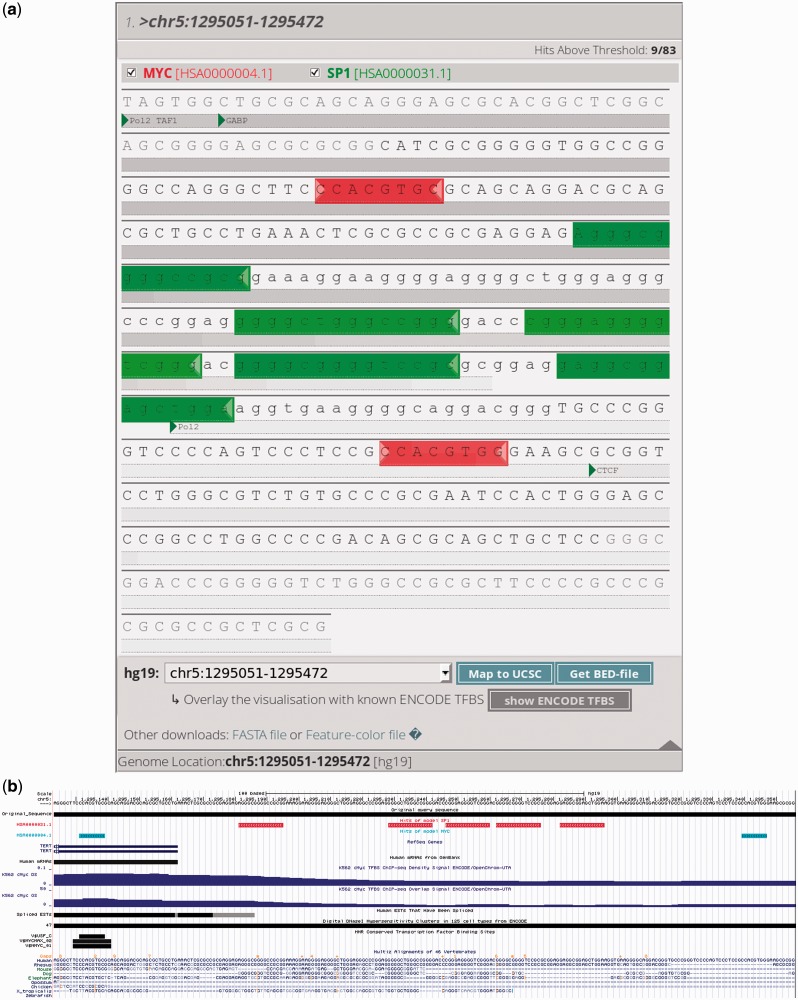
The most important mechanism in the regulation of transcription is the binding of a transcription factor (TF) to a DNA sequence called the TF binding site (TFBS). Most binding sites are short and degenerate, which makes predictions based on their primary sequence alone somewhat unreliable. We present a new web tool that implements a flexible and extensible algorithm for predicting TFBS. The algorithm makes use of both direct (the sequence) and several indirect readout features of protein-DNA complexes (biophysical properties such as bendability or the solvent-excluded surface of the DNA). This algorithm significantly outperforms state-of-the-art approaches for in silico identification of TFBS. Users can submit FASTA sequences for analysis in the PhysBinder integrative algorithm and choose from >60 different TF-binding models. The results of this analysis can be used to plan and steer wet-lab experiments. The PhysBinder web tool is freely available at http://bioit.dmbr.ugent.be/physbinder/index.php.
转录调控中最重要的机制是转录因子 (TF) 与称为 TF 结合位点 (TFBS) 的 DNA 序列的结合。大多数结合位点较短且简并,这使得仅基于其一级序列进行预测有些不可靠。我们提出了一种新的网络工具,该工具实现了一种灵活且可扩展的算法,用于预测 TFBS。该算法利用了蛋白质-DNA 复合物的直接(序列)和几个间接读出特征(生物物理特性,如柔韧性或 DNA 的溶剂排除表面)。该算法在 TFBS 的计算机识别方面明显优于最先进的方法。用户可以提交 FASTA 序列进行分析,并在 PhysBinder 综合算法中选择 >60 种不同的 TF 结合模型。该分析的结果可用于规划和指导湿实验室实验。PhysBinder 网络工具可免费在 http://bioit.dmbr.ugent.be/physbinder/index.php 获得。